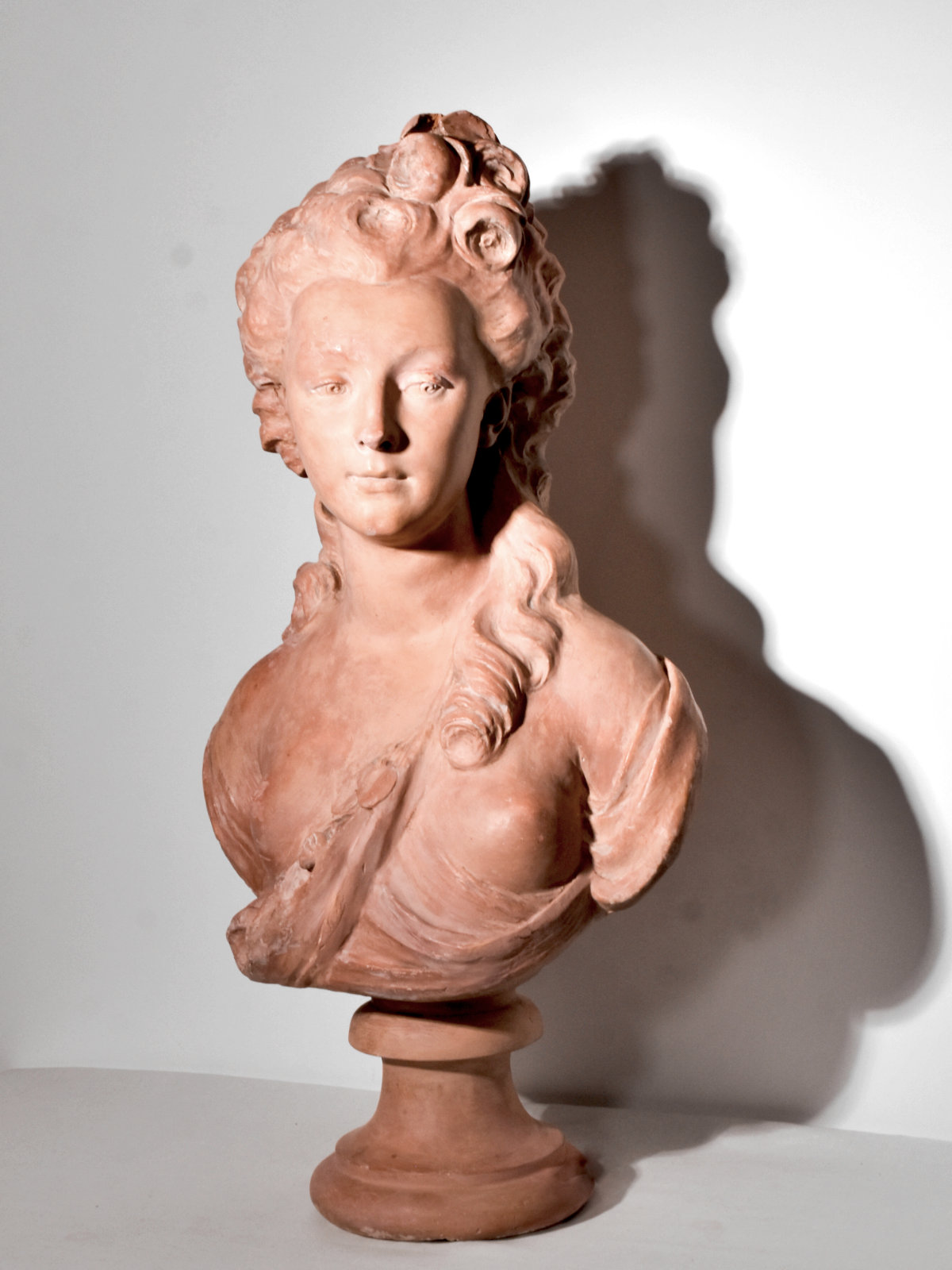
Imposing antique plaster bust with terracotta patina, depicting Mademoiselle Luzy, celebrated 18th-century actress and emblematic figure of the Comédie Française. This model is an edition after the original sculpture by Jean-Jacques Caffieri (1725-1792), the great Neoclassical sculptor renowned for his busts of eminent literary, theatrical and intellectual figures such as Voltaire, Diderot and Rousseau. The bust bears the stamp of the City of Versailles, attesting to an institutional provenance and a fine early edition. The execution is distinguished by the quality of the modelling, the precision of the detail in the coiffure and the elegance of the drapery typical of the Neoclassical style. Very good overall condition. Moulded signature JJ Caffieri on the terrace. Stamp: Ville de Versailles on the reverse. Early 20th century.
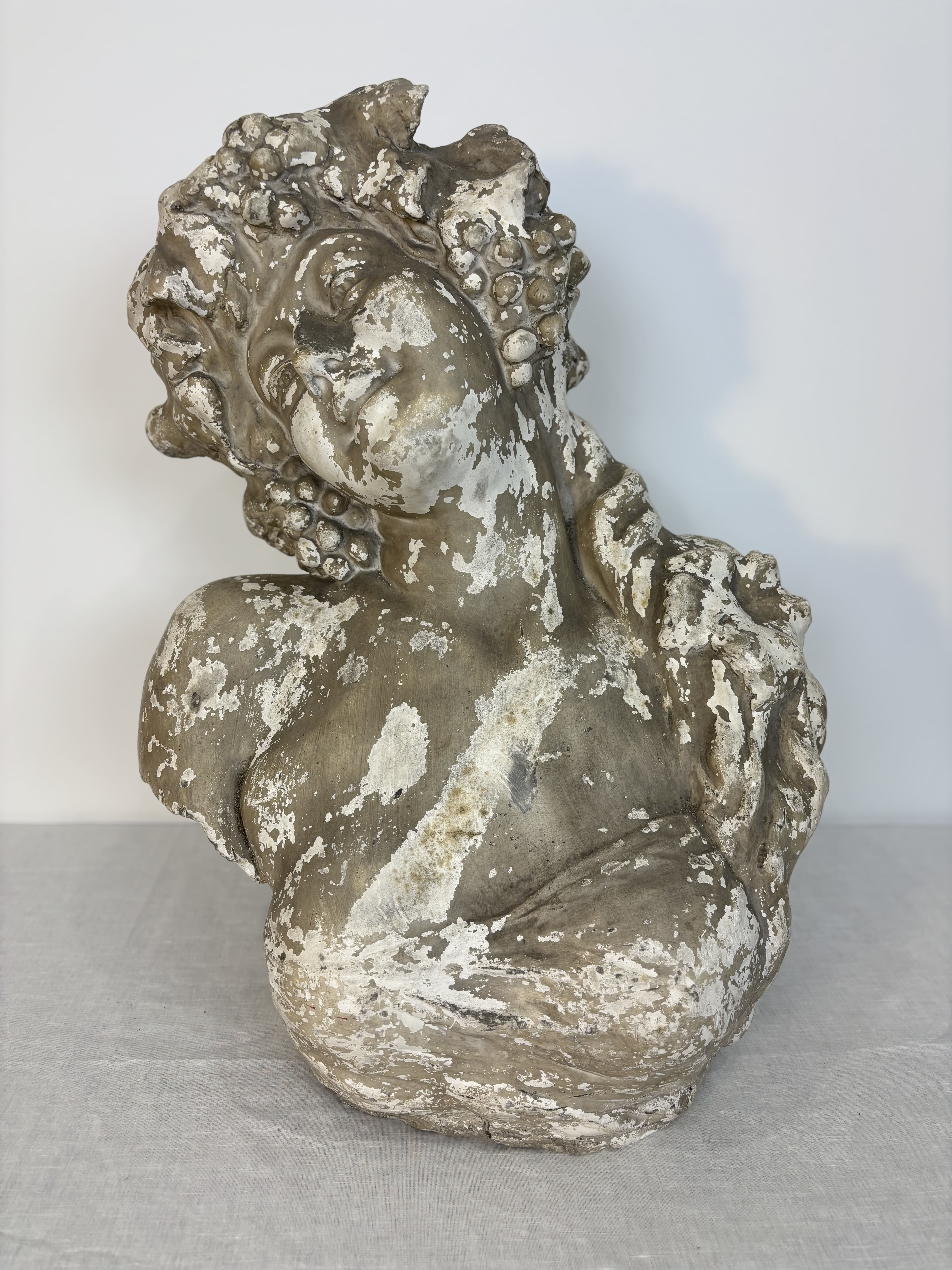
Large patinated plaster bust — Bacchante with grape clusters — Signed (Frans...) — Flanders or Belgium — Early 20th century. Spectacular and expressive, this large patinated plaster bust depicts a Bacchante, a figure associated with the cult of Dyonisos/Bacchus, her head tilted and adorned with grape clusters. The sculpture captivates through its scale, its movement, the charm of its dreamy countenance and the richness of the modelling of volumes typical of productions from the late Art Nouveau period. Acquired in Belgium, this piece bears an incised signature that is difficult to read, though the first name Frans is clearly identifiable, pointing to a Belgian or Flemish sculptor active around the beginning of the 20th century. Fine patina. Circa 1920.
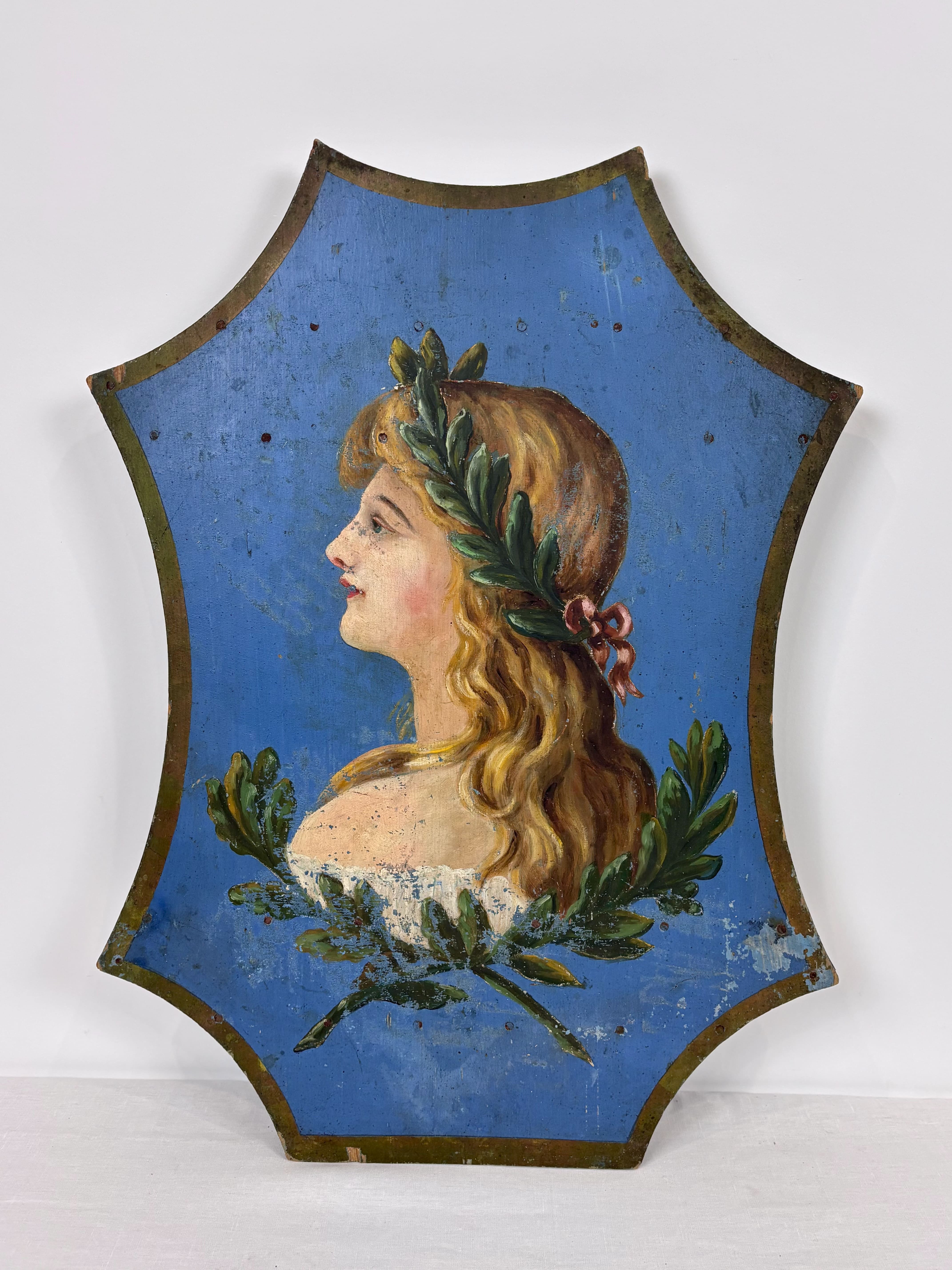
A superb decorative flag-holder / escutcheon from the late 19th century, probably Belgium or Northern France, painted on a wooden support. It depicts the portrait of a young woman in profile, crowned with a laurel wreath. The figure, her gaze turned towards the distance, evokes the female allegories employed in 19th-century decorative arts: muse, victory or republican figure. The piece features a shaped, scalloped format. The background is treated in a deep blue, enhanced by a painted frame in olive tones. Fine quality of execution.
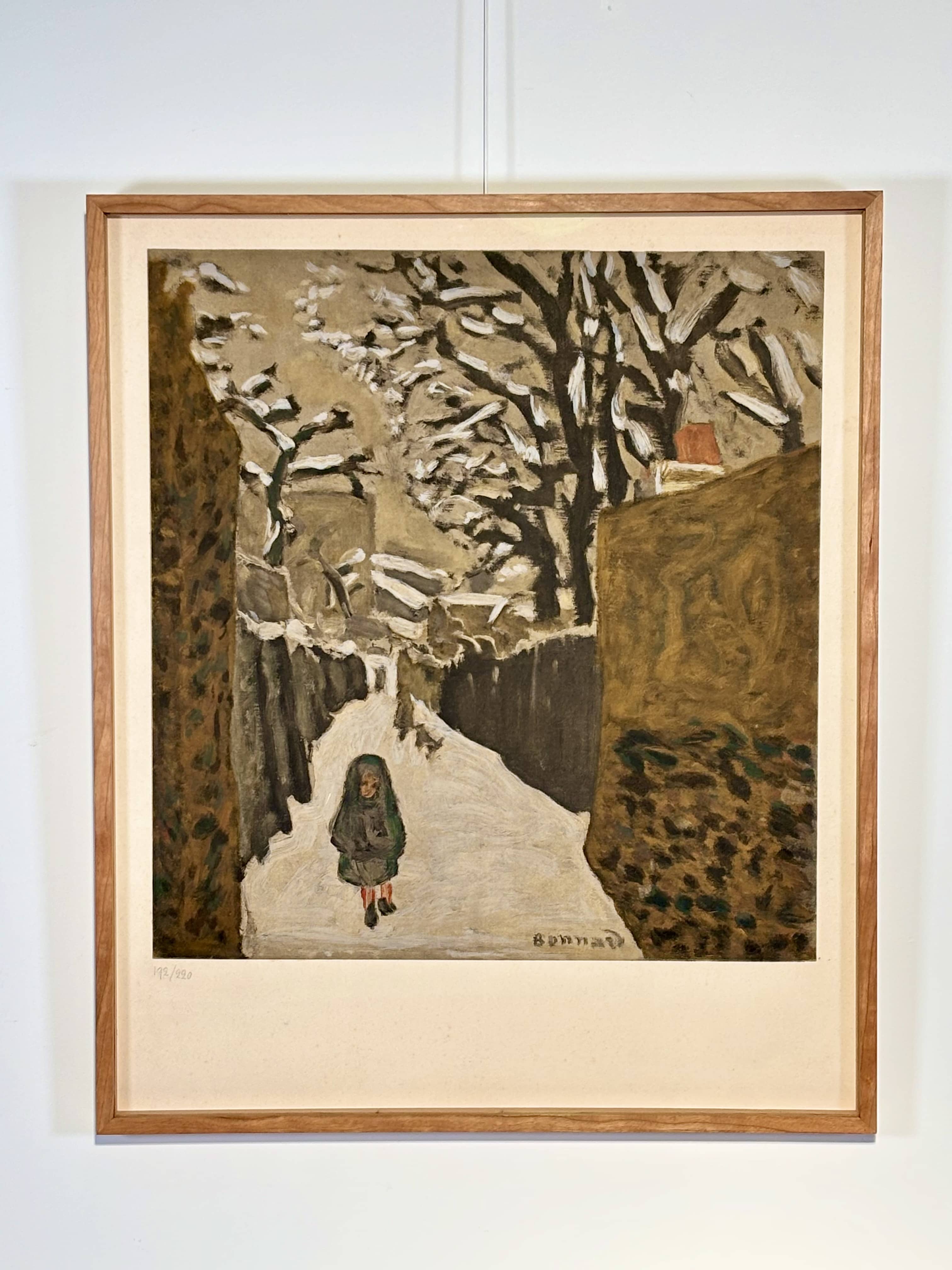
Colour print/lithograph on wove paper after the iconic work by Pierre Bonnard depicting an intimate winter landscape.
The composition opens onto a snow-covered path bordered by walls and trees with branches heavy with snow, at the centre of which a child advances, wrapped in a coat.
All the modernity of the post-Impressionist movement is present: tight framing, stylisation of forms, outlined touches of colour and a muted palette enlivened by the vivid accent of a chimney in the background and the child’s legs. A composition characteristic of Bonnard’s view of wintry Parisian street scenes.
The artist’s signature is printed in the plate at the lower right.
Numbered in pencil 192/220 at the lower left.
Posthumous reproduction, art edition type, from the 1950s–1970s.
The work benefits from a bespoke museum-quality frame under glass: anti-reflective, UV-filtering glass.
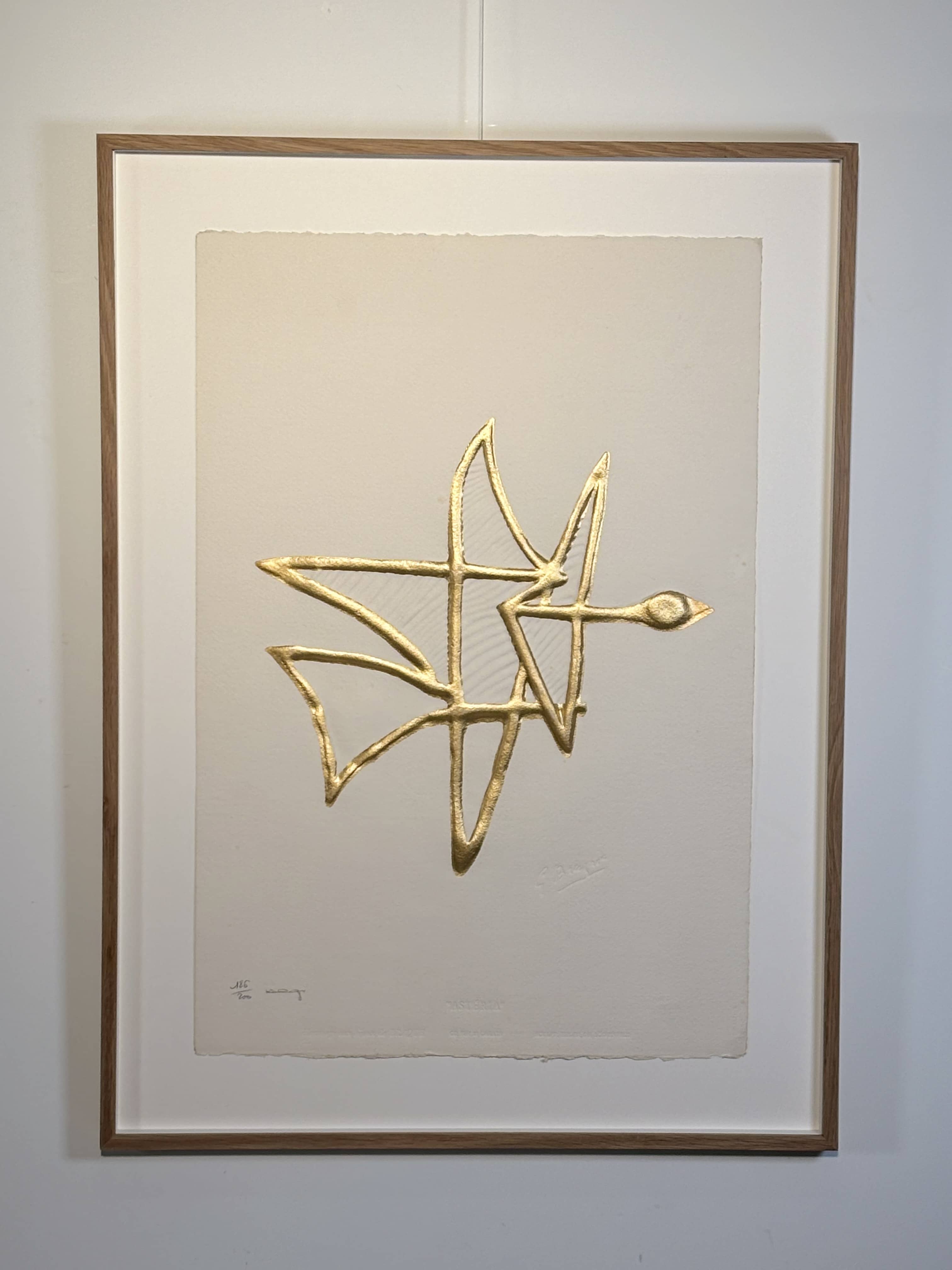
After Georges Braque (1882–1963), Astéria.
A very fine embossed print, gilded with 23-carat fine gold, produced after a creation by Georges Braque by Baron Heger de Löwenfeld, the artist’s collaborator in the realisation of his celebrated jewellery.
The work belongs to the suite “Hommage aux bijoux de Braque”, devoted to the jewellery creations conceived by Georges Braque at the end of his life and transposed in relief by Heger de Löwenfeld.
On thick, deckle-edged paper, the composition is treated in deep embossing: the motif, entirely gilded in fine gold, genuinely stands out from the sheet, lending it an almost sculptural character.
The subject, Astéria, belongs to the mythological repertoire so dear to Braque in the final years of his oeuvre. The figure is reduced to an ensemble of powerful, pared-down lines, midway between drawing, sculpture and jewel.
Example numbered 186/200 in pencil.
Signature of Heger de Löwenfeld in pencil, lower left.
“G. Braque” signature in relief / blind stamp within the sheet.
Numerous blind-stamped inscriptions in the paper:
“ASTERIA”; “Or fin 23 carats”; “Hommage aux bijoux de Braque”; “Sculpt. Heger de Löwenfeld”
Edition produced circa 1970–1971.
Examples from this suite are notably documented with the publisher Pierre de Tartas in Paris.
Presented in an elegant bespoke museum-quality frame under glass, the subject set on a raised mount, with anti-reflective and anti-UV glass. Oak borders.
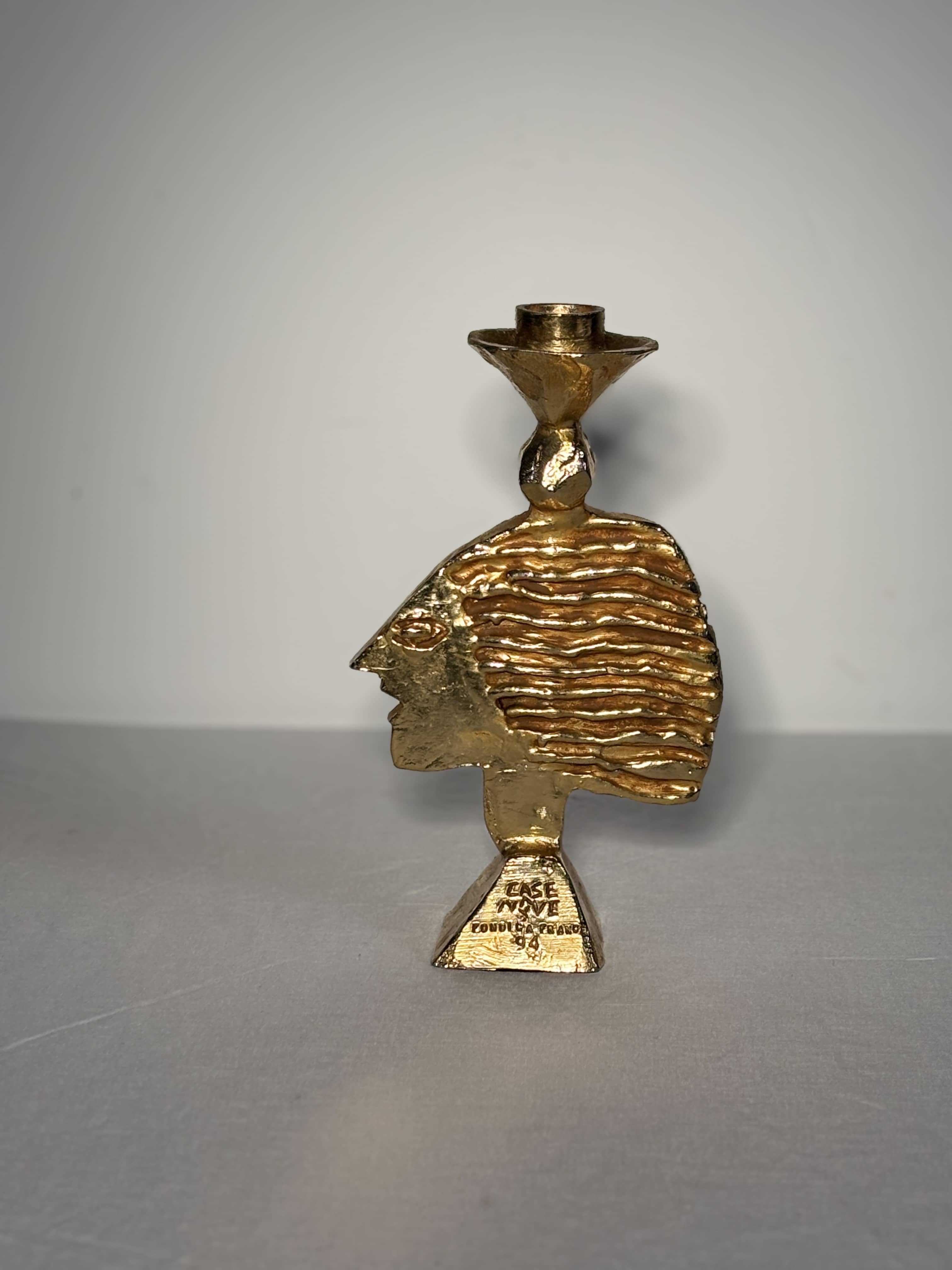
Gilt bronze candlestick signed Casenove, foundry mark Fondica, dated 94 (1994).
In perfect condition.
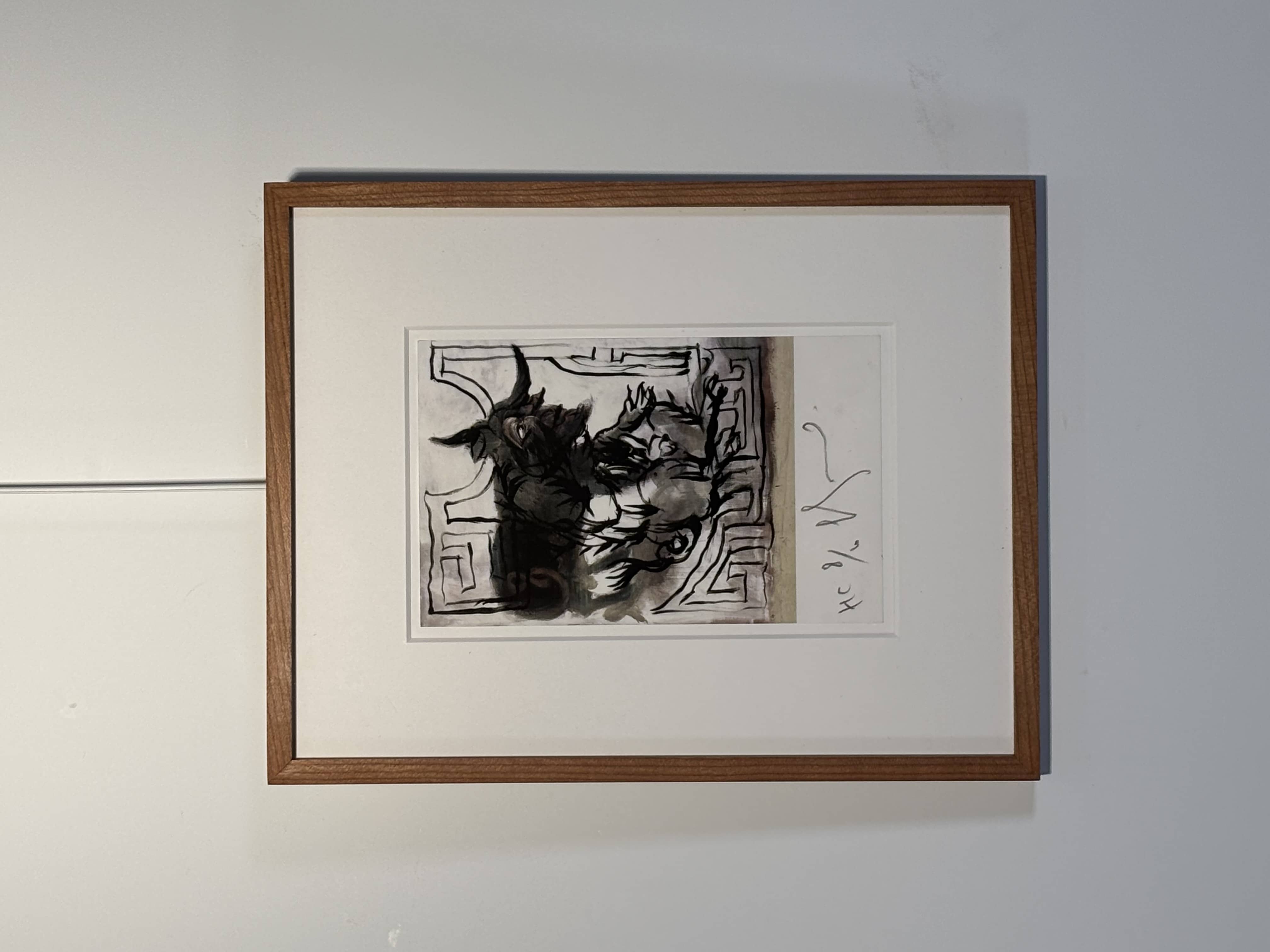
“L’Apiculteur et les Indiens” — a print by Gérard Garouste, Hors Commerce, signed and numbered 8/10.
The Minotaur emerges from a Grecian setting, with meanders and foliate scrolls drawn in black line, almost architectural in feel.
The face escapes this rigour: hand-painted in browns and pinks that soften the figure.
In Garouste’s work, “the Indian” is never a mere anecdotal detail. Ever since his play “Le Classique et l’Indien” (1977), the figure has embodied the painter’s double: opposite the Classical — reason, order — the Indian carries the savage, the mad, the uncontrollable. A theme he would explore for over thirty years, right up to his “Indiennes” series.
The full title of this print echoes that of a book Michel Onfray devoted to his painting in 2009.
Presented in museum-quality framing, with anti-reflective and UV-protective glass.
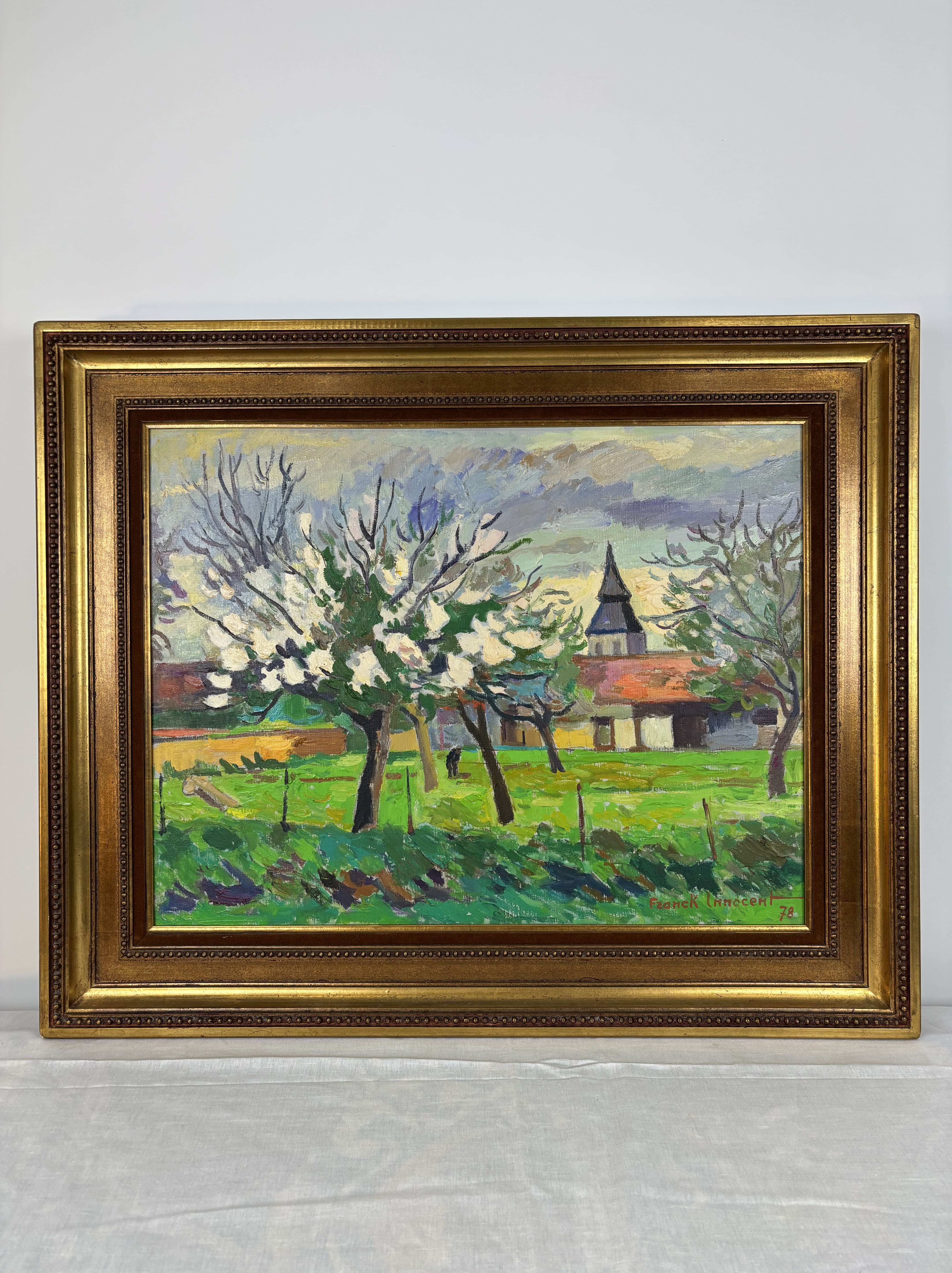
A very fine oil on canvas by the painter Franck Innocent, École de Rouen, depicting the Normandy countryside in springtime. Signed and dated lower right, countersigned, titled and dated on the reverse. With a dedication on the reverse: “to my wife, with my most respectful and grateful regards. 31.12.78. Jean” and “To my mother, to Vally, with all my affection. Pierrot”. Handsomely framed.
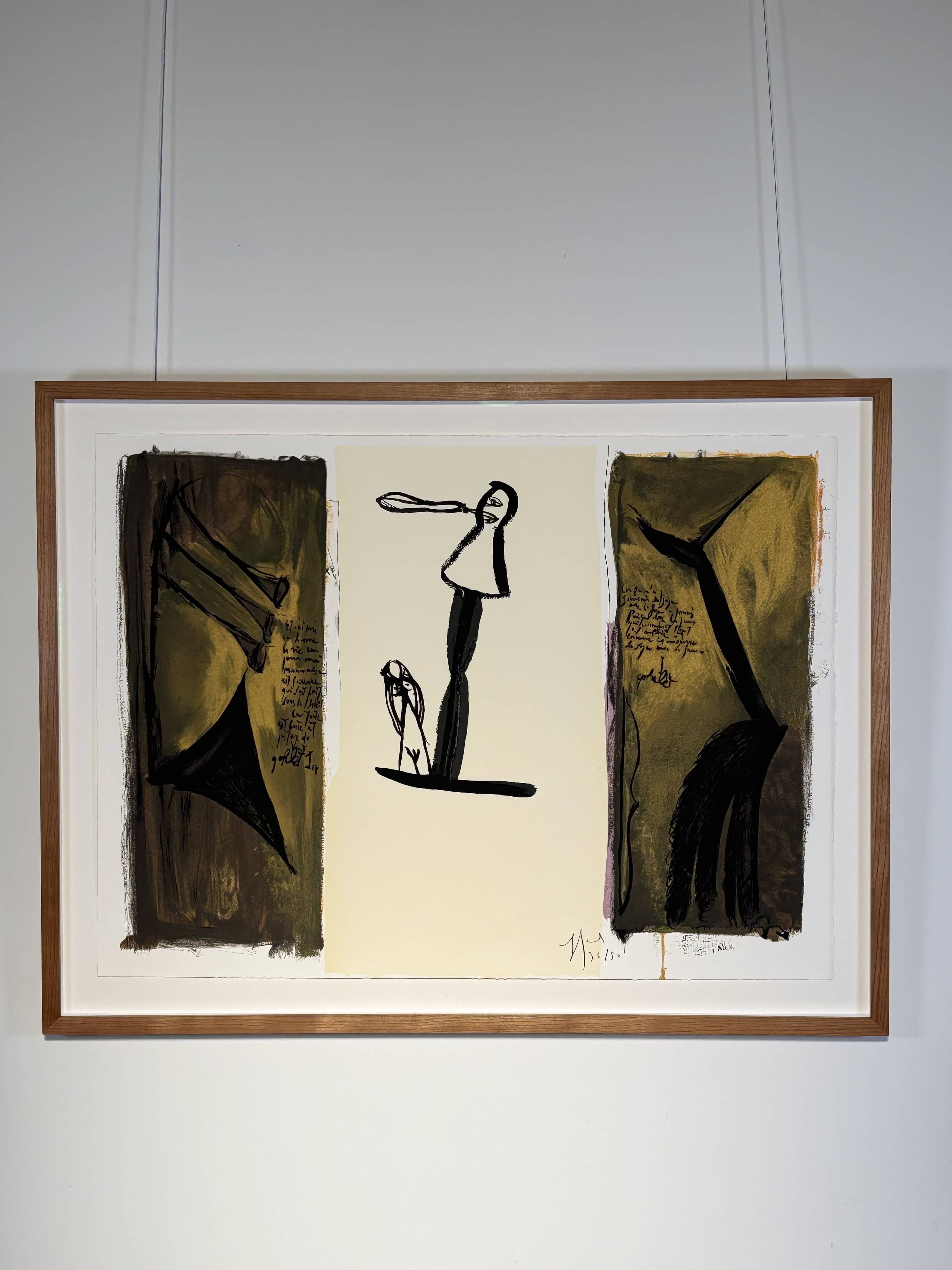
Important original colour lithograph conceived in the form of a narrative triptych, a major subject in the artist’s œuvre.
The composition is organised around a pared-down central panel dominated by a slender, hieratic figure (recalling the world of Don Quixote or the Preacher), flanked by two expressionist scenes rendered in powerful tones of ochres, dark earths and deep blacks.
The work bears witness to Garouste’s fascination with sacred texts and the Hebrew language, incorporating two handwritten philosophical passages drawn from the biblical Book of Ecclesiastes (signed with its Hebrew name, Gohélet / Qohélet):
On the left (Gohélet I, 17): “And I have seen life, one day evil to me, is the work that has been done under the sun, for all is vanity and pasture of the wind.”
On the right: “For who has remembrance of the wise man with the fool for ever, since in the days to come all is already forgotten. And how the wise man dies with the fool.”
Institutional reference: A similar impression from this same edition is held in the national collections of the Centre Pompidou / Musée National d’Art Moderne (inventory no. AM 2022-64).
Original colour lithograph on heavy wove paper.
Numbered 35 / 50 in pencil (highly confidential edition of only 50 impressions).
Signed in pencil with the artist’s official monogram “MG” lower right.
Excellent state of preservation, with remarkable freshness of the pigments.
Museum framing: Exceptional bespoke presentation carried out by a leading Parisian workshop.
Float mount in a box frame: the work is fixed in a reversible manner, revealing the entirety of the deckled edges of the paper. Cherrywood box-profile moulding, neutral conservation backing and museum-quality glass (anti-reflective and UV-protective).

A rare ensemble of four profile portraits, painted in black gouache with highlights, on blue-green tinted paper, presented under glass. Two men and two women are depicted, their coiffures and costumes characteristic of the fashion of the late eighteenth century and the Directoire period. More precious than simple cut silhouettes, these painted effigies render with finesse the details of the faces, hair and fabrics. Each portrait is presented within a brown fillet and united in a single mount. The ensemble is preserved in a giltwood frame adorned with carved friezes and palmettes. Good overall condition. Wear and patina of time.
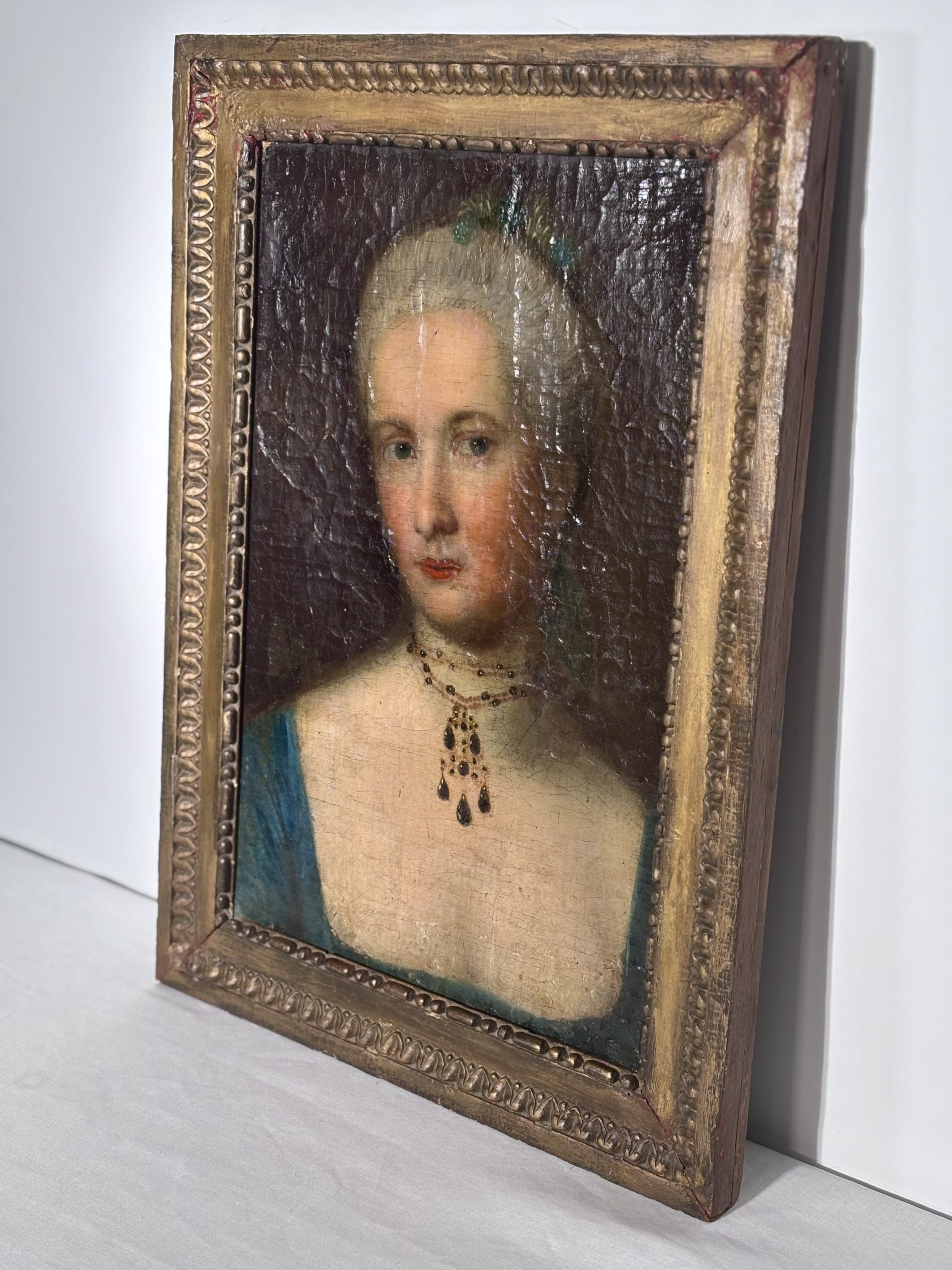
Oil on panel depicting the bust-length portrait of an elegant lady, wearing a blue low-cut gown and adorned with a necklace. Her powdered coiffure, embellished with green ribbons, illustrates the refined fashion of the second half of the 18th century. The painting, executed on a dark ground, together with the treatment of the flesh tones, is evocative of a Germanic work. This treatment enhances the brilliance of the jewellery and the delicacy of the face. Presented in an antique giltwood frame with beading and moulded decoration, the work retains all its cabinet charm. Age craquelure, retouches. Good overall condition.
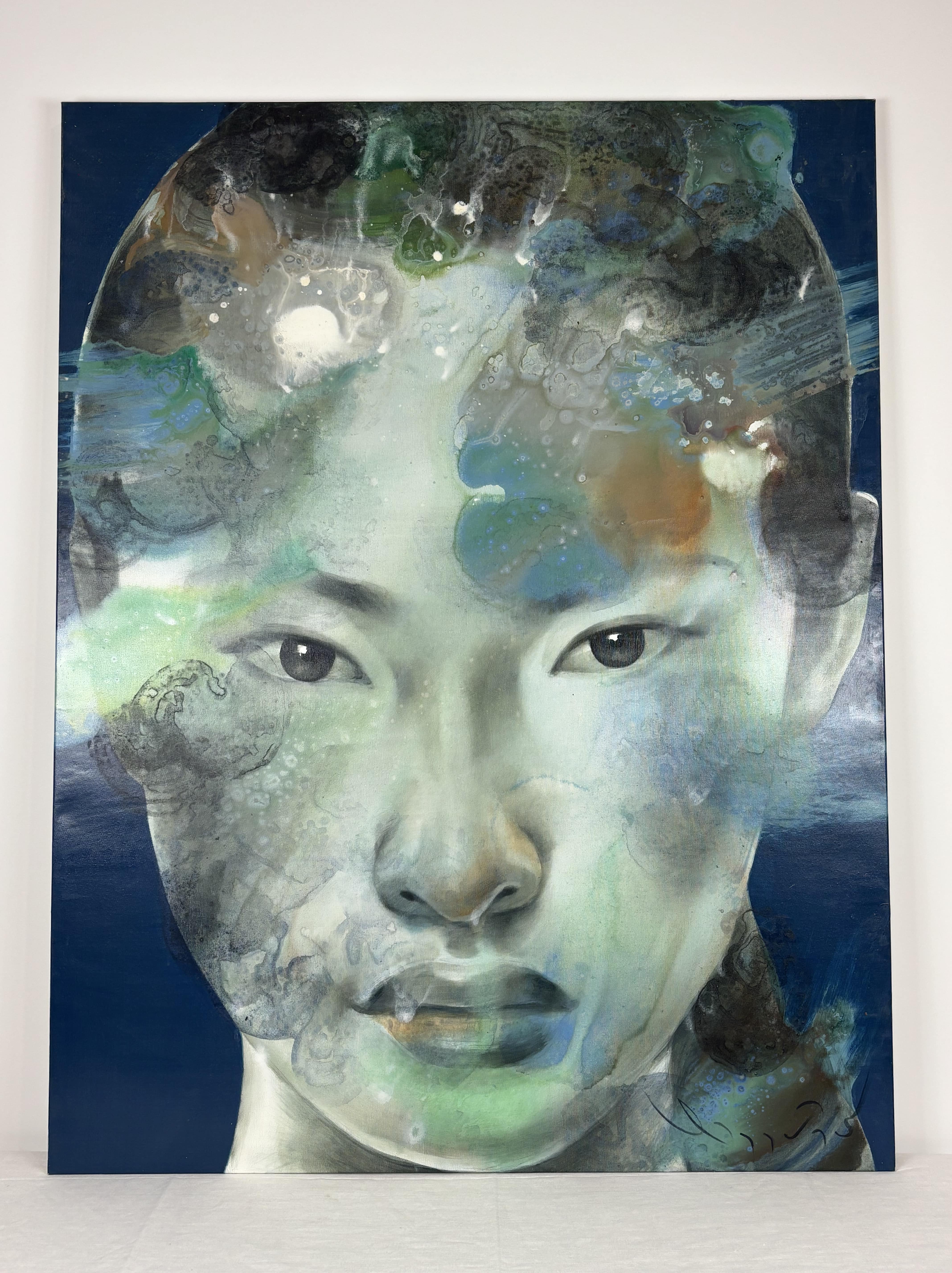
Large contemporary portrait by the Thai artist Silawit Poolsawat, renowned for his powerful and sensitive works. Asian Beauty captures the delicacy and depth of an Asian female face, in a composition that blends realism, subtle transparencies and dreamlike atmospheres. Silawit Poolsawat’s paintings are inspired by women and children he has encountered during his travels, whose expressions have left a profound impression on him. Signed lower right. Framing: mounted on an aluminium stretcher, ready to hang.