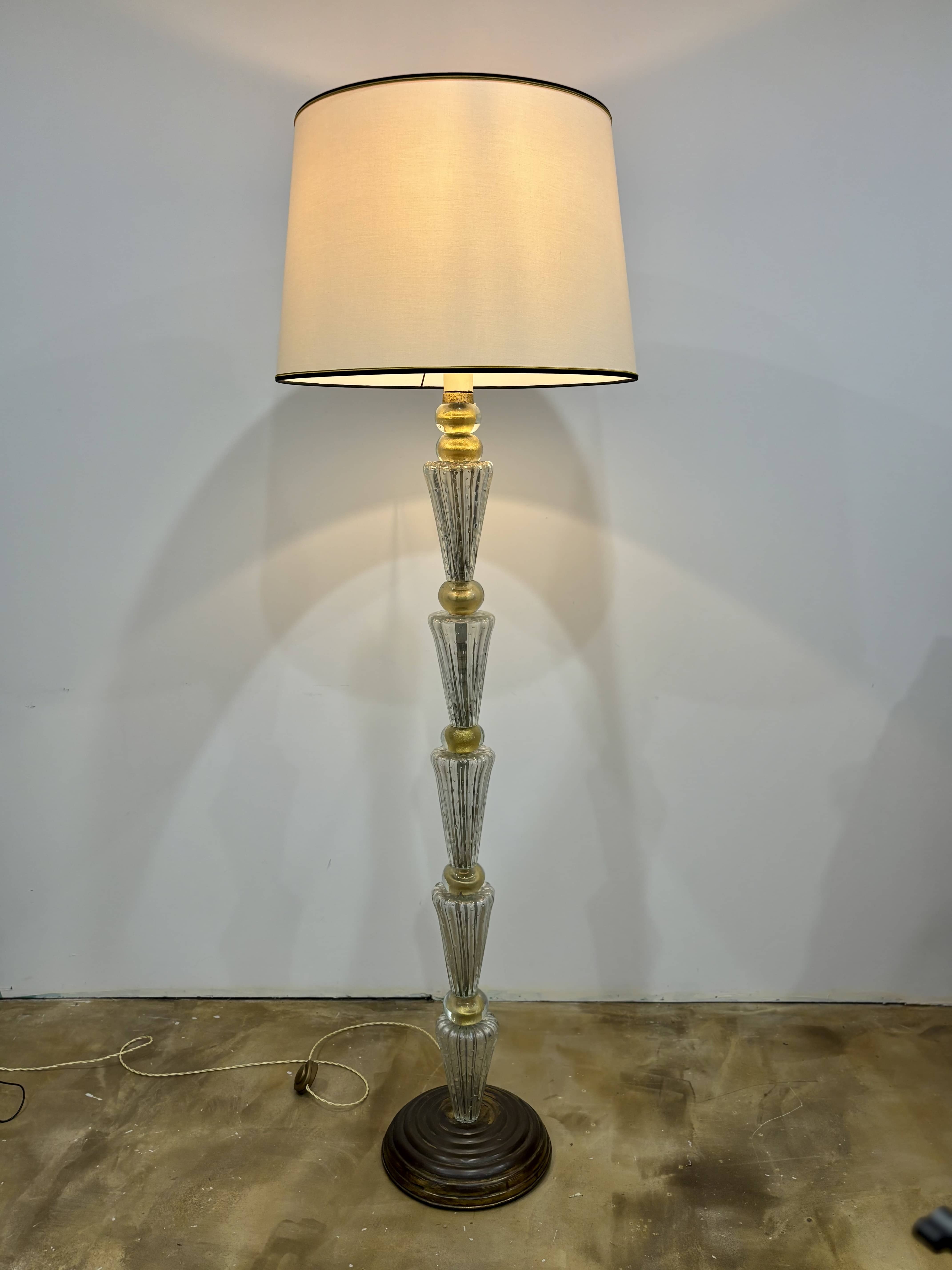
Large and elegant Murano glass floor lamp, emblematic of the exceptional craftsmanship of mid-twentieth-century Venetian glassworks (in the taste of the creations of Barovier & Toso or Archimede Seguso).
- The Shaft : The slender central shaft is composed of an alternating stack of balusters and geometric elements in ribbed and bubbled clear glass, alternating with elements in glass with gold inclusions, offering a superb visual contrast and beautifully capturing the light.
- The Base: The whole rests on a circular base in moulded metal, formerly gilded. The gilding, partially faded by time, today reveals a lovely dark brown patina with traces of gilt.
- The Shade : It is surmounted by a large shade in ecru/greige fabric, bordered with a black braid highlighted by a gold piping with a twisted passementerie button detail, ensuring a soft and warm diffusion of light.
- Excellent state of preservation. No cracks, chips or nicks on any of the glass elements.
- Electrical wiring entirely renewed to current standards (twisted silk-effect textile cable in gold/brass, foot switch and standard bulb holder). Ready to be installed.
Italy, circa 1940-1950
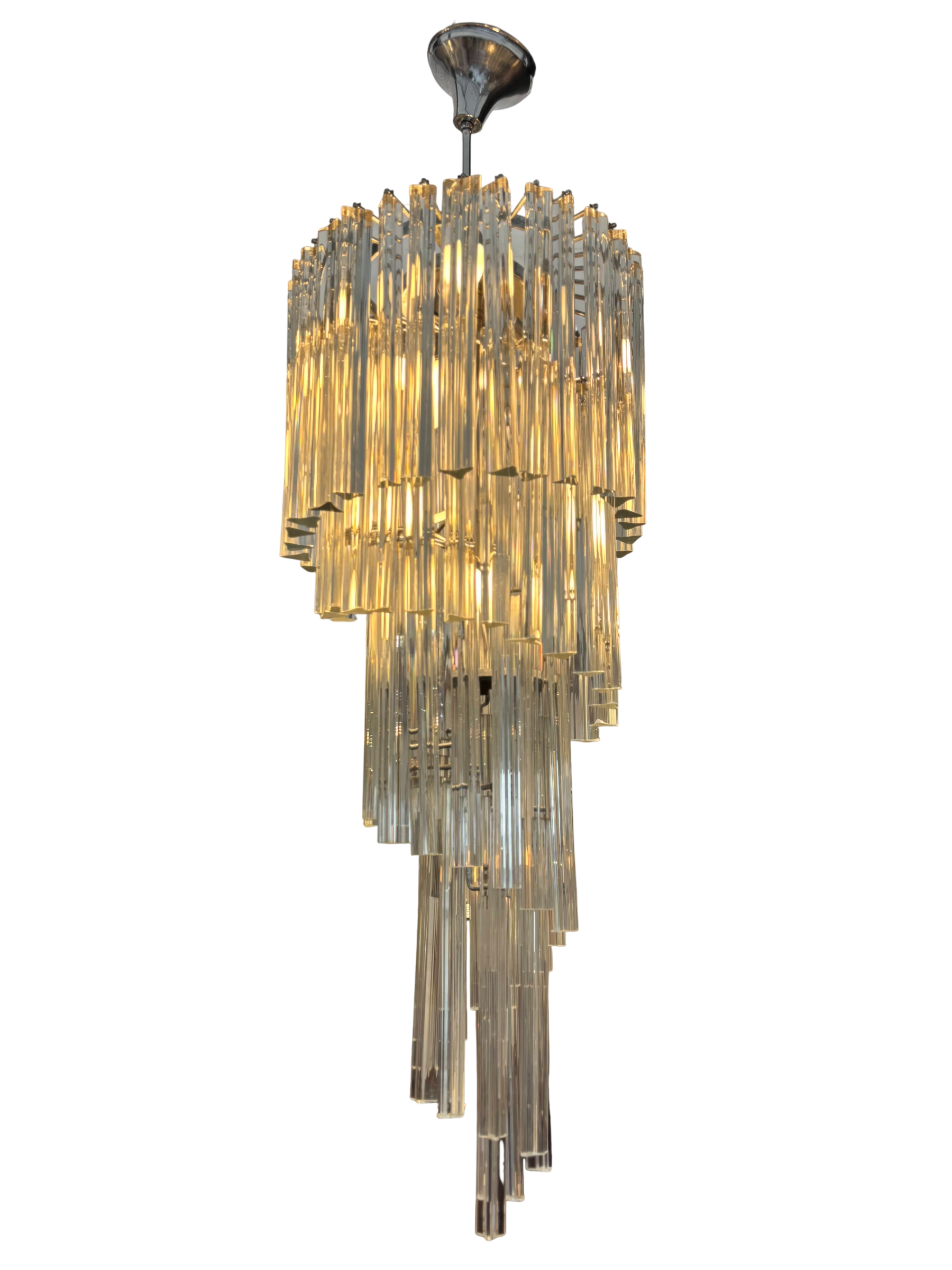
Spectacular Italian chandelier in Murano glass, composed of a multitude of long crystalline glass rods with prismatic section, arranged in a cascade and of varying heights.
The composition, particularly elegant and sculptural, forms an animated and airy silhouette, characteristic of the great Italian glass design of the second half of the twentieth century Venini, and of its productions notably including compositions using prismatic elements of the Triedri type, developed from the late 1950s onwards. The glass elements, of great transparency, offer magnificent plays of light and reflections when illuminated.
The chandelier features a silvered/chromed structure. The warm reflections visible in the photographs come solely from the lighting.
A very fine piece of character, monumental and rare, particularly suited to a contemporary interior, an entrance hall, a dining room or a space benefiting from a generous ceiling height.
Italy, circa 1960-1970.
Electrification redone by a professional.
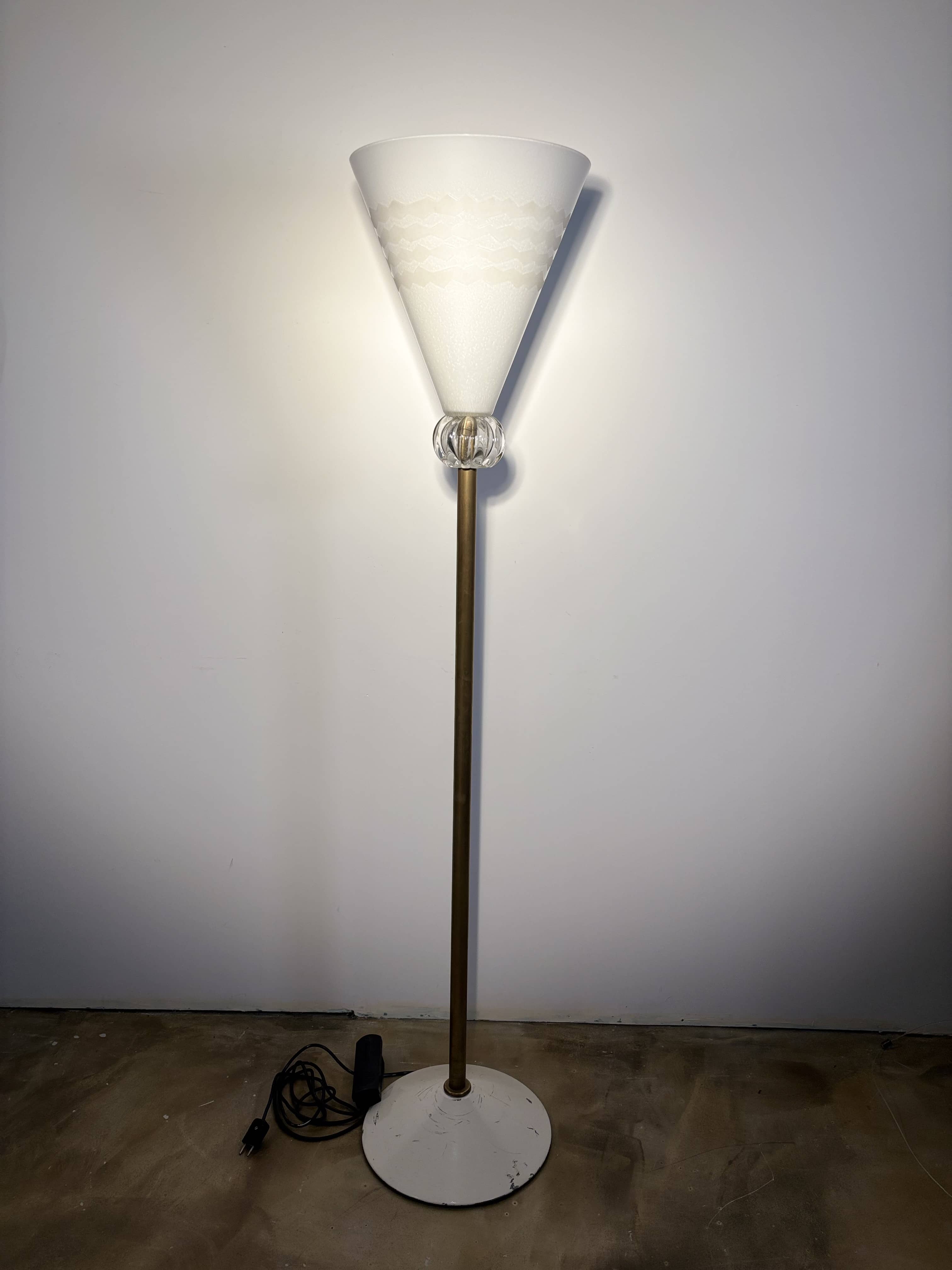
Italian floor lamp signed Barovier & Toso, Murano, with original label preserved (Barovier & Toso lozenge logo + certification label “Vetri Murano VM 007”, label of the Consorzio Venezia Vetro used between 1981 and the early 2000s).
The conical shade in blown opaline glass, with the granular texture characteristic of Venetian work, is adorned with a frieze of waves acid-etched on its lower third, drawing upon techniques and a decorative vocabulary inherited from the great years of Venetian glassmaking. It rests upon a sphere of colourless Murano glass, blown and cut with twisted ribs, which closes it onto the brass stem — a torchère-type floor lamp, the light being diffused upwards through the glass.
The shaft, in brass, descends to a circular base in white lacquered metal. Original foot dimmer.
Good general condition consistent with use. The lacquered base shows visible marks of use and micro-scratches (see photographs), without any effect on the structure or the functioning.
Glass and crystal sphere intact, without chip or crack.
Original electrics in working order.
Origin: Italy, Murano — Barovier & Toso, circa 1980.
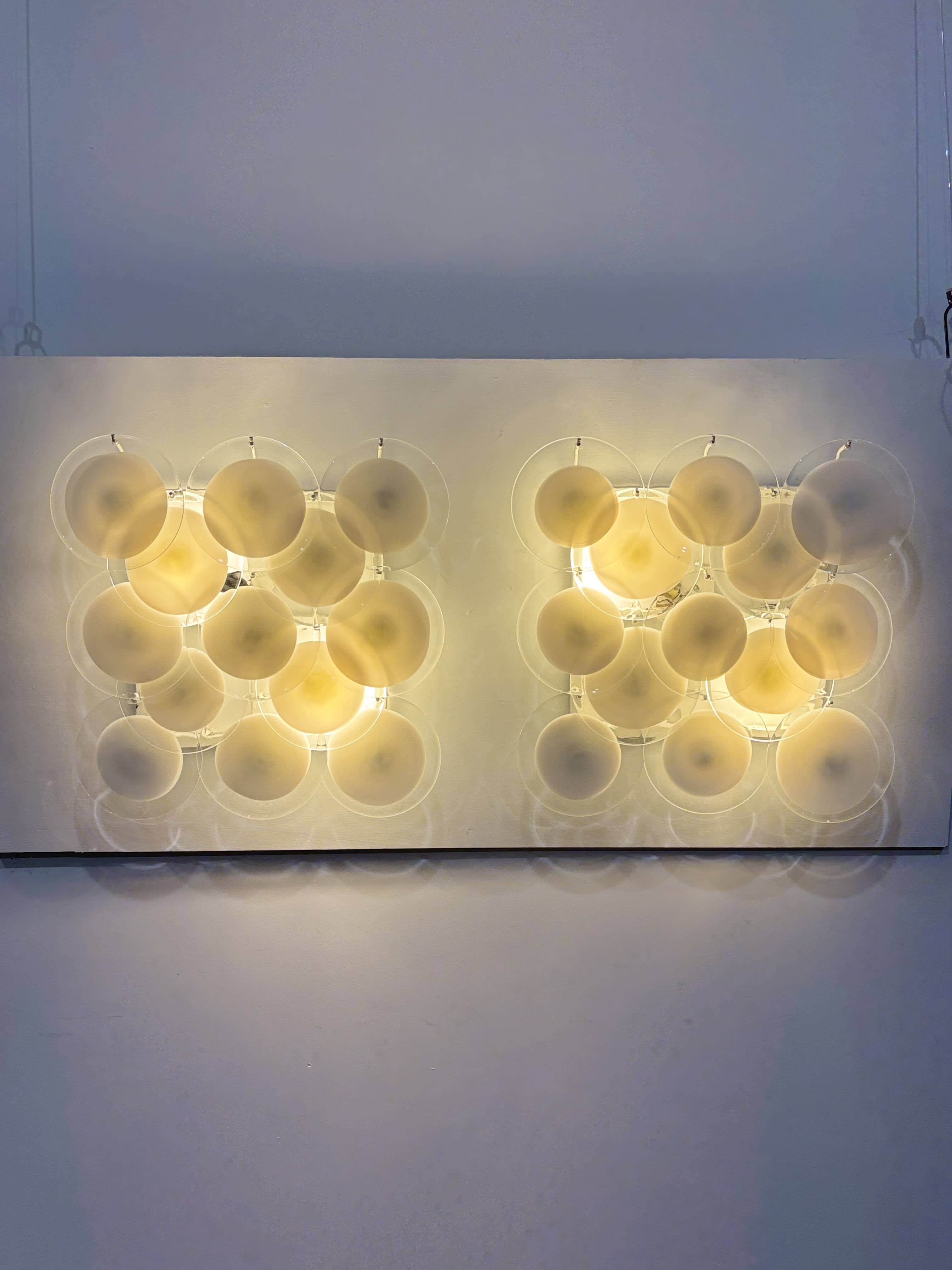
Nine mouth-blown glass discs, each presenting a satin white opaline heart encircled by a ring of clear crystal — such is the visual grammar of these wall lights from the Vistosi glassworks, one of the founding houses of Murano lighting.
Mounted on their original white lacquered metal structure, the discs reveal upon illumination a diffuse, warm and luminous halo of great softness and great elegance.
An iconic signature of twentieth-century Italian design.
A doubly rare piece: for its generous square format and for the fact that it is presented as a matching pair, intact.
Sold as a pair.
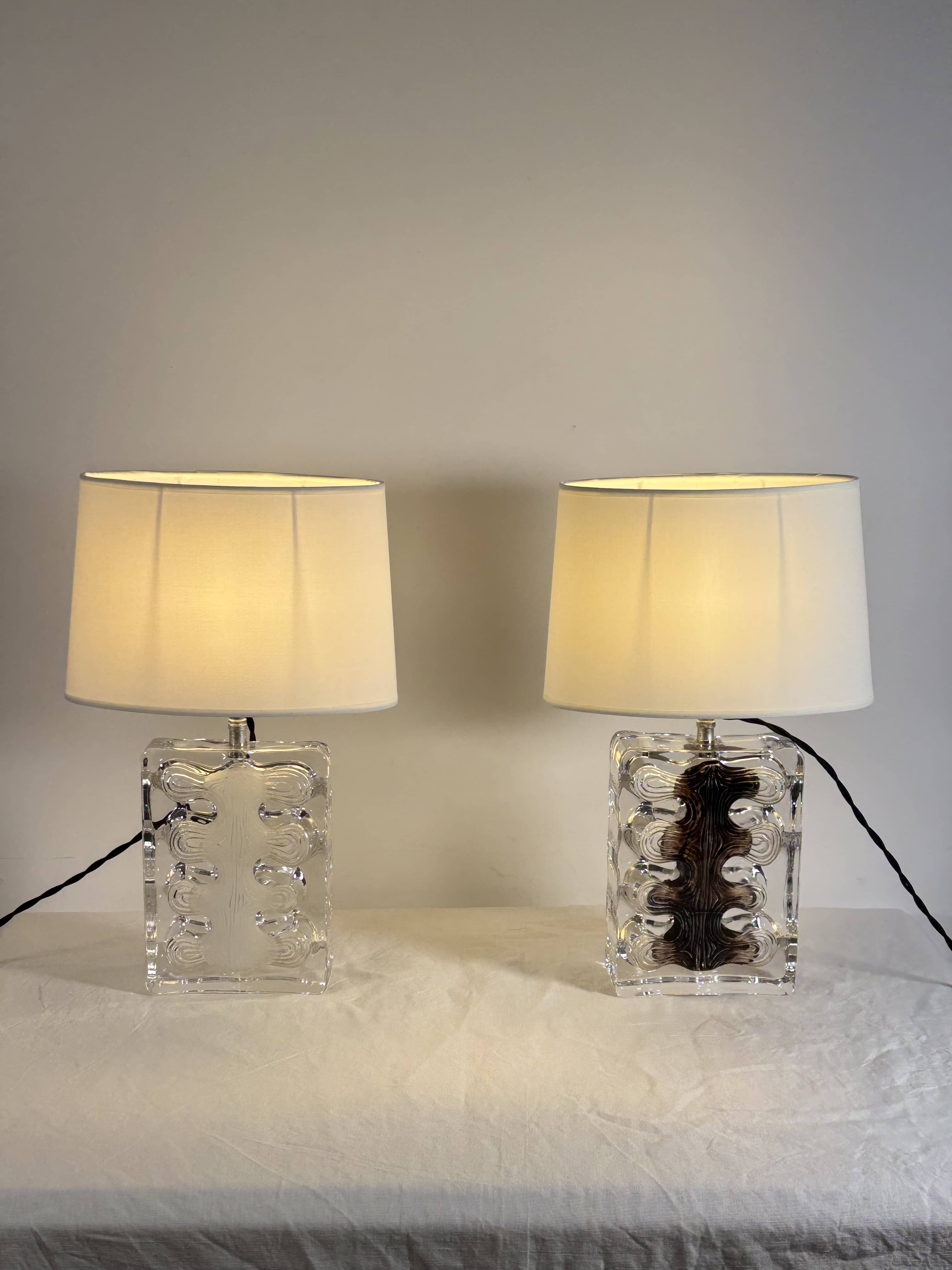
Pair of lamps with rectangular solid crystal bases, Lynx model, created in 1973 by the sculptor Jean-Pierre Demarchi, then artistic director of the Daum crystal works.
The crystal, hollowed with a biomorphic form of symmetrical scrolls, is enhanced by a column of white opaline crystal on one of the two bases and brown crystal on the other — a variation in tone that distinguishes each piece without breaking the unity of the pair.
The interplay between the transparency of the crystal and the matte finish of the central appliqué captures the light with striking sculptural presence, faithful to Demarchi’s approach, which regarded crystal as a material in its own right, on a par with bronze or stone.
The strength of this pair lies in its bold chromatic and textural contrast.
Signed Daum France on each base.
Newly rewired to current standards by a professional.
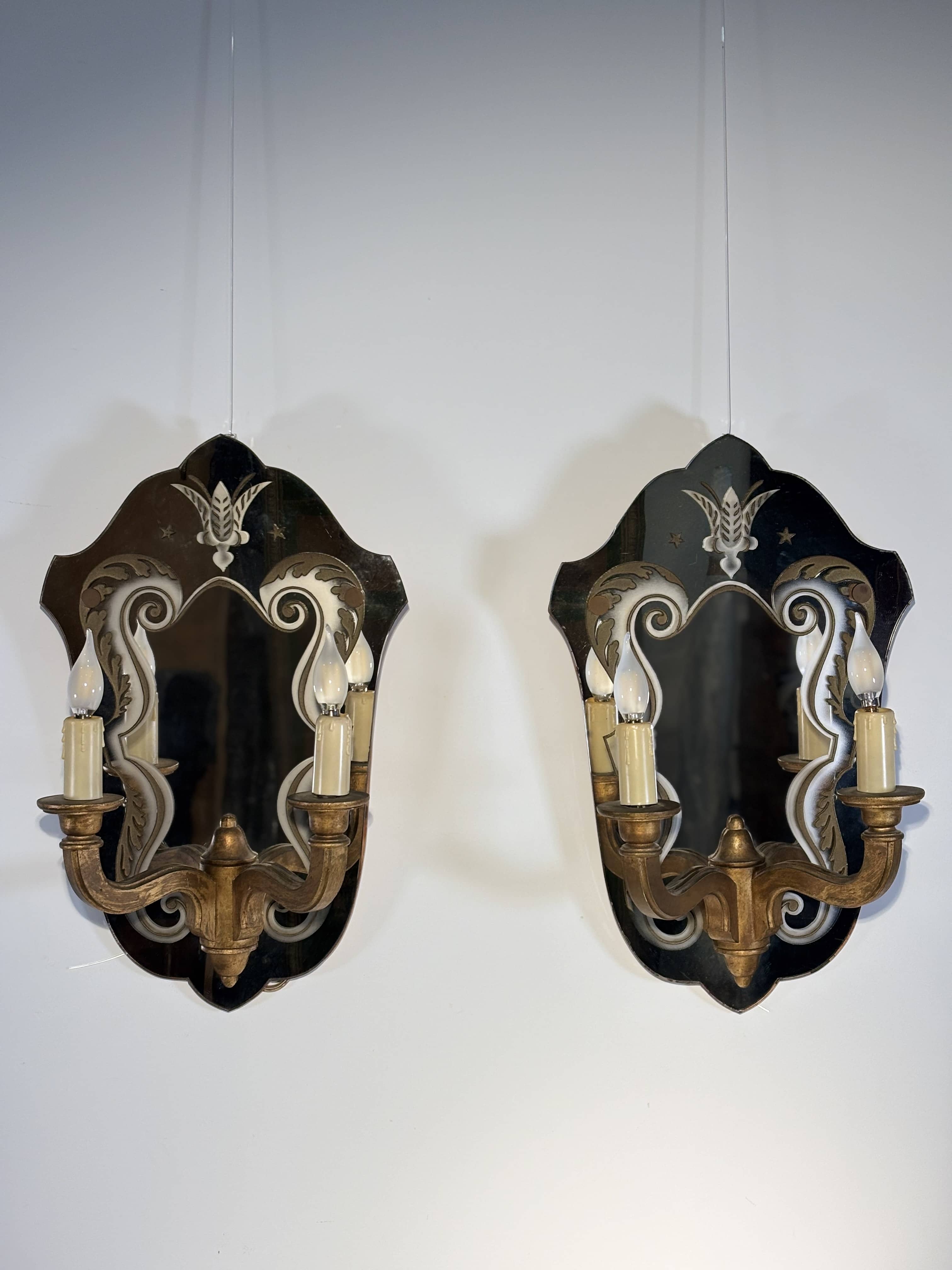
Elegant pair of two-branch wall lights, Italian or Venetian-style work dating from the mid-twentieth century (circa 1950).
Each sconce comprises a shaped and curved mirror plate with a bevelled edge, forming the reflective backing. The glass is richly intaglio-engraved and enhanced with gilded and sanded motifs, depicting at the summit a stylised foliate motif framed by stars, together with broad leafy scrolls running along the contours.
The lower structure supporting the two light-arms is crafted in carved and gilded wood with an antique-style patina.
The curved double-moulded arms support moulded drip-pans. The backs are in original plywood.
Very good overall condition.
Original electrification.
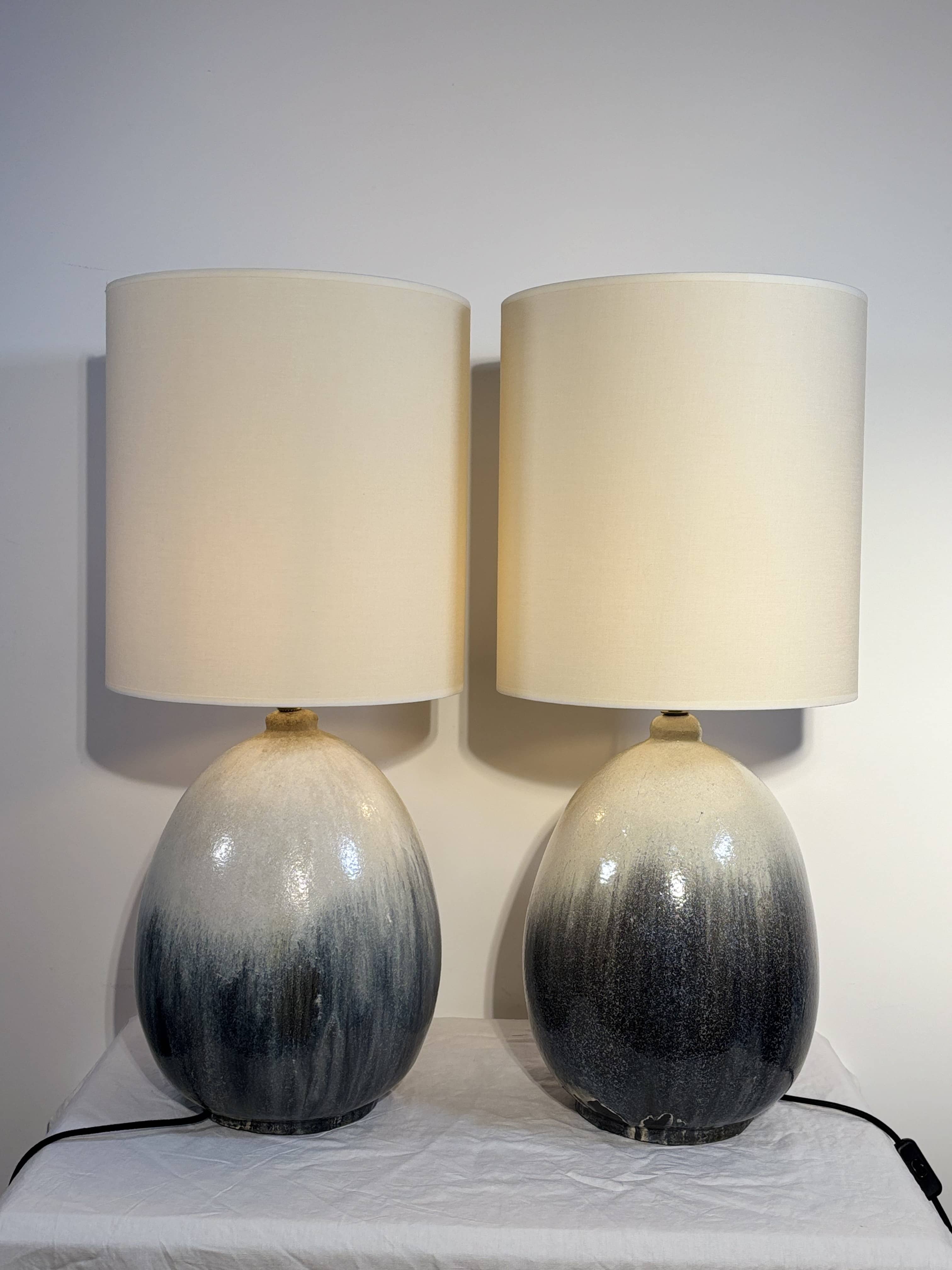
Rare pair of monumental lamps in glazed stoneware, the work of the Florentine ceramicist Marcello Fantoni (1915–2011), one of the leading figures of twentieth-century Italian art ceramics, whose pieces are held in the permanent collections of the Metropolitan Museum of Art, the Victoria & Albert Museum and the Museo Internazionale delle Ceramiche in Faenza.
The hand-thrown ovoid bodies display a poured glaze of remarkable chromatic subtlety: the creamy, frosted white of the crown melts through a gradient into a bluish grey, then a deep midnight blue, punctuated by ashen streaks. Flecks of pyrite and textured crystalline effects (characteristic of Fantoni’s explorations of materials) enrich the surface, at once granular and luminous, revealing Fantoni’s mastery in the working of fire.
Each piece is signed by hand on the underside.
The electrification has been entirely renewed by a professional (new socket and wiring). The cylindrical shades in natural ecru fabric were made to measure by a shade-maker from the Decorative Arts sector, in perfect harmony with the tonality of the ceramics.

Wall light by the French designer Louis Sognot, emblematic of the organic modernism of the 1950s.
Bent rattan structure forming an elegant curvilinear handle supporting a lantern / cage.
Cylindrical inner shade in original ecru fabric filtering a soft, subdued light.
Original socket.
Very fine original condition.
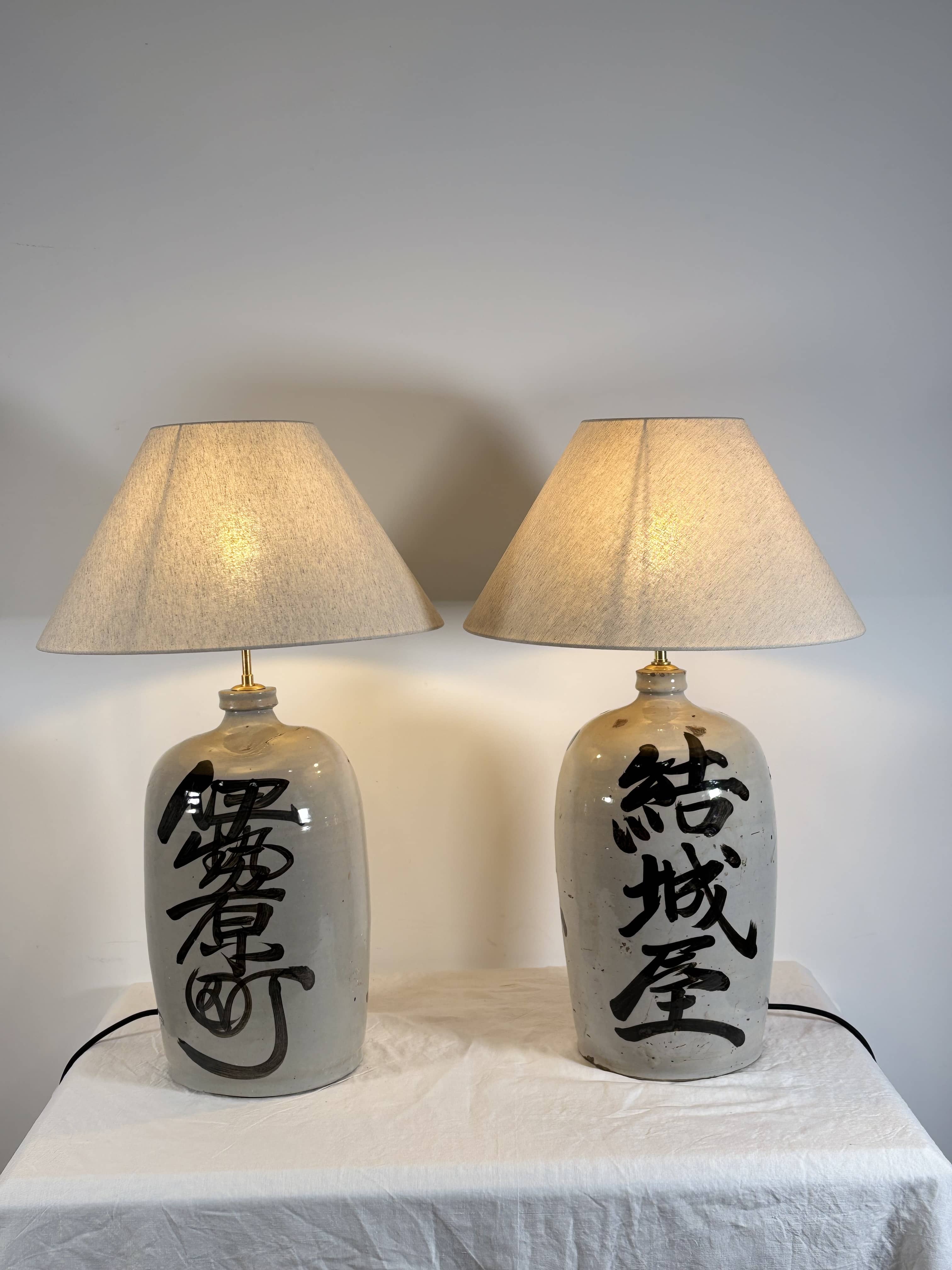
Pair of lamps mounted on sake jars (tobin) in grey-white glazed stoneware, Japan, first half of the 20th century.
Each jar bears, on several faces, calligraphic inscriptions in black ink under the glaze, executed with the brush with remarkable gestural flair — names of trading houses and merchant quarters (Yūkiya, Rokkōmachi) characteristic of the commercial production of the Meiji–Taishō era. Body in stoneware with a slightly sanded ivory glaze, banded neck, squat ovoid form.
Traces of wear and natural patina consistent with age and original use.
Entirely new electrical fitting, carried out by a professional electrician, in accordance with current French standards.
Gilt brass socket. Conical natural linen shade included.
Available individually: €500 each
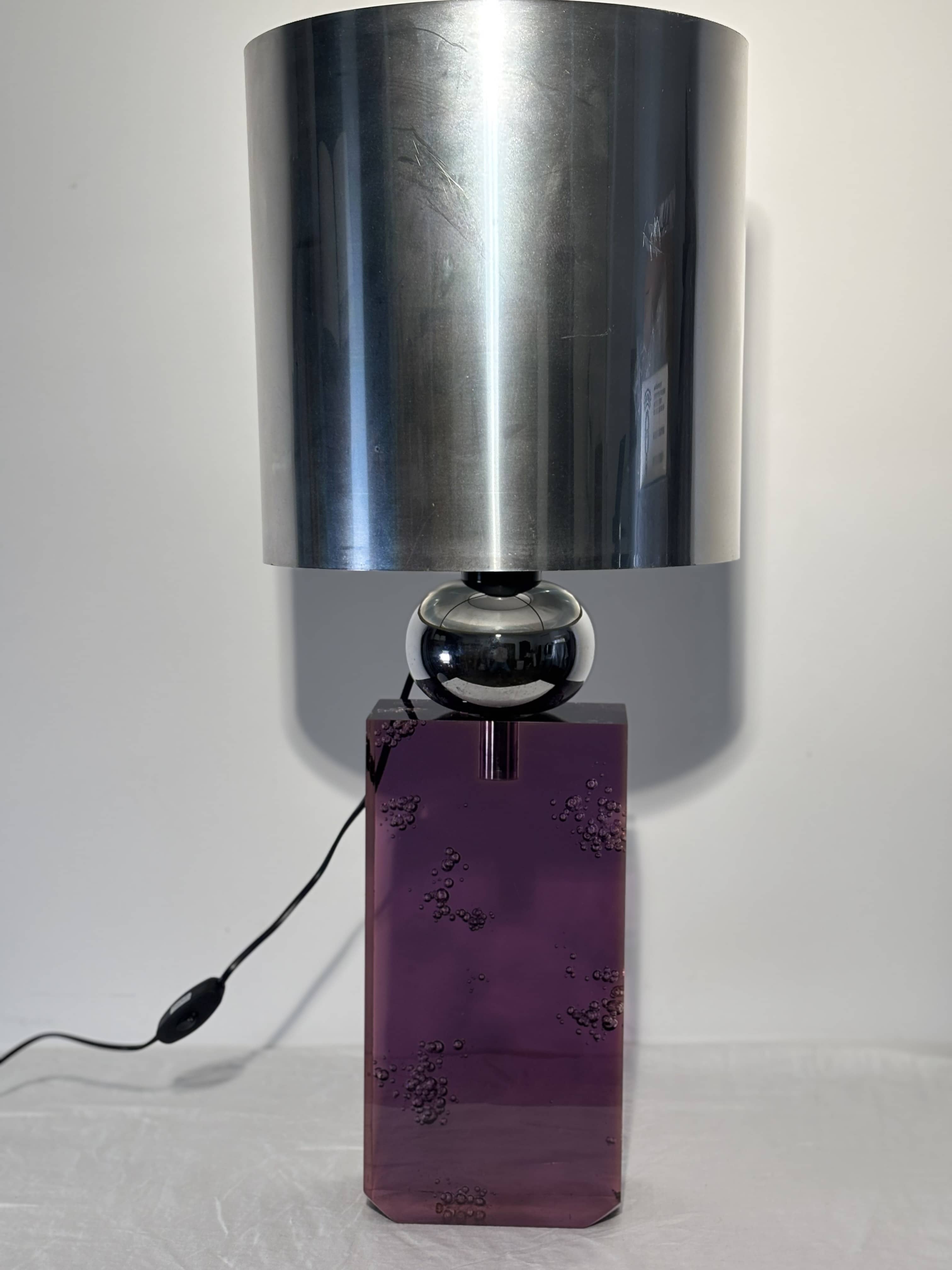
A remarkable Italian table lamp from the 1970s, a period of creative effervescence during which transalpine design established itself as a global benchmark. The monolithic stem in cast translucent acrylic, of intense amethyst hue, presents bubble inclusions trapped within the mass during casting — an artisanal process characteristic of the finest Italian ateliers of the decade.
The rectangular section with bevelled edges lends the whole an assertive sculptural character. The chromed metal sphere articulating the stem and the socket, together with the cylindrical shade in brushed silvered metal, sit squarely within the formal vocabulary of the Italian Space Age, in the spirit of the creations of Romeo Rega.
Unsigned piece, attributable to a Milanese or Venetian design atelier of the 1970s.
Side wiring.
Origin: Italy, circa 1970
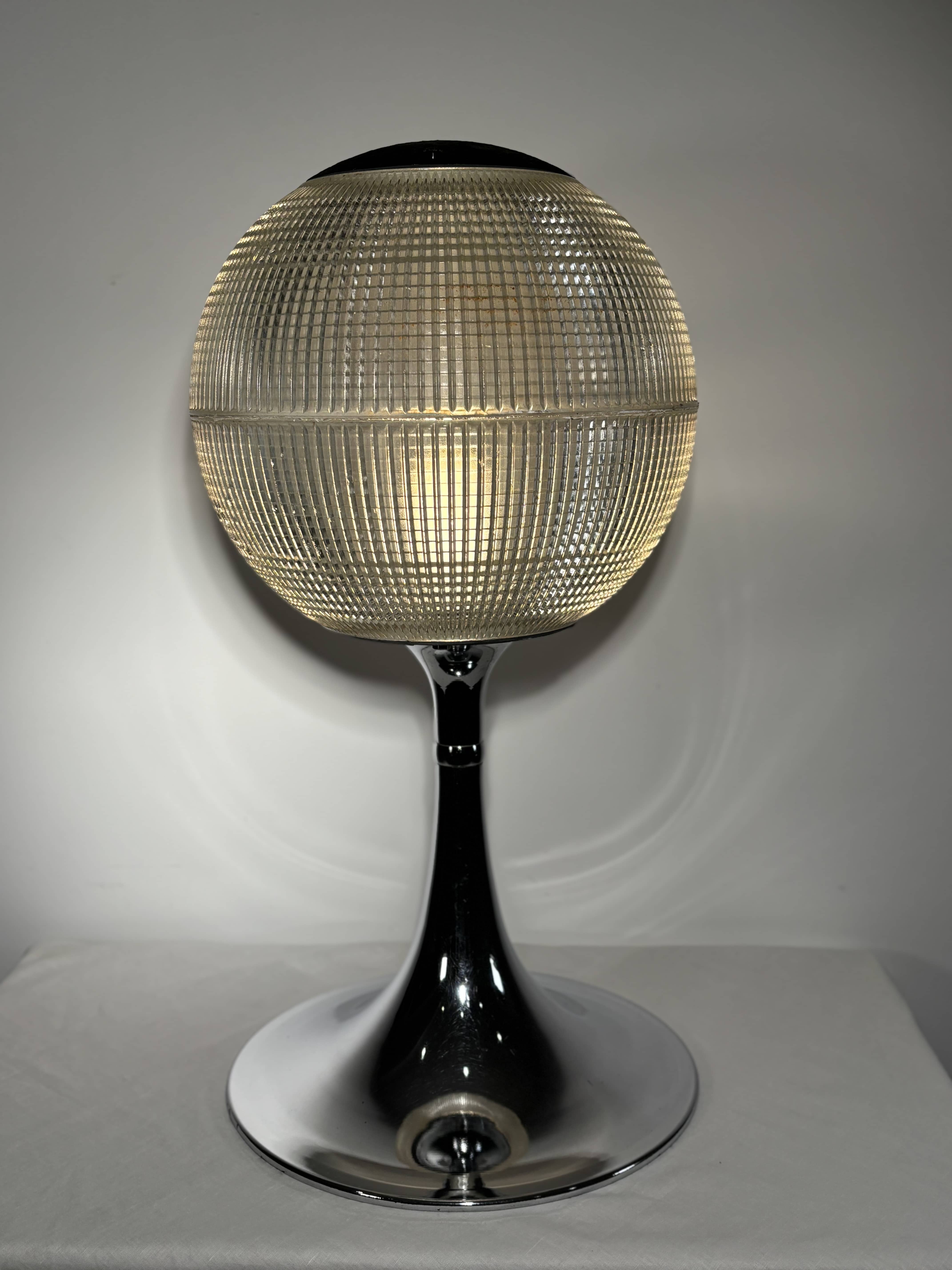
A unique collector’s piece for connoisseurs and enthusiasts of industrial and Space Age lighting. A genuine globe from the street furniture of the city of Paris, this characterful table lamp combines a chromed metal tulip-style base, emblematic of the 1970s, with a holophane glass globe. The globe is remarkable for its intricate moulded prismatic glass pattern, with grid and striated motifs typical of the historic urban luminaires of Paris.
This textured glass is not merely aesthetic; it is designed for optimal light diffraction, creating a soft yet shimmering ambience.
A true sculpture of light, at the crossroads of industrial design and modernism.
Some traces of age on the glass.
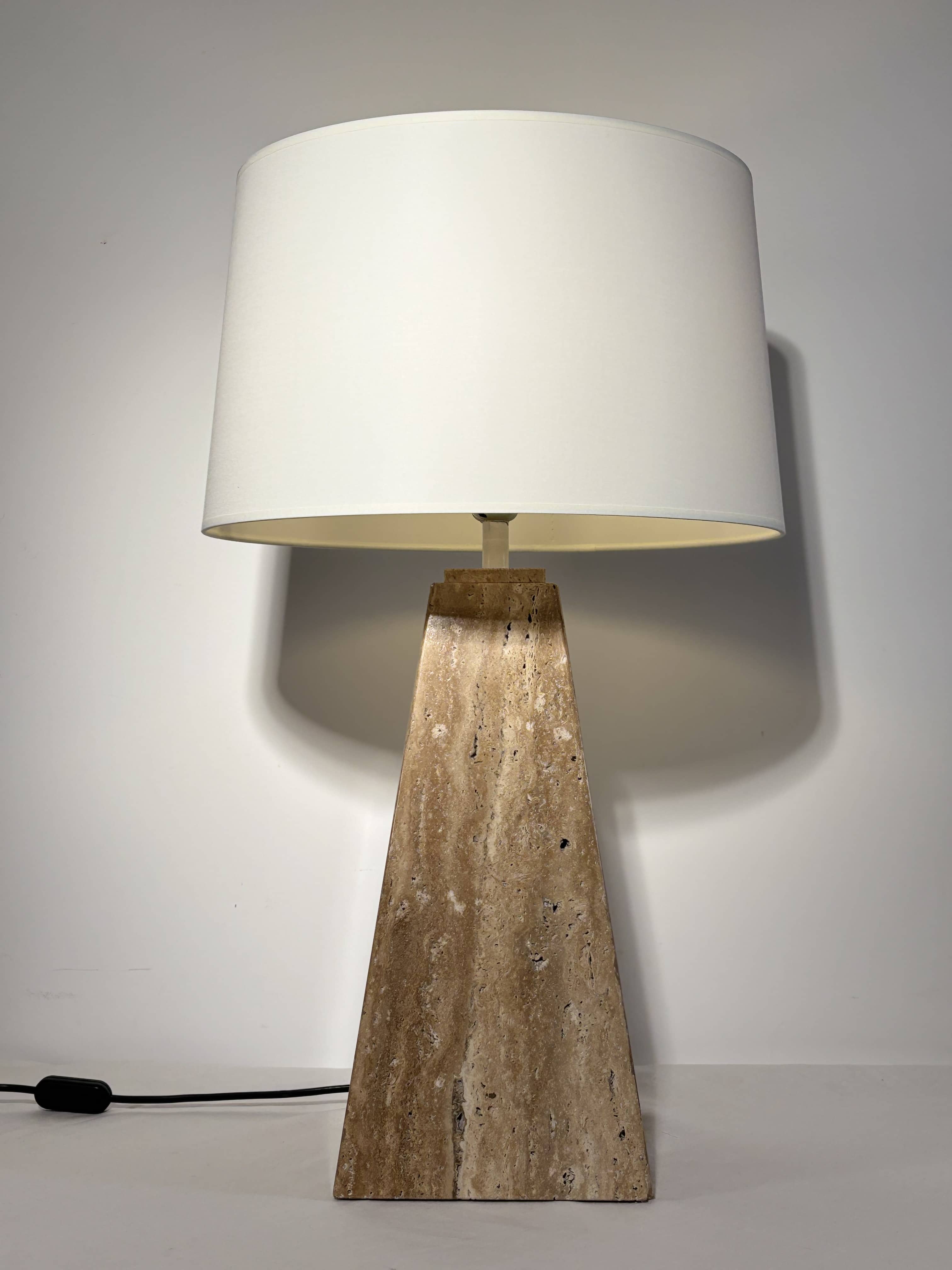
Remarkable pyramidal lamp base of square section, hewn from a block of unfilled Roman travertine displaying its characteristic horizontal veining, alternating warm ochre and beige.
The surface retains its natural cavities, a deliberate treatment that lends the piece its sculptural power and firmly situates it within the brutalist and mineral aesthetic of Italian design of the 1970s.
The shaft tapers progressively from base to crown in an obelisk-like movement of great geometric rigour.
Original label present: AREA Illuminazione, a transalpine manufacturer renowned for its luminaires in fine natural stone.
Later shade. Ivory white.
Very good overall condition.
Functional electrical fittings.