Our Collection
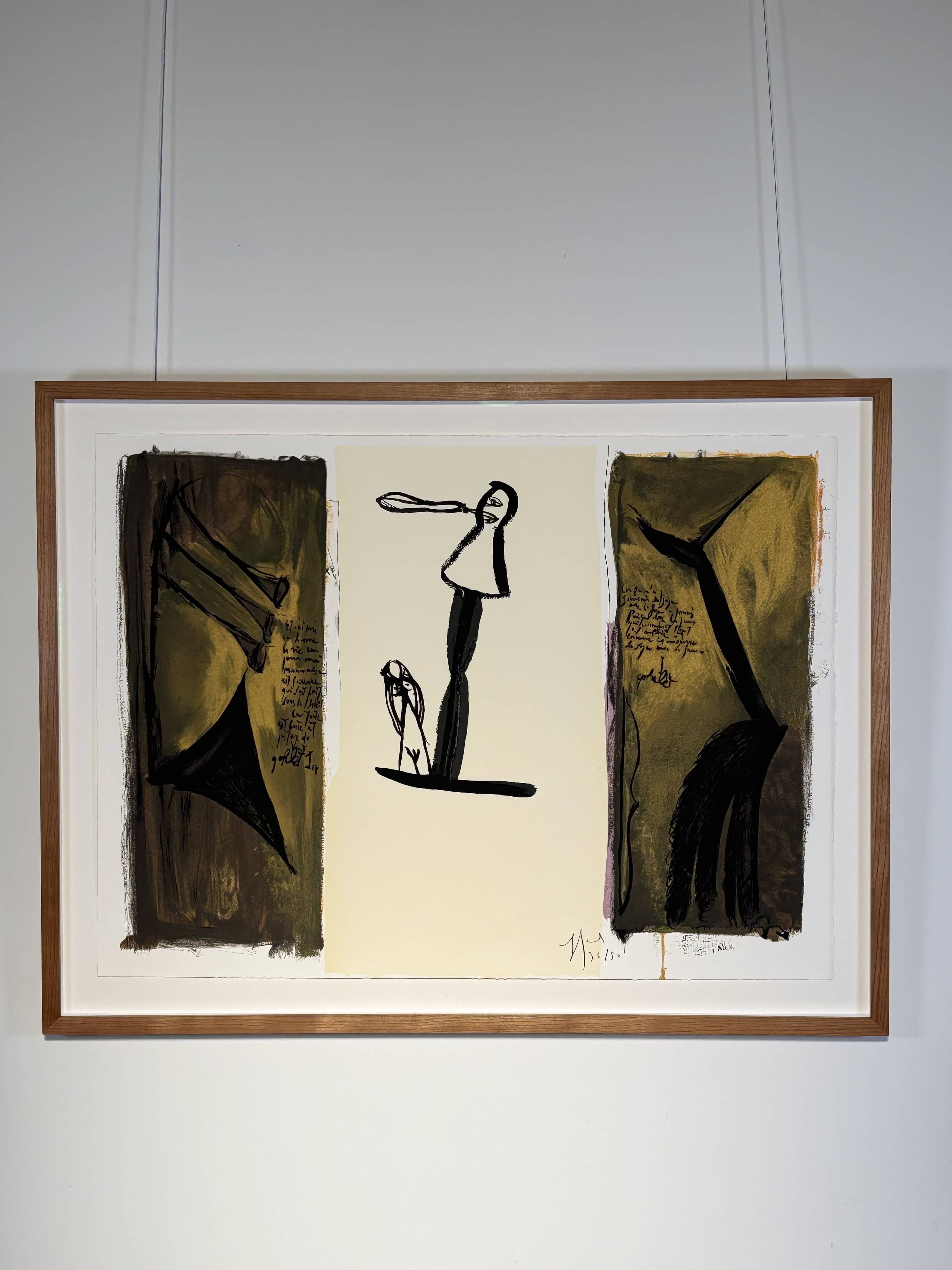
Important original colour lithograph conceived in the form of a narrative triptych, a major subject in the artist’s œuvre.
The composition is organised around a pared-down central panel dominated by a slender, hieratic figure (recalling the world of Don Quixote or the Preacher), flanked by two expressionist scenes rendered in powerful tones of ochres, dark earths and deep blacks.
The work bears witness to Garouste’s fascination with sacred texts and the Hebrew language, incorporating two handwritten philosophical passages drawn from the biblical Book of Ecclesiastes (signed with its Hebrew name, Gohélet / Qohélet):
On the left (Gohélet I, 17): “And I have seen life, one day evil to me, is the work that has been done under the sun, for all is vanity and pasture of the wind.”
On the right: “For who has remembrance of the wise man with the fool for ever, since in the days to come all is already forgotten. And how the wise man dies with the fool.”
Institutional reference: A similar impression from this same edition is held in the national collections of the Centre Pompidou / Musée National d’Art Moderne (inventory no. AM 2022-64).
Original colour lithograph on heavy wove paper.
Numbered 35 / 50 in pencil (highly confidential edition of only 50 impressions).
Signed in pencil with the artist’s official monogram “MG” lower right.
Excellent state of preservation, with remarkable freshness of the pigments.
Museum framing: Exceptional bespoke presentation carried out by a leading Parisian workshop.
Float mount in a box frame: the work is fixed in a reversible manner, revealing the entirety of the deckled edges of the paper. Cherrywood box-profile moulding, neutral conservation backing and museum-quality glass (anti-reflective and UV-protective).

A rare ensemble of four profile portraits, painted in black gouache with highlights, on blue-green tinted paper, presented under glass. Two men and two women are depicted, their coiffures and costumes characteristic of the fashion of the late eighteenth century and the Directoire period. More precious than simple cut silhouettes, these painted effigies render with finesse the details of the faces, hair and fabrics. Each portrait is presented within a brown fillet and united in a single mount. The ensemble is preserved in a giltwood frame adorned with carved friezes and palmettes. Good overall condition. Wear and patina of time.
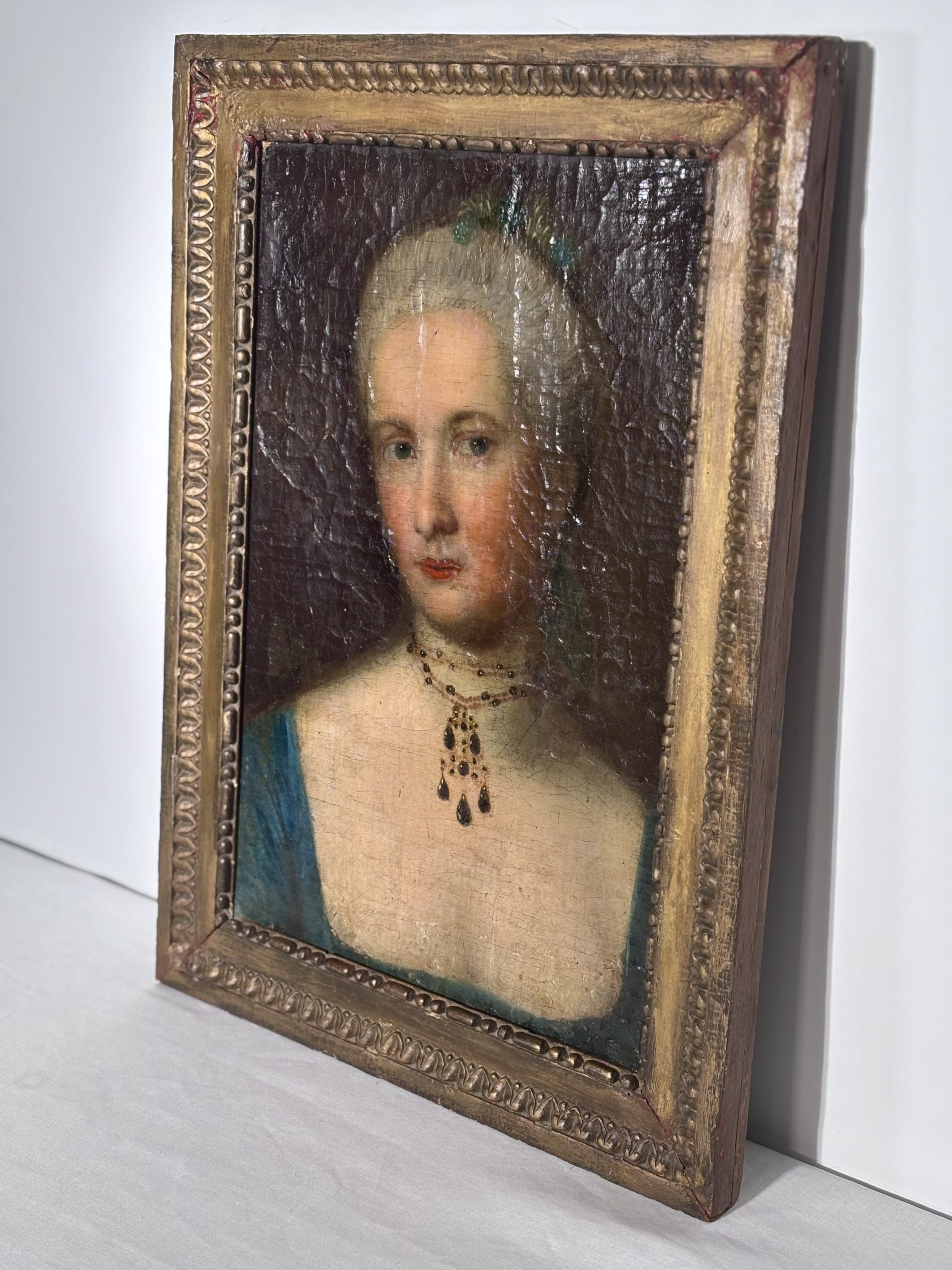
Oil on panel depicting the bust-length portrait of an elegant lady, wearing a blue low-cut gown and adorned with a necklace. Her powdered coiffure, embellished with green ribbons, illustrates the refined fashion of the second half of the 18th century. The painting, executed on a dark ground, together with the treatment of the flesh tones, is evocative of a Germanic work. This treatment enhances the brilliance of the jewellery and the delicacy of the face. Presented in an antique giltwood frame with beading and moulded decoration, the work retains all its cabinet charm. Age craquelure, retouches. Good overall condition.
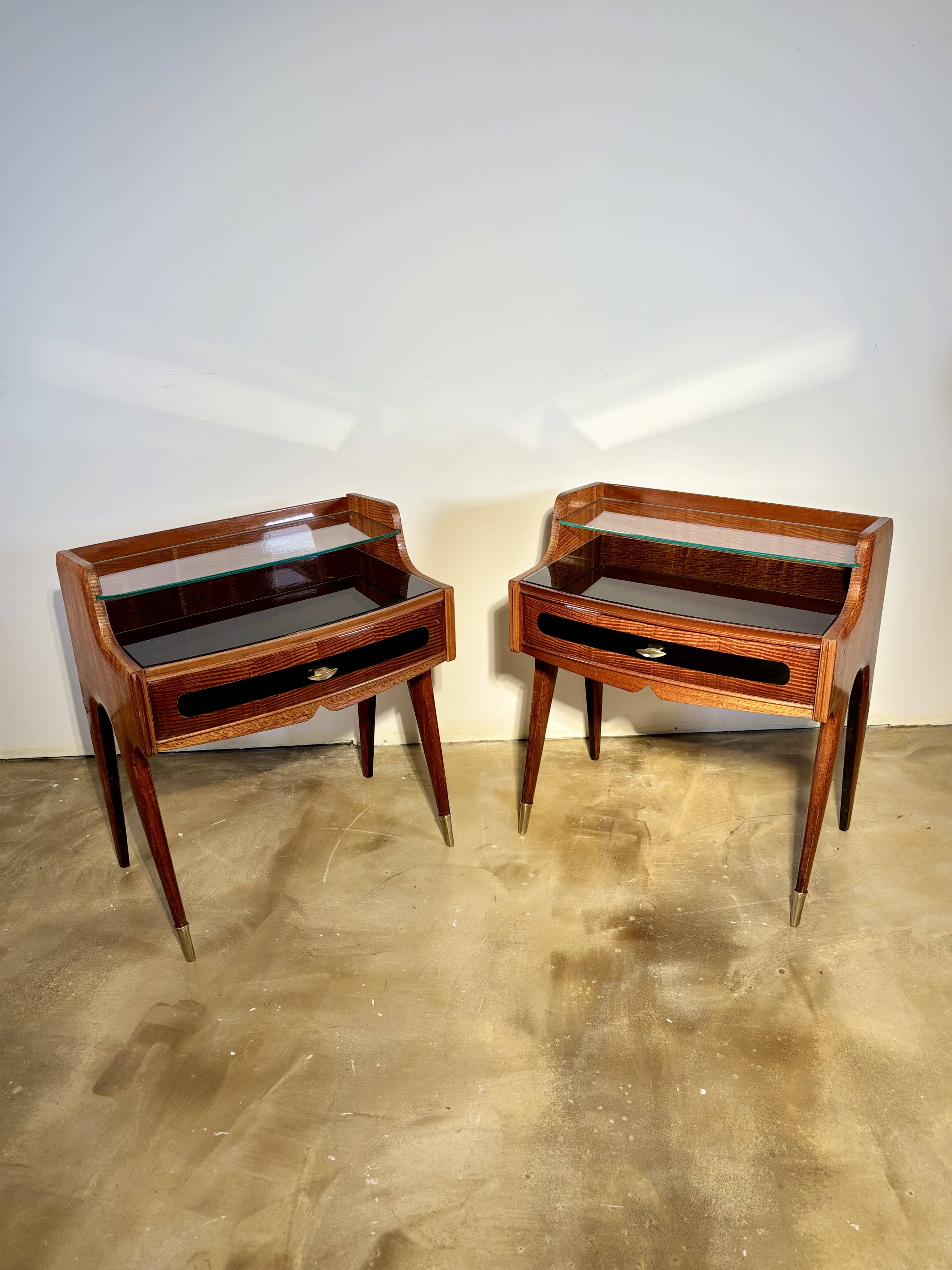
A remarkable pair of bedside tables (or sofa ends) in flamed mahogany veneer, representative of prestigious mid-twentieth-century Milanese cabinetmaking, in the manner of Paolo Buffa.
The veneer reveals a russet-orange shimmer with golden reflections that shift according to the light. The sides, sculpted in an inverted arch, lend the whole a remarkable lightness despite the presence of the material. Four tapered legs terminate in conical feet of cast brass.
Each piece is fitted with a drawer featuring a two-tone façade — a band of pear wood stained black, a noble substitute for ebony, set against a warm mahogany ground — closed by an elegant ogee cut-out. The cast brass handle, shaped as a flattened gondola, is characteristic of the decorative vocabulary of northern Italy in the 1960s. The top, covered with black églomisé glass, is surmounted by an open gallery with a clear glass shelf edged in green.
Sold as a pair only.
Very good overall condition. Veneer intact, drawers functional. Slight traces of use consistent with age.
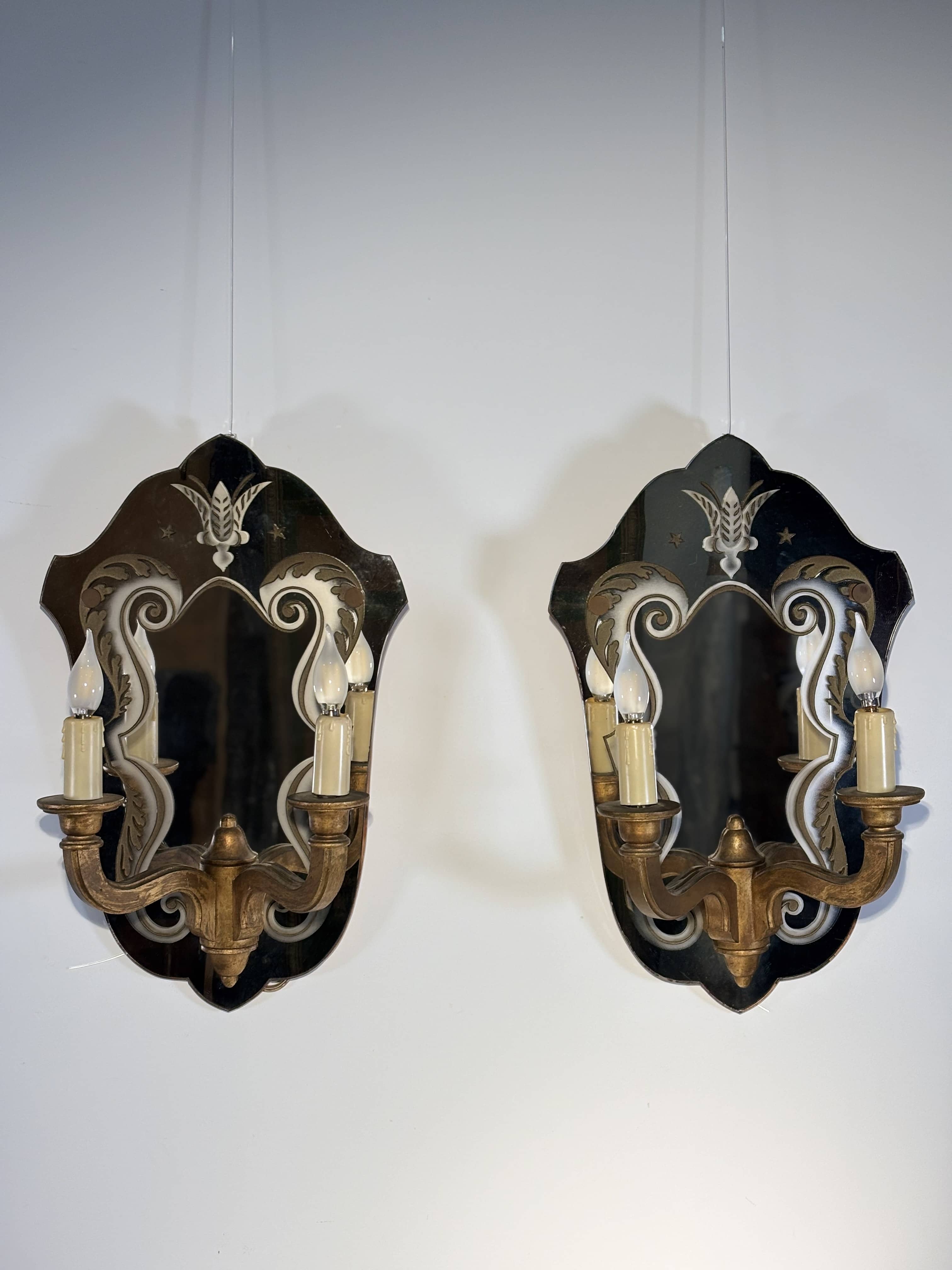
Elegant pair of two-branch wall lights, Italian or Venetian-style work dating from the mid-twentieth century (circa 1950).
Each sconce comprises a shaped and curved mirror plate with a bevelled edge, forming the reflective backing. The glass is richly intaglio-engraved and enhanced with gilded and sanded motifs, depicting at the summit a stylised foliate motif framed by stars, together with broad leafy scrolls running along the contours.
The lower structure supporting the two light-arms is crafted in carved and gilded wood with an antique-style patina.
The curved double-moulded arms support moulded drip-pans. The backs are in original plywood.
Very good overall condition.
Original electrification.
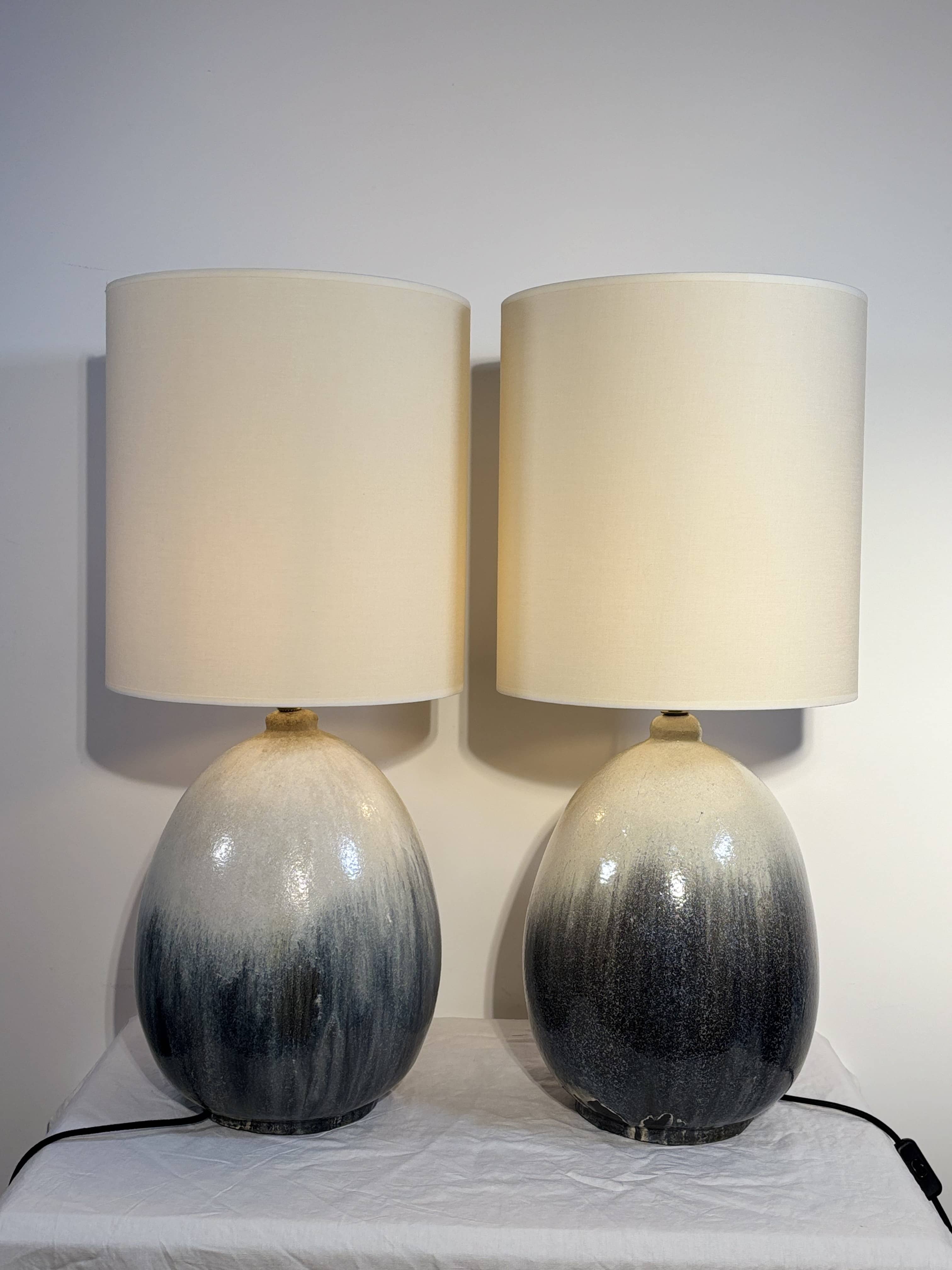
Rare pair of monumental lamps in glazed stoneware, the work of the Florentine ceramicist Marcello Fantoni (1915–2011), one of the leading figures of twentieth-century Italian art ceramics, whose pieces are held in the permanent collections of the Metropolitan Museum of Art, the Victoria & Albert Museum and the Museo Internazionale delle Ceramiche in Faenza.
The hand-thrown ovoid bodies display a poured glaze of remarkable chromatic subtlety: the creamy, frosted white of the crown melts through a gradient into a bluish grey, then a deep midnight blue, punctuated by ashen streaks. Flecks of pyrite and textured crystalline effects (characteristic of Fantoni’s explorations of materials) enrich the surface, at once granular and luminous, revealing Fantoni’s mastery in the working of fire.
Each piece is signed by hand on the underside.
The electrification has been entirely renewed by a professional (new socket and wiring). The cylindrical shades in natural ecru fabric were made to measure by a shade-maker from the Decorative Arts sector, in perfect harmony with the tonality of the ceramics.
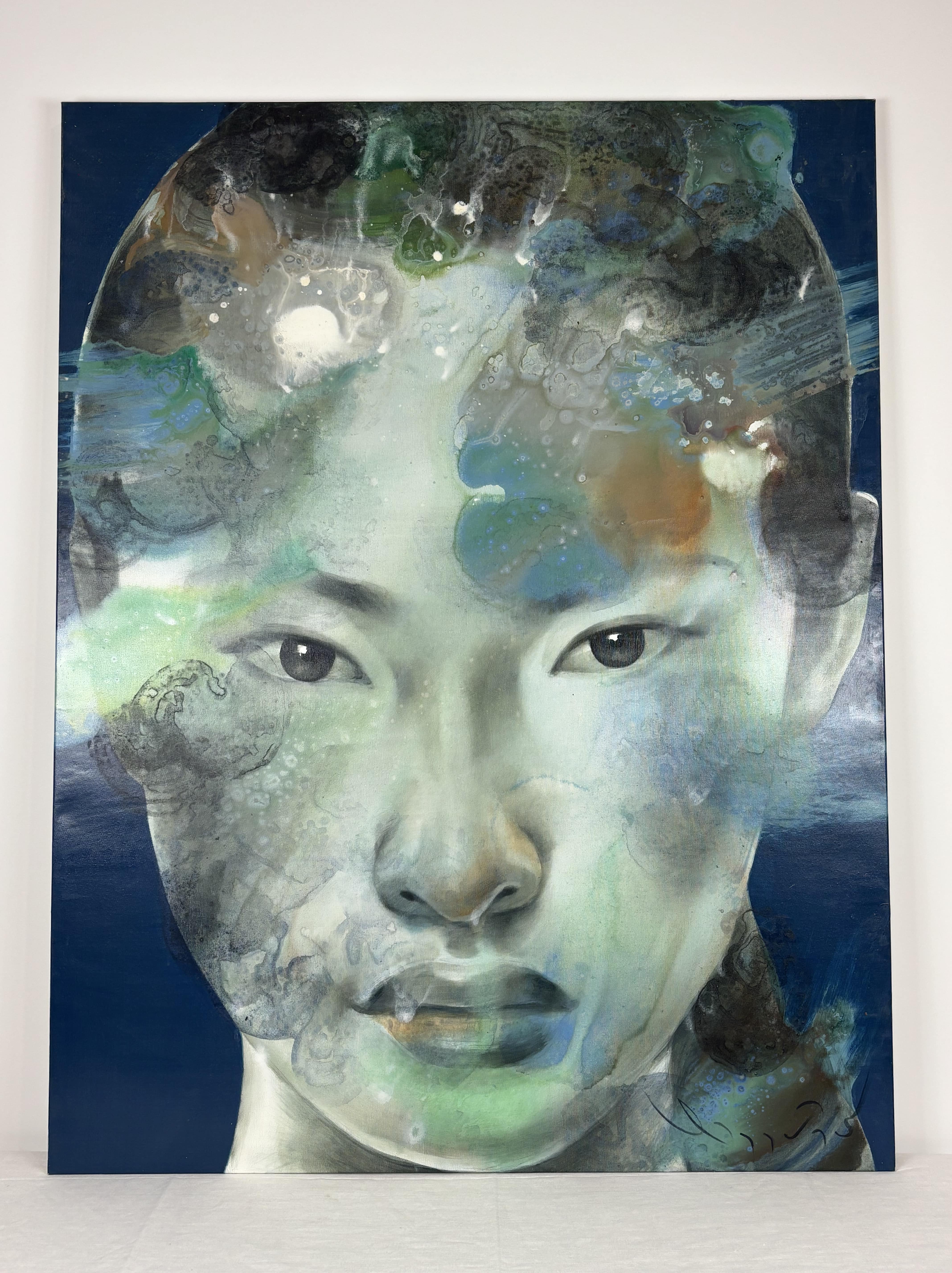
Large contemporary portrait by the Thai artist Silawit Poolsawat, renowned for his powerful and sensitive works. Asian Beauty captures the delicacy and depth of an Asian female face, in a composition that blends realism, subtle transparencies and dreamlike atmospheres. Silawit Poolsawat’s paintings are inspired by women and children he has encountered during his travels, whose expressions have left a profound impression on him. Signed lower right. Framing: mounted on an aluminium stretcher, ready to hang.
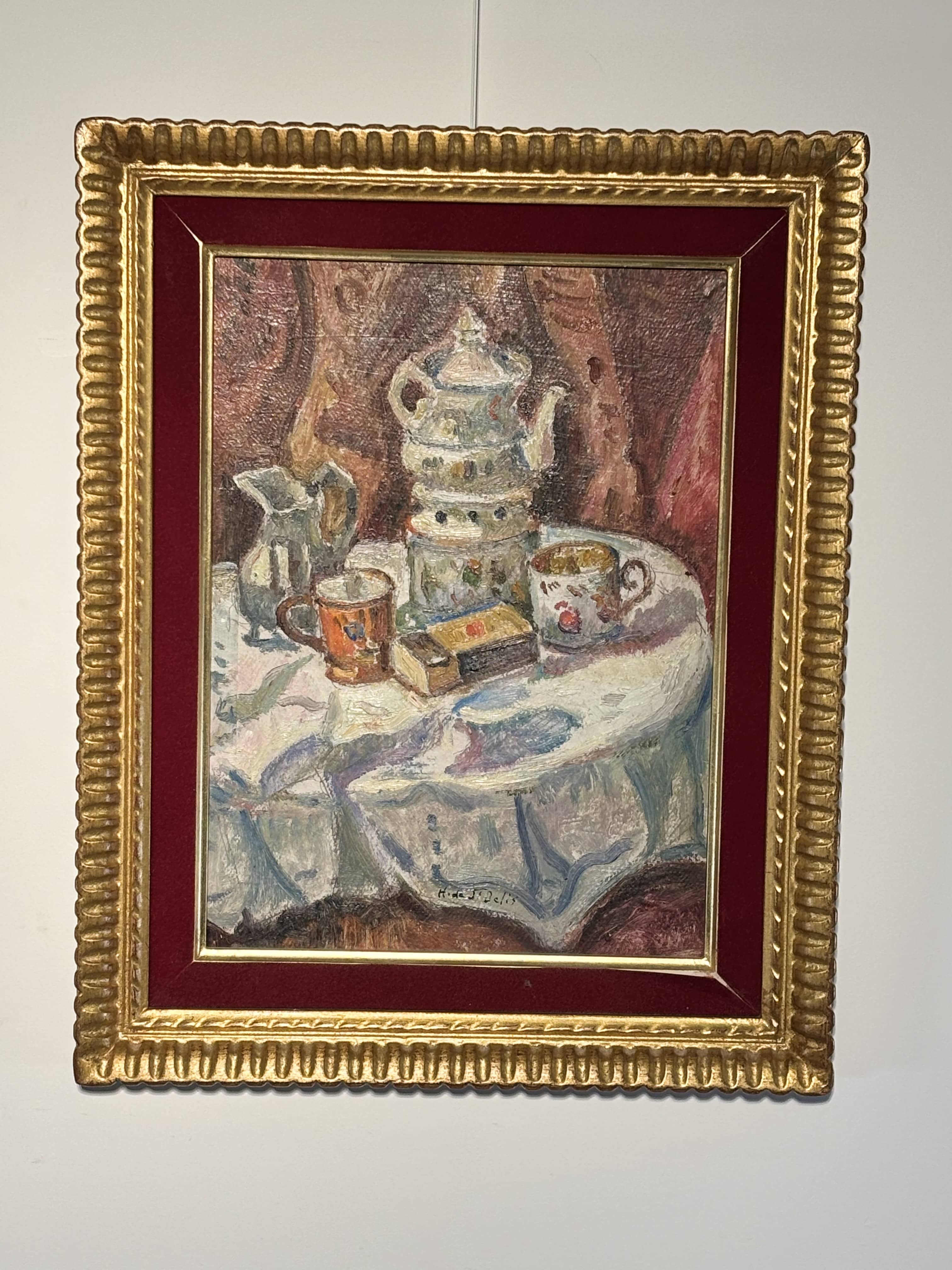
A luminous oil on heavy card (historic Canson & Montgolfier support) depicting an intimate studio scene: a table laid for tea with its samovar, ceramic cups and a box of matches.
The work bears witness to the superb technical mastery of Henri de Saint-Delis, an emblematic figure of the École de Rouen and of Honfleur. The artist deploys a modern touch, generous in impasto, inherited both from Norman Impressionism and from the chromatic freedom of Fauvism. The white cloth, sculpted by light, shimmers with bluish and mauve reflections characteristic of his finest manner. The impasted, vibrant brushwork and the chromatic range of ochres, blues and powdery pinks are typical of the artist’s style, having trained in Le Havre alongside Othon Friesz, Raoul Dufy and Georges Braque, before settling permanently in Honfleur where he would paint the greater part of his œuvre.
Signed lower.
Work authenticated by the Cabinet Marc Ottavi, Paris (approved C.V.V. expert, specialising in nineteenth- and twentieth-century paintings).
Support: The reverse bears its original label from the manufacturer Canson & Montgolfier (No. 347, moiré grain), a precious mark of the period.
Framing: Presented in a period-style moulded and gilded wooden frame, enhanced by an elegant burgundy velvet Marie-Louise which perfectly underscores the warm tones of the background.

Wall light by the French designer Louis Sognot, emblematic of the organic modernism of the 1950s.
Bent rattan structure forming an elegant curvilinear handle supporting a lantern / cage.
Cylindrical inner shade in original ecru fabric filtering a soft, subdued light.
Original socket.
Very fine original condition.
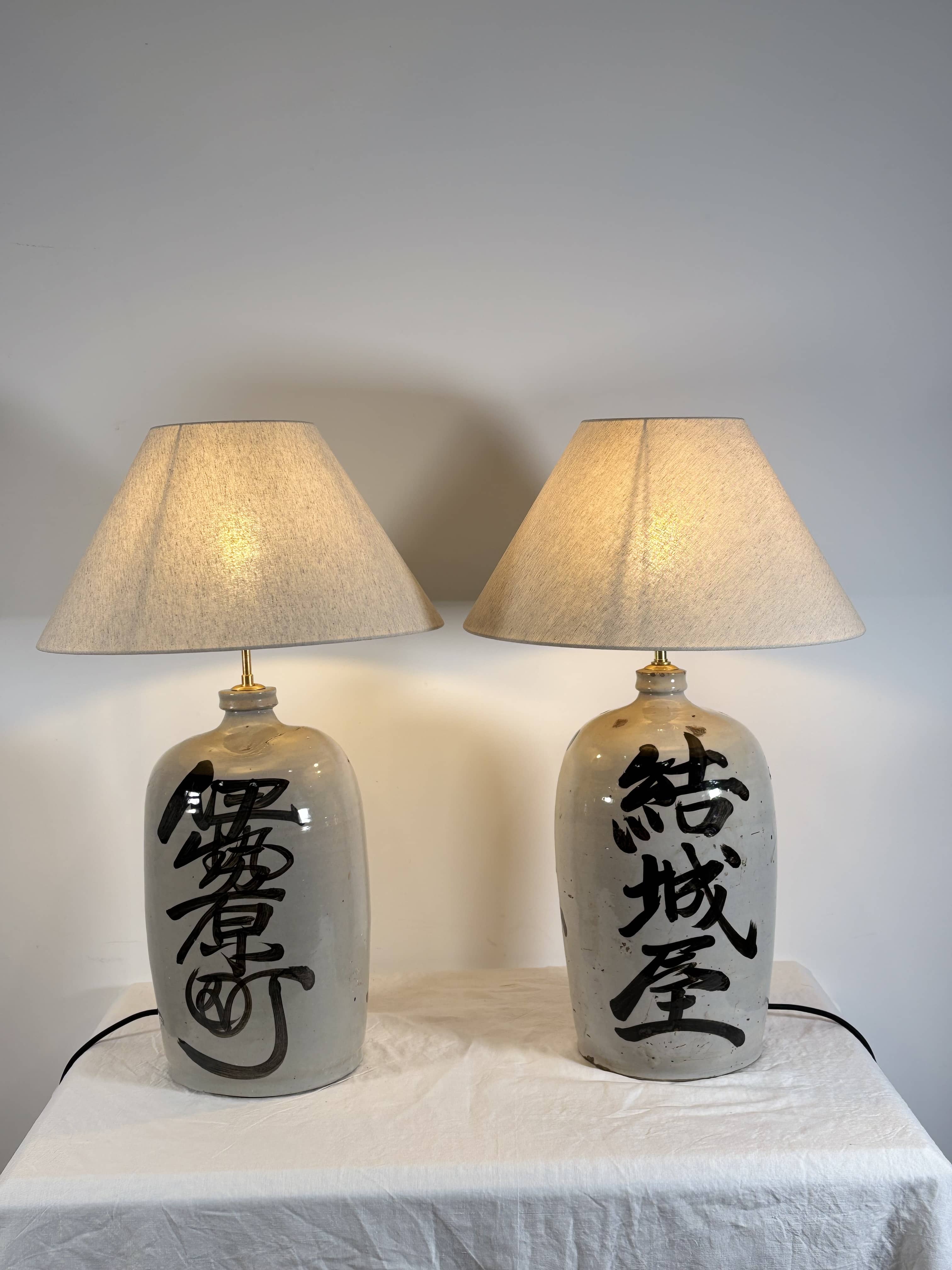
Pair of lamps mounted on sake jars (tobin) in grey-white glazed stoneware, Japan, first half of the 20th century.
Each jar bears, on several faces, calligraphic inscriptions in black ink under the glaze, executed with the brush with remarkable gestural flair — names of trading houses and merchant quarters (Yūkiya, Rokkōmachi) characteristic of the commercial production of the Meiji–Taishō era. Body in stoneware with a slightly sanded ivory glaze, banded neck, squat ovoid form.
Traces of wear and natural patina consistent with age and original use.
Entirely new electrical fitting, carried out by a professional electrician, in accordance with current French standards.
Gilt brass socket. Conical natural linen shade included.
Available individually: €500 each
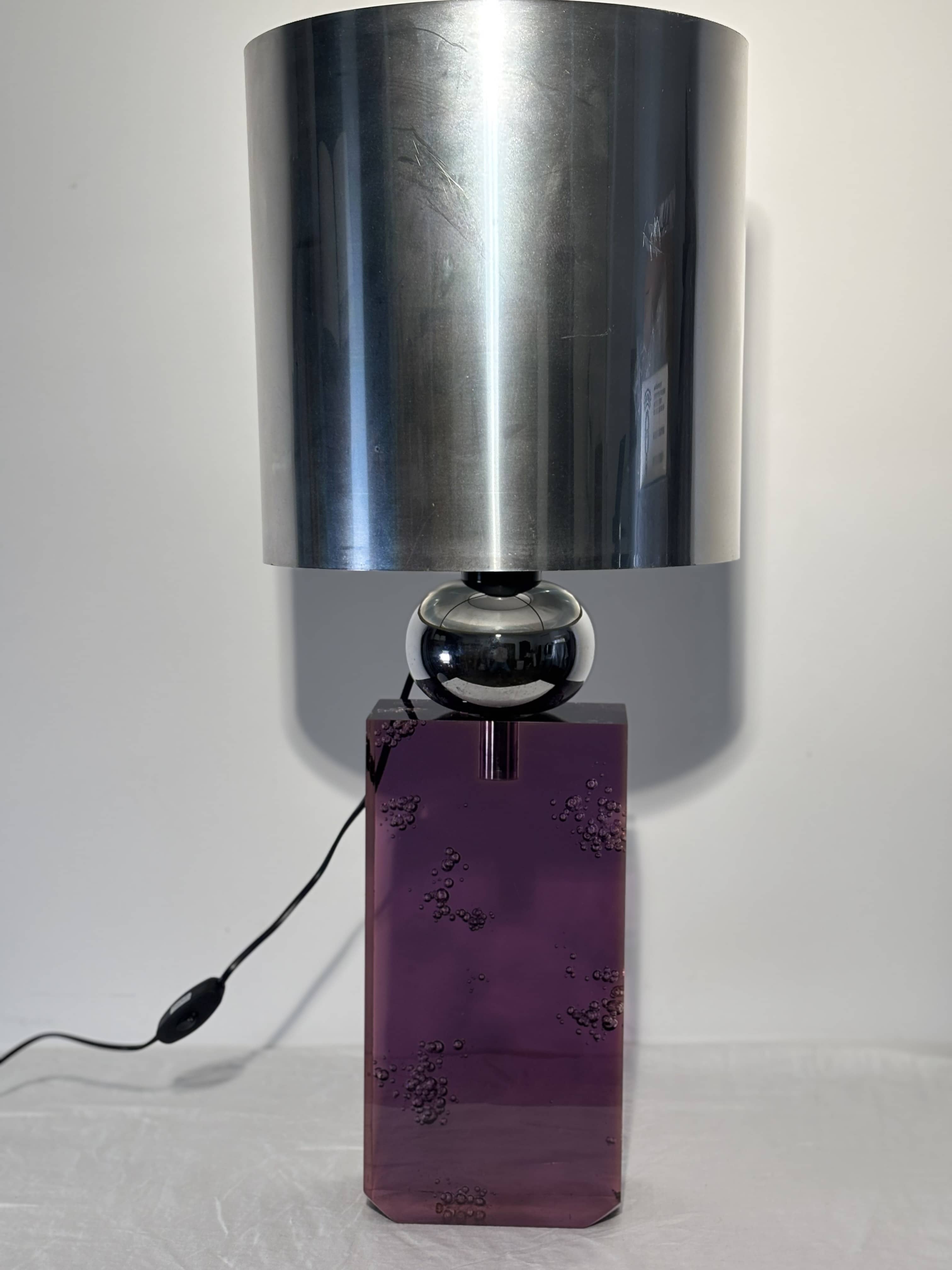
A remarkable Italian table lamp from the 1970s, a period of creative effervescence during which transalpine design established itself as a global benchmark. The monolithic stem in cast translucent acrylic, of intense amethyst hue, presents bubble inclusions trapped within the mass during casting — an artisanal process characteristic of the finest Italian ateliers of the decade.
The rectangular section with bevelled edges lends the whole an assertive sculptural character. The chromed metal sphere articulating the stem and the socket, together with the cylindrical shade in brushed silvered metal, sit squarely within the formal vocabulary of the Italian Space Age, in the spirit of the creations of Romeo Rega.
Unsigned piece, attributable to a Milanese or Venetian design atelier of the 1970s.
Side wiring.
Origin: Italy, circa 1970
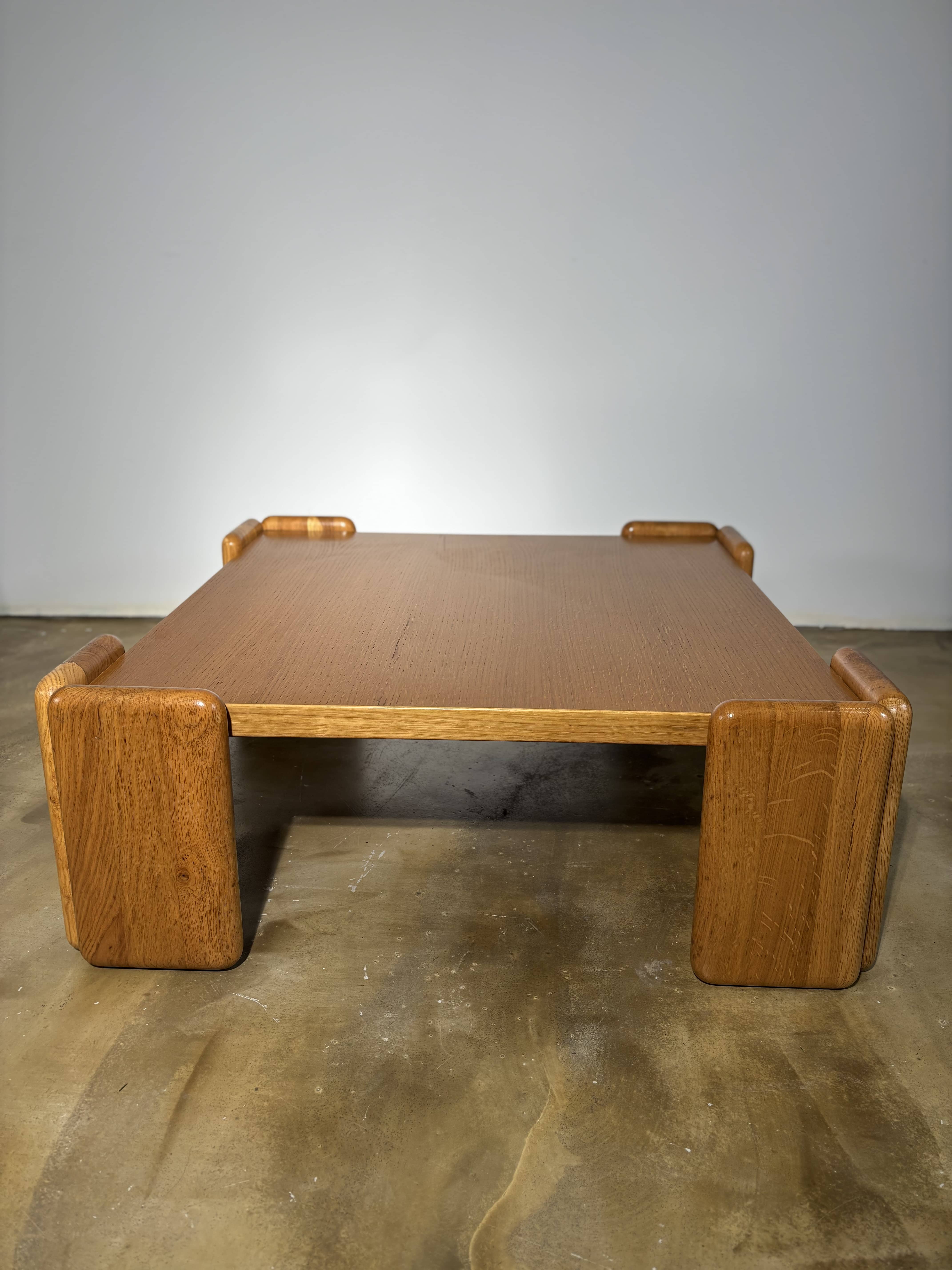
A fine coffee table designed by Mario Marenco for Mobilgirgi, Italy, 1970s.
Crafted in solid oak, this table is distinguished by its four characteristic legs composed of rounded slats that rise above the top — an immediately recognisable signature of Mario Marenco’s design.
The top rests between the legs in a perfect balance of sturdiness and lightness. The texture of the oak, the knots in the wood and the carefully rounded edges bear witness to superior craftsmanship.
Very good overall condition, with a patina of use consistent with the age of the piece.
Italy, 1970s.
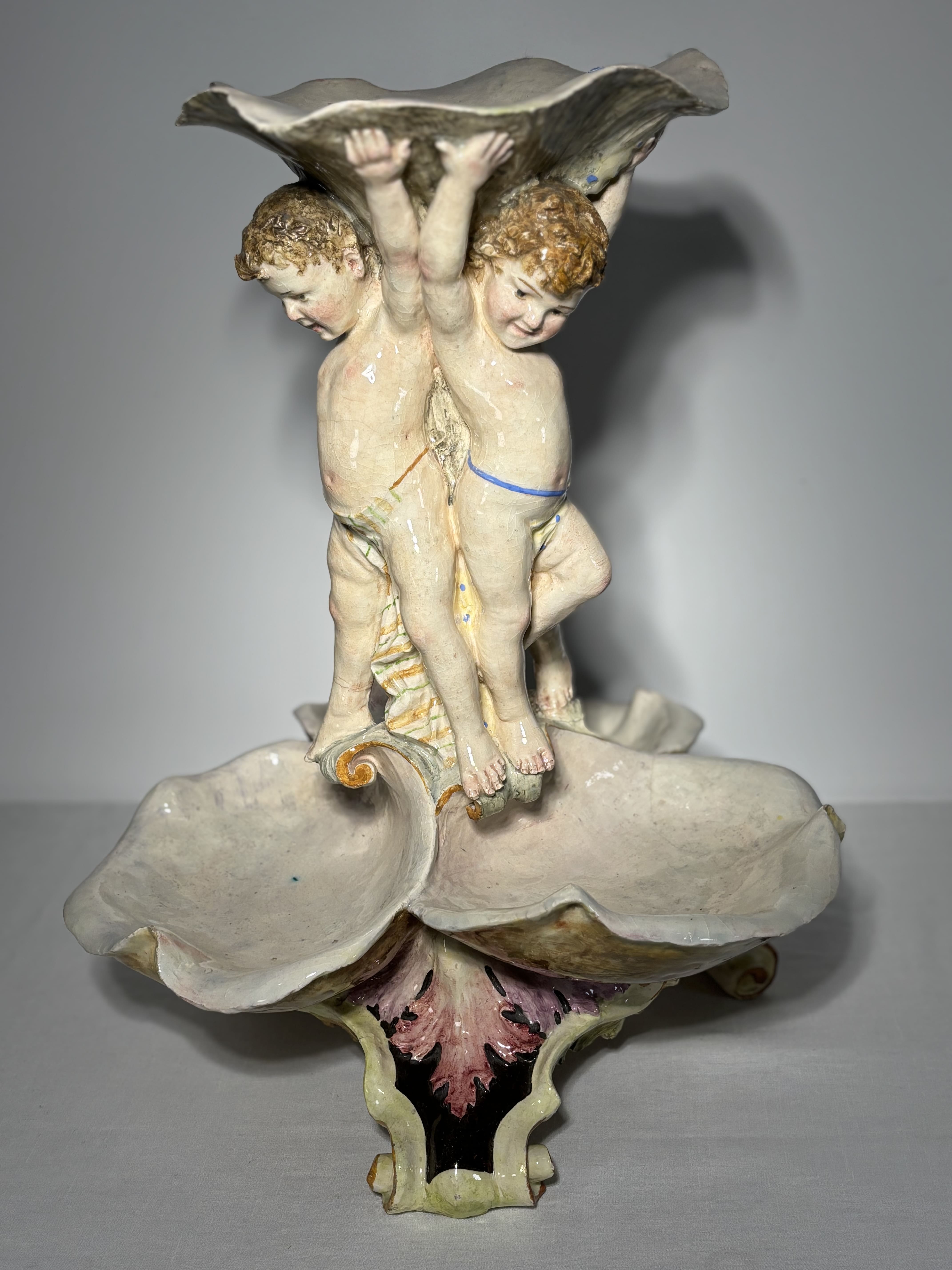
Large Italian majolica centrepiece in the Neo-Rococo style, depicting three Putti supporting a wide shell-shaped bowl, resting on a triple scrolling shell adorned with stylised polychrome foliage.
The naturalistic decoration and polychromy are typical of Italian decorative production of the late 19th century, in the tradition of the Capodimonte or Bassano workshops. Majolica with thick glaze, polychrome decoration. Finely modelled faces. Highly sculptural base.
Beautiful presence and a piece of generous proportions.
Italy, late 19th – early 20th century
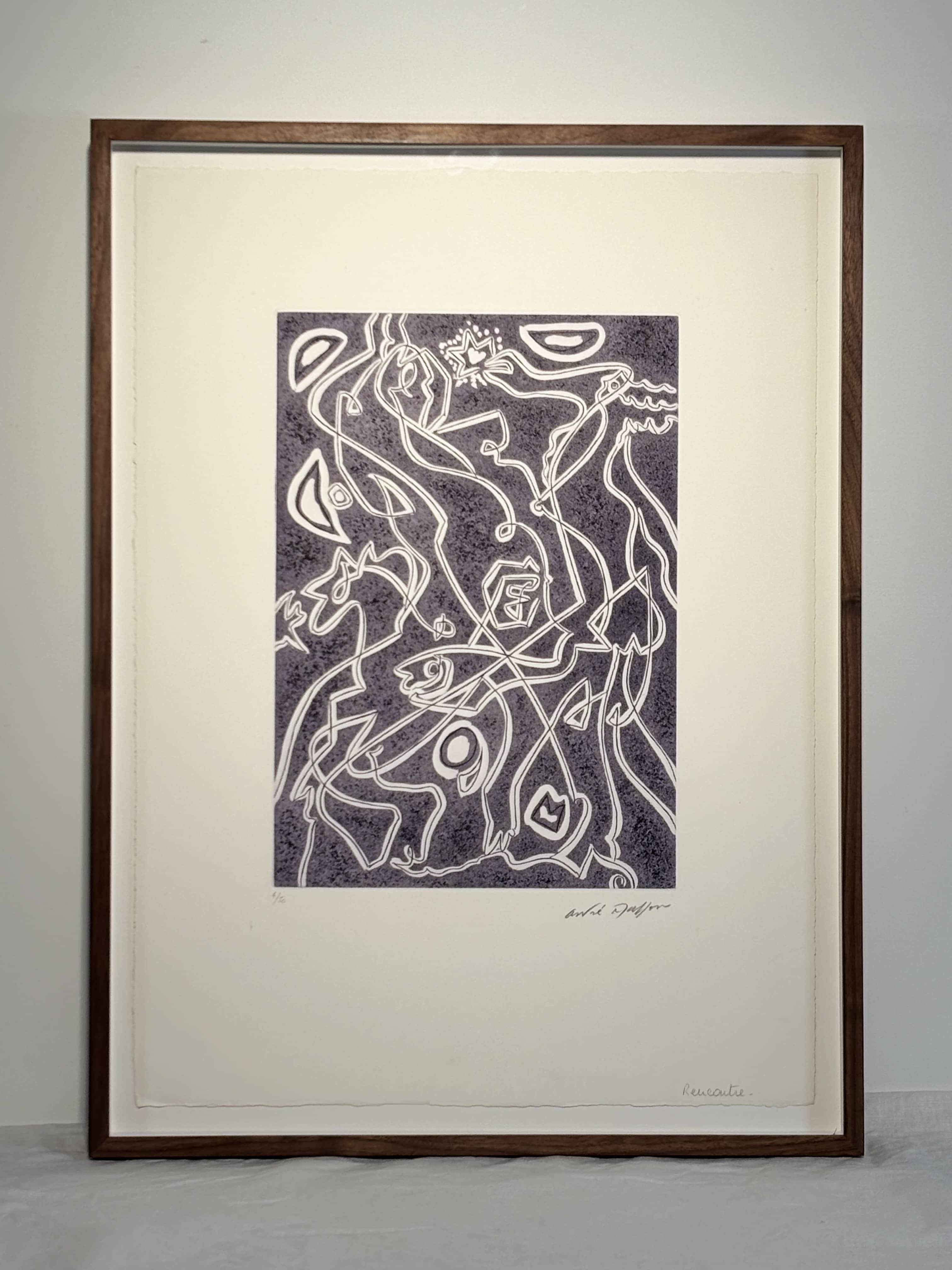
A central figure of Surrealism, André Masson was one of the inventors of automatic painting — a freedom of gesture that would directly influence Pollock and American Abstract Expressionism. His graphic œuvre, poised between myth, metamorphosis and vital energy, is today held in the world’s foremost collections.
“Rencontre” is a striking illustration of this: against a grainy violet-grey ground, fluid white lines conjure animal silhouettes, fragmented faces and archaic symbols in a swirling dance. Automatism in its purest state.
Original colour print, signed in pencil, numbered 4/50. Laid paper with deckle edges.
Image: 29.5 × 20.5 cm — Sheet: 47.8 × 35 cm.
Framed under glass by a leading Parisian atelier.
Walnut frame: 52 × 39 × 3 cm
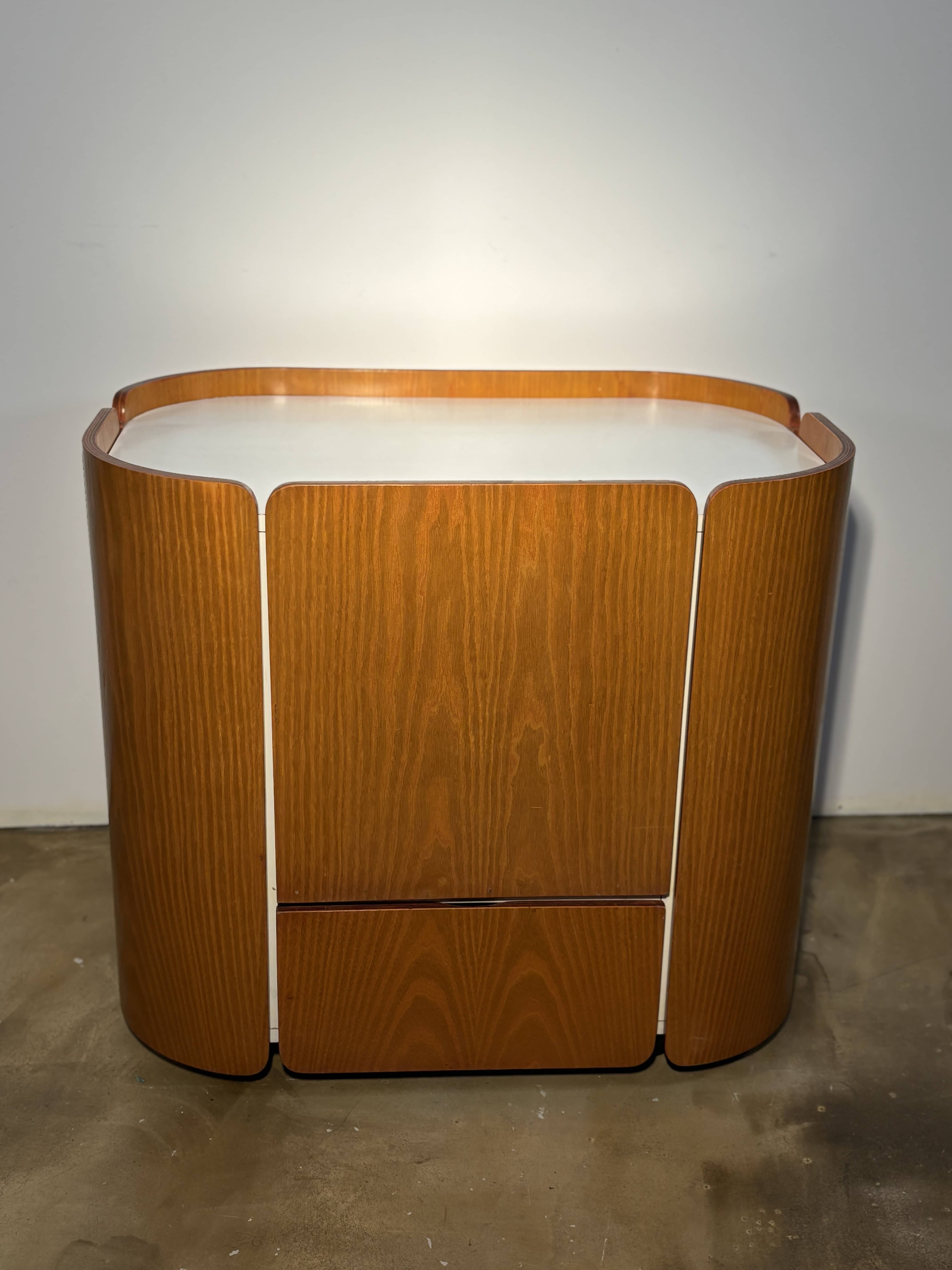
A rare wheeled occasional drinks cabinet known as a Dry Bar Cart, an emblematic creation by the celebrated Milanese architect and designer Carlo di Carli (1910-1999) for the prestigious Italian editor FARM (Scorzè), circa 1960/1965.
This piece is distinguished by the masterly use of thermoformed bent wood, the editor’s speciality, offering lines of organic and fluid purity. Conceived to be both functional and mobile, it stands on original castors discreetly concealed beneath its base, allowing it to be moved with ease about a drawing room.
Two large curved doors open to reveal suspended semi-circular shelves, fitted with original silvered metal retaining straps to secure glasses and decanters.
The front opens by means of a fall-front fitted with an articulated mechanical stay. It reveals a generous central compartment lacquered in white, specially designed to store bottles upright in complete safety. In the lower section, a wide concealed drawer is harmoniously integrated into the plinth for the storage of bar accessories.
As the rear of the cabinet benefits from the same carefully applied veneer as the front, this bar may be used at the centre of a room or at the end of a sofa.
Materials: blond walnut veneer, service surfaces in laminate/white lacquer, original stay and fittings.
Excellent overall condition, smooth mechanism, functional castors. Light oxidation on the hinge metalwork commensurate with its age (see photograph).
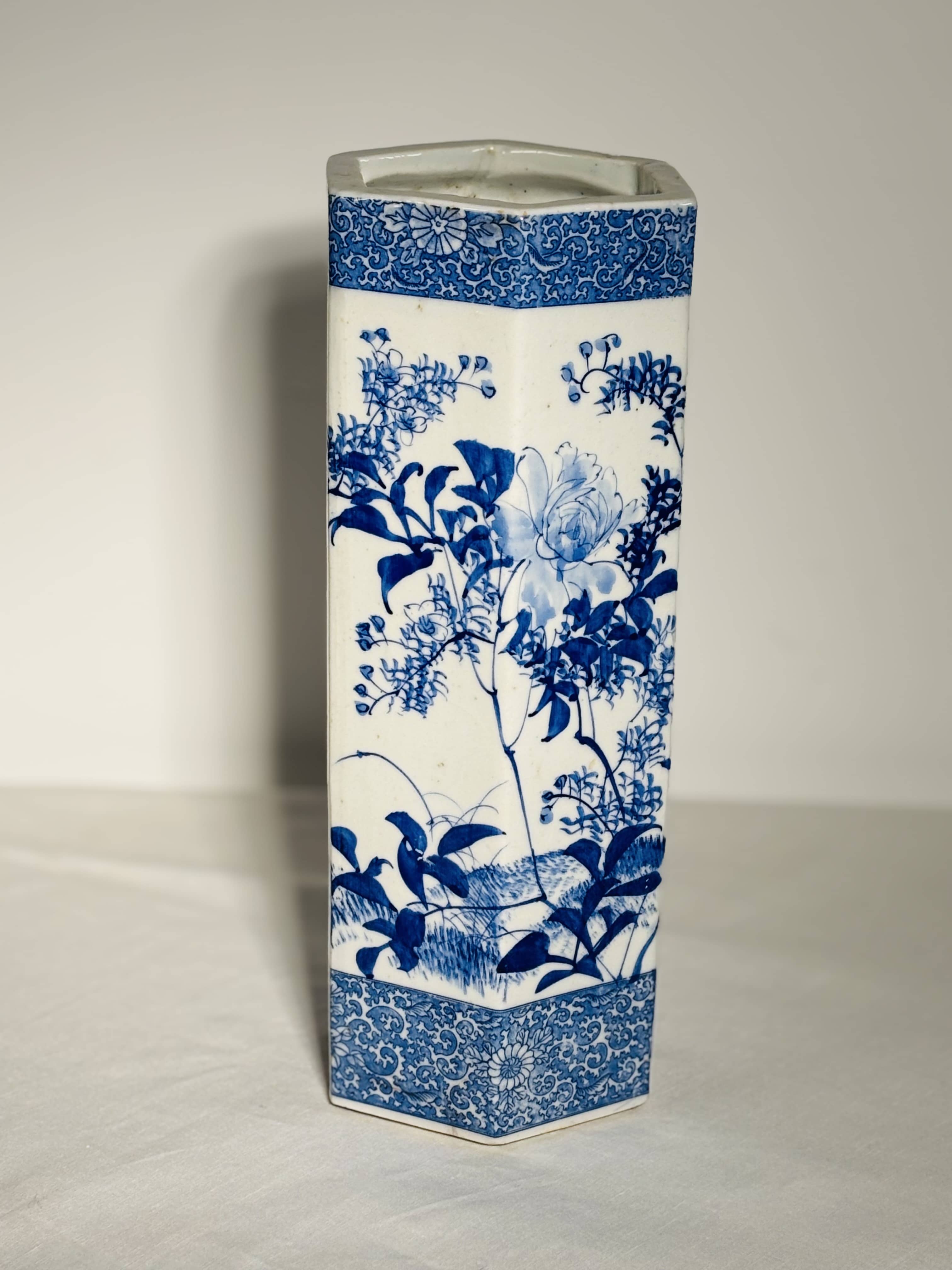
An elegant hexagonal porcelain vase decorated in “Blue and White”, dating from the late Meiji period (circa 1890-1910).
This vase displays a rich and balanced naturalistic decoration, depicting peonies in full bloom — a symbol of prosperity and nobility — together with butterflies, rendered with great graphic finesse. The drawing is distinguished by a lively line and the deep cobalt blue gradations characteristic of Japanese production from the Seto region intended for export.
The upper and lower registers are emphasised by intricate friezes of flowering scrolls and stylised lotus flowers, lending a classical structure and great elegance to the whole.
The hexagonal form, rarer and more sought-after than classical cylindrical shapes, offers captivating plays of light across the facets, making it an ideal decorative object for a contemporary setting or for mounting as a fine lamp.
In fine overall condition.
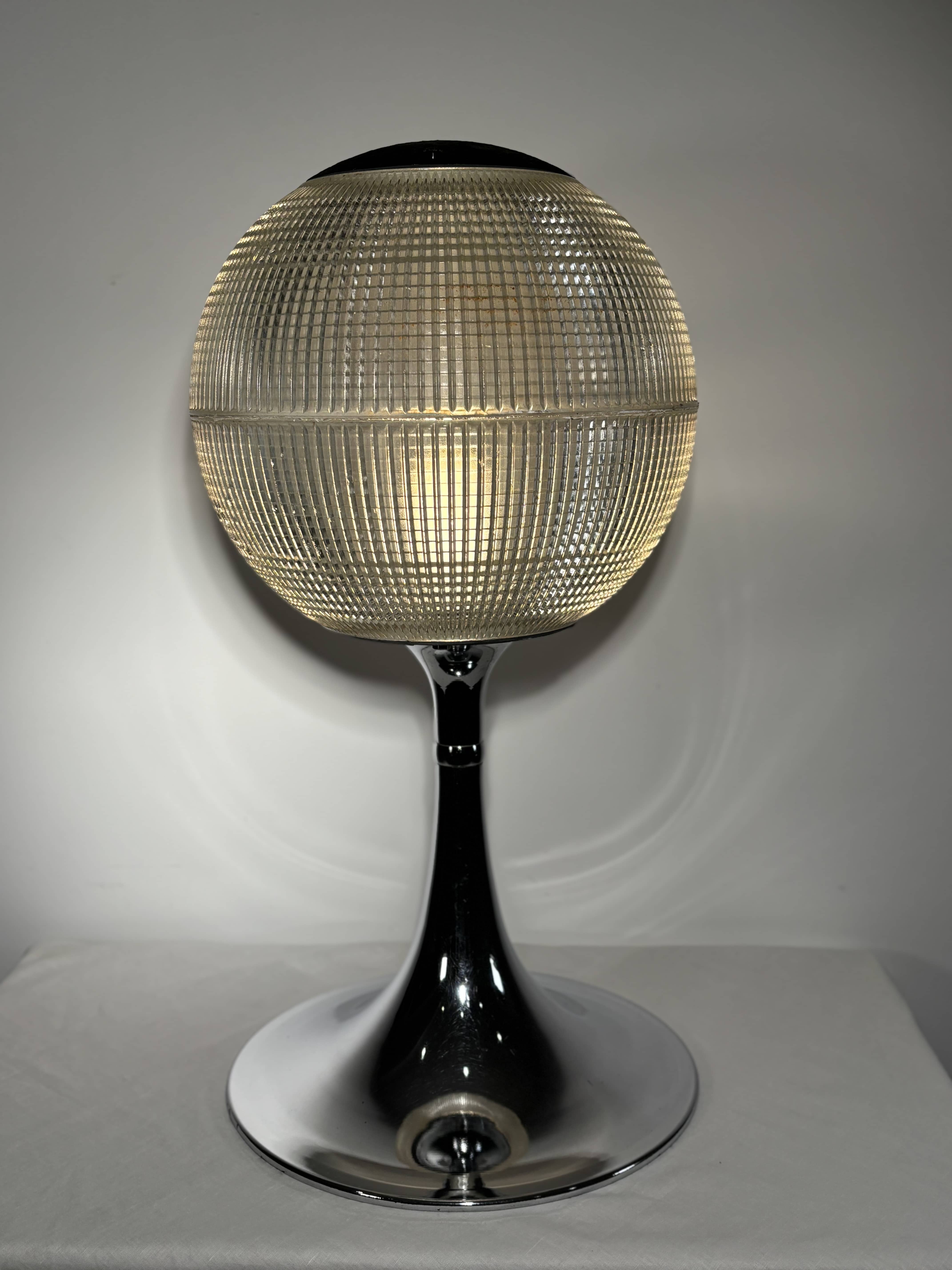
A unique collector’s piece for connoisseurs and enthusiasts of industrial and Space Age lighting. A genuine globe from the street furniture of the city of Paris, this characterful table lamp combines a chromed metal tulip-style base, emblematic of the 1970s, with a holophane glass globe. The globe is remarkable for its intricate moulded prismatic glass pattern, with grid and striated motifs typical of the historic urban luminaires of Paris.
This textured glass is not merely aesthetic; it is designed for optimal light diffraction, creating a soft yet shimmering ambience.
A true sculpture of light, at the crossroads of industrial design and modernism.
Some traces of age on the glass.
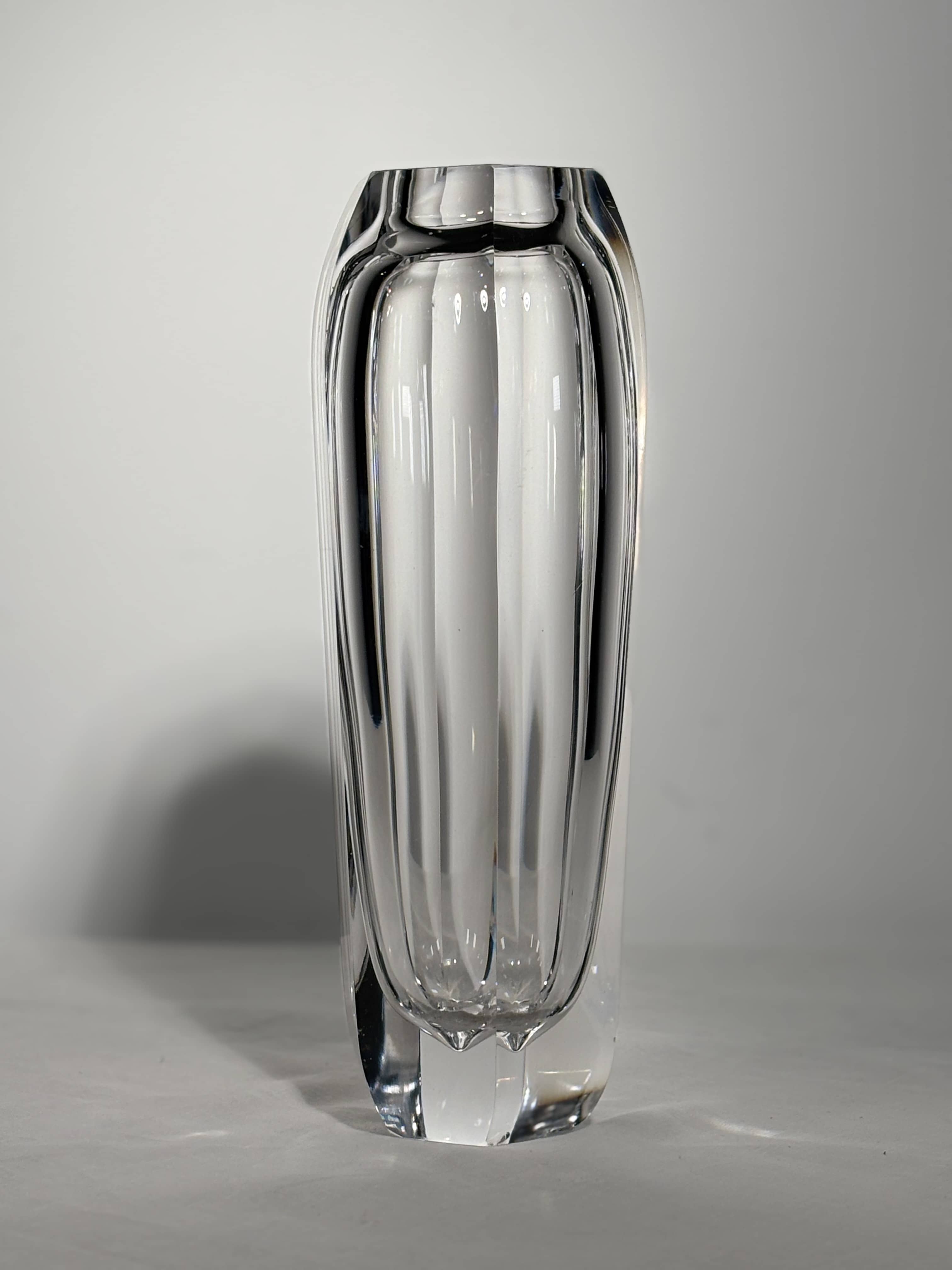
Large blown and cut crystal vase, signed and dated beneath the base Boda 1947. A piece from the Boda Glasbruk manufactory (Sweden), predating the Erik Höglund period and the merger of the manufactories that would give rise to Kosta Boda AB in 1976.
The vase displays a slender form with thick walls, structured by six vertical ribs cut into the mass of the crystal, creating a remarkable optical effect of an inner cylinder suspended within the material.
Colourless crystal of exceptional purity and clarity, of significant weight bearing witness to the high lead content characteristic of the quality productions of this period. In 1947, Boda Glasbruk was still an independent manufactory, producing pieces in the great glassmaking tradition of Småland.
This pre-Höglund period is little documented and signed and dated pieces from it are rare. The formal vocabulary of this vase — architectural rigour, the interplay of mass and transparency, the geometric treatment of surfaces — fits squarely within the nascent Nordic modernism of the post-Second World War years.
Good overall condition for a piece of this age. One will note a small chip on the base as well as two minuscule nibbles on one of the edges, without affecting the aesthetic legibility of the whole.
Engraved with a point beneath the base: Boda 1947
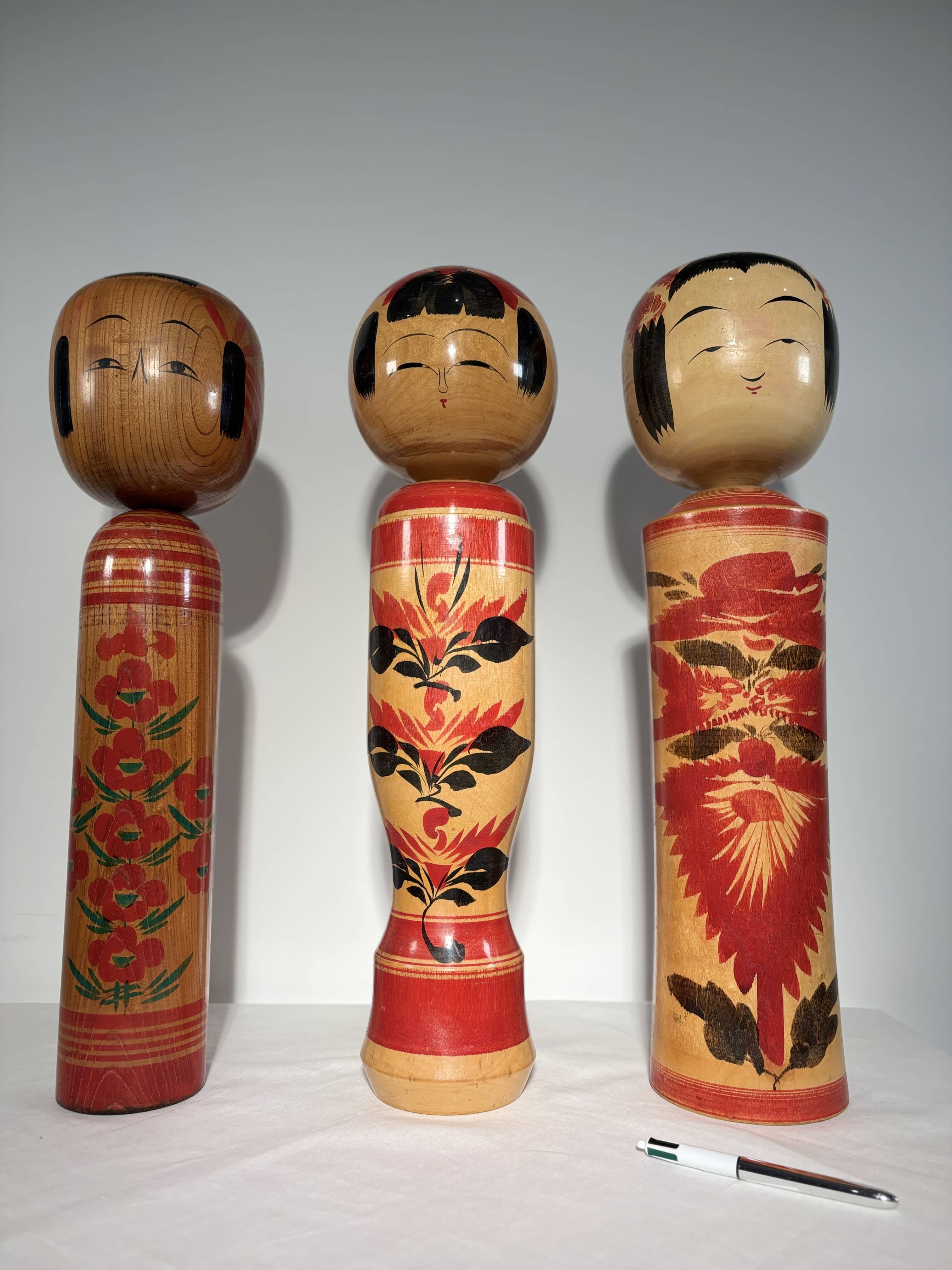
A rare set of three monumental traditional Japanese dolls in turned wood, known as Kokeshi Dentō. Originating from the mountainous Tōhoku region in the north of the archipelago, these sculptures of refined design embody the very essence of the Mingei folk art movement.
Their presence is all the more remarkable here owing to their monumental format (over 60 cm in height), a size rarely encountered for this type of artisanal piece, making them true collector’s objects for interior decoration or architectural display. Each piece is signed or stamped beneath its base by the master turner who fashioned it.
Lot details (from left to right):
1. Yajirō style Kokeshi (H. 60 cm): This model is distinguished by the use of a wood with a strikingly graphic and pronounced natural grain. The cylindrical body is adorned with stylised camellia (tsubaki) motifs, hand-painted in green and red pigments and framed by characteristic concentric lines. Calligraphed signature beneath the base.
2. Naruko style Kokeshi (H. 61 cm): Displaying the cream tone of traditional wood, this piece features a voluminous head assembled according to the traditional technique and an elegantly waisted silhouette. The painted floral decoration is accompanied by broad bands of red pigment at the shoulders and base. Artisan’s seal beneath the base.
3. Large monumental Tōgatta style Kokeshi (H. 62 cm): The centrepiece of the lot through its sheer presence. It bears a powerful design depicting a great radiating chrysanthemum painted in bold strokes. On the reverse, the base carries a long calligraphed honorific inscription indicating that it was awarded the Prize of the Japanese Ministry of Labour, a most prestigious official distinction recognising the high quality and craftsmanship of the artisan.
Fine overall condition for pieces of this size and period. The wood is sound, heavy and stable. The original colours and pigments have remained wonderfully warm, complemented by a superb natural patina. Light marks, minor superficial scratches and slight discolouration consistent with use, entirely in keeping with their age and authenticity.
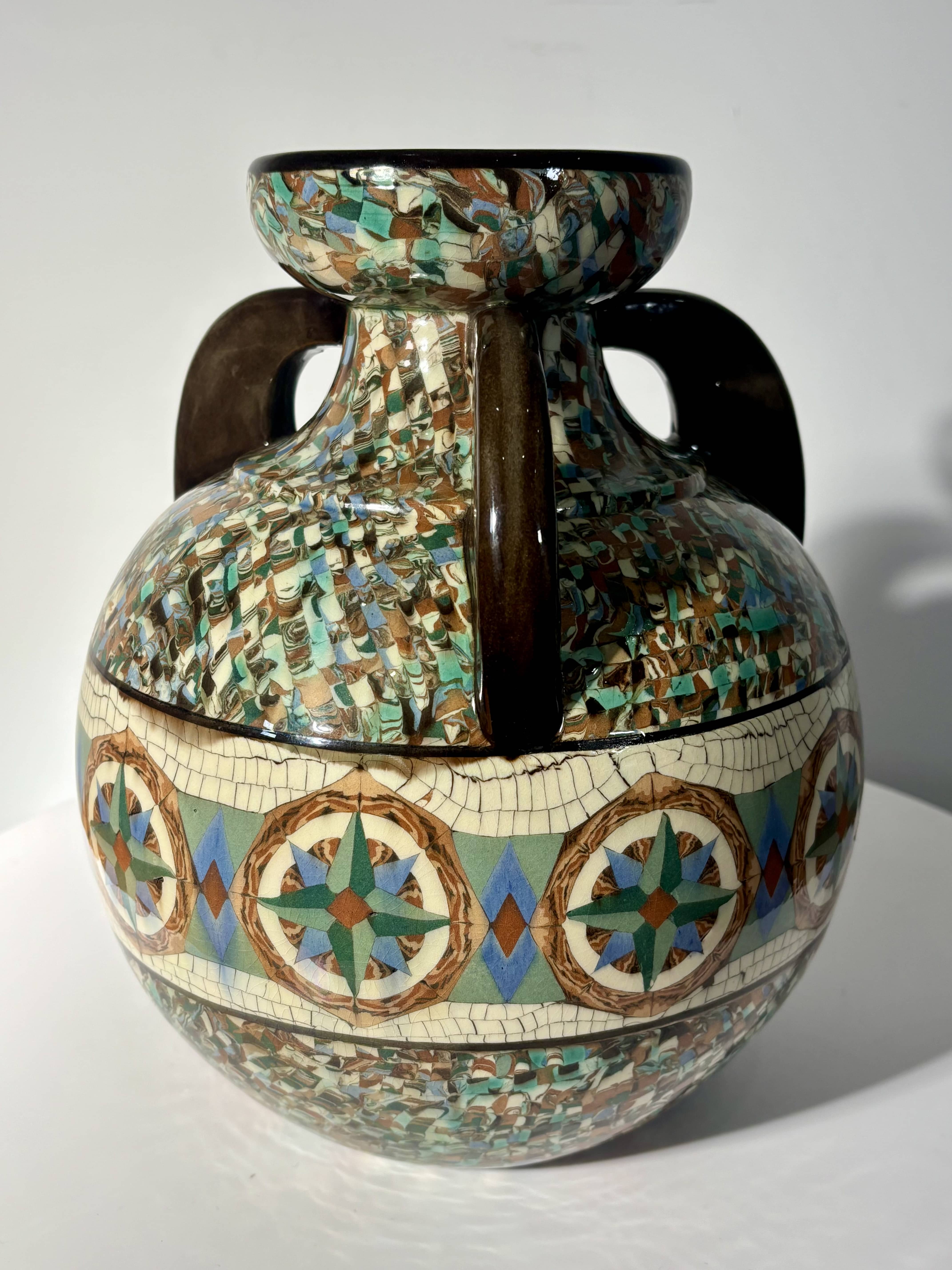
An exceptional and rare three-handled vase by the master ceramicist Jean Gerbino. This piece is a masterful testament to the savoir-faire of Vallauris during its ‘golden age’. The originality of this work lies in the technique of mosaic clays, a unique process developed by Gerbino after fifteen years of research. It is not a painted decoration, but a true marquetry of clays coloured throughout the mass, meticulously assembled prior to throwing. The decoration comprises a wide central frieze featuring polychrome Compass Roses (or Wind Roses), surrounded by intricate registers of chequerboards and organic motifs in turquoise, ochre and umber tones. An exceptional piece of rare dimensions, this vase stands apart from the workshop’s usual production. The precision of the mosaic joins and the refinement of the glaze attest to a very high quality of execution. The piece is in perfect condition, with no chips or hairline cracks. Signature: stamp beneath the base ‘Gerbino’ ‘Vallauris (AM)’. About the artist: Jean Gerbino (1876-1966) is one of the most prestigious names in twentieth-century French ceramics. Grand Prix of the Boulle Exhibition in 1931, he created a style instantly recognisable, blending the art of ancient mosaic with modernity of form. France, 20th century, circa 1950.
Galerie Bleu Magenta brings together a singular selection of antiques, vintage design and decorative arts, ranging from 18th-century furniture to 1970s Murano lighting, with signed 20th-century ceramics in between. Each piece is chosen with exacting care for its aesthetic value, its authenticity and its ability to converse with contemporary interiors. The gallery champions a vision of sustainable, responsible luxury, where beauty circulates, is passed on and grows richer over time. Exploring our catalogue, you will discover antique furniture, baroque mirrors, Italian glass, period seating, decorative objects and rare creations, all selected for their refinement and singularity.

I recently bought a handcrafted lamp from Bleu Magenta and I am completely won over! The unique design and exceptional quality really impressed me. The customer service was also flawless, with personalised advice and quick delivery.
I found the perfect gift for my best friend's birthday: a set of handmade ceramic vases. Not only were they beautiful, but the story behind each creation added a personal touch that made my gift even more special!