Our Collection
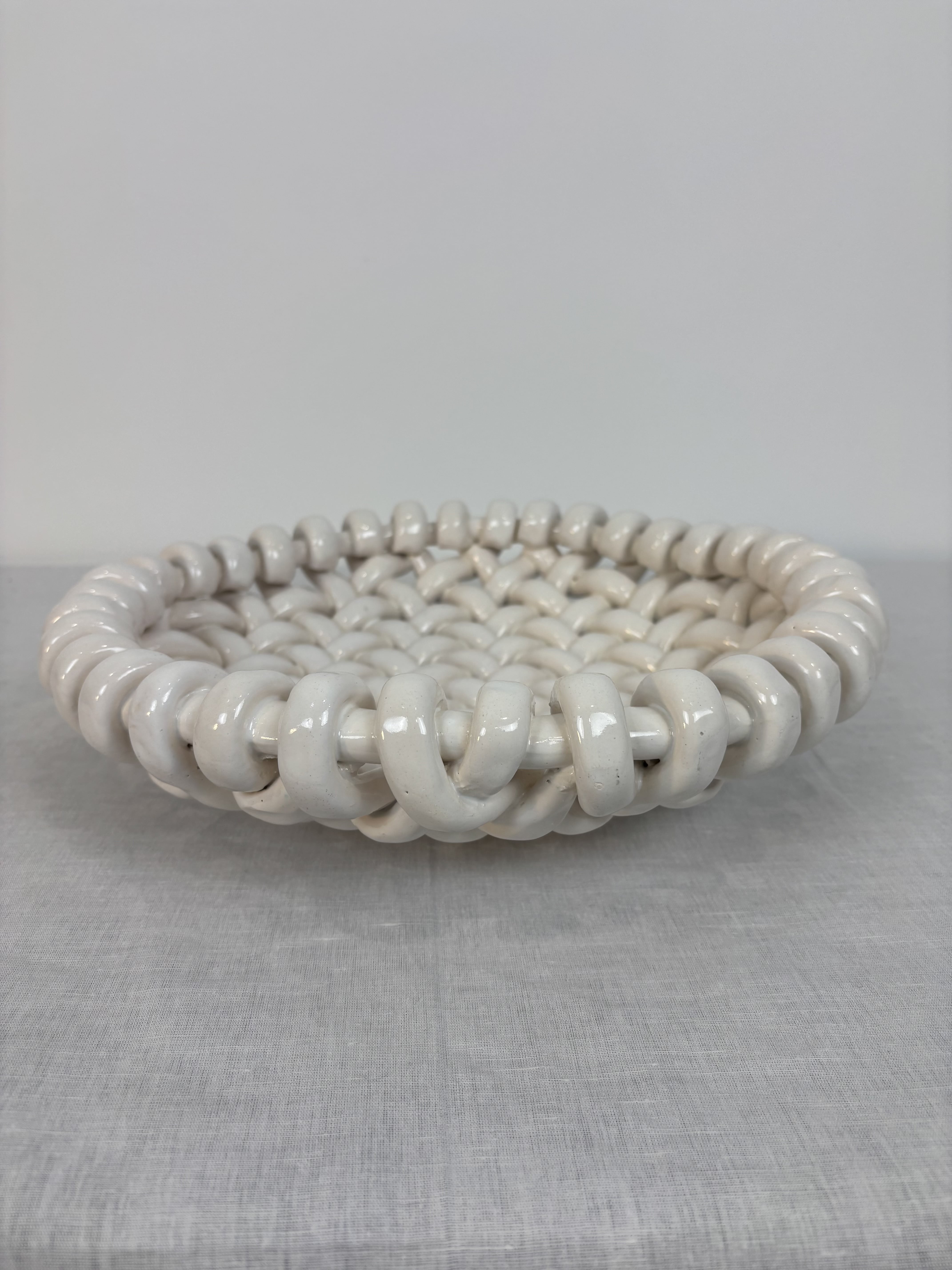
Jérôme Massier (1850-1916), Vallauris. A highly decorative round openwork basket in white-glazed ceramic with a fine glossy glaze. Generous and elegant form, finely pierced in the manner of regular basket-weave. Signed in the hollow beneath the base on the flattened edge: "Jérôme Massier Vallauris". Very good general condition. Weight 2.850 kg.
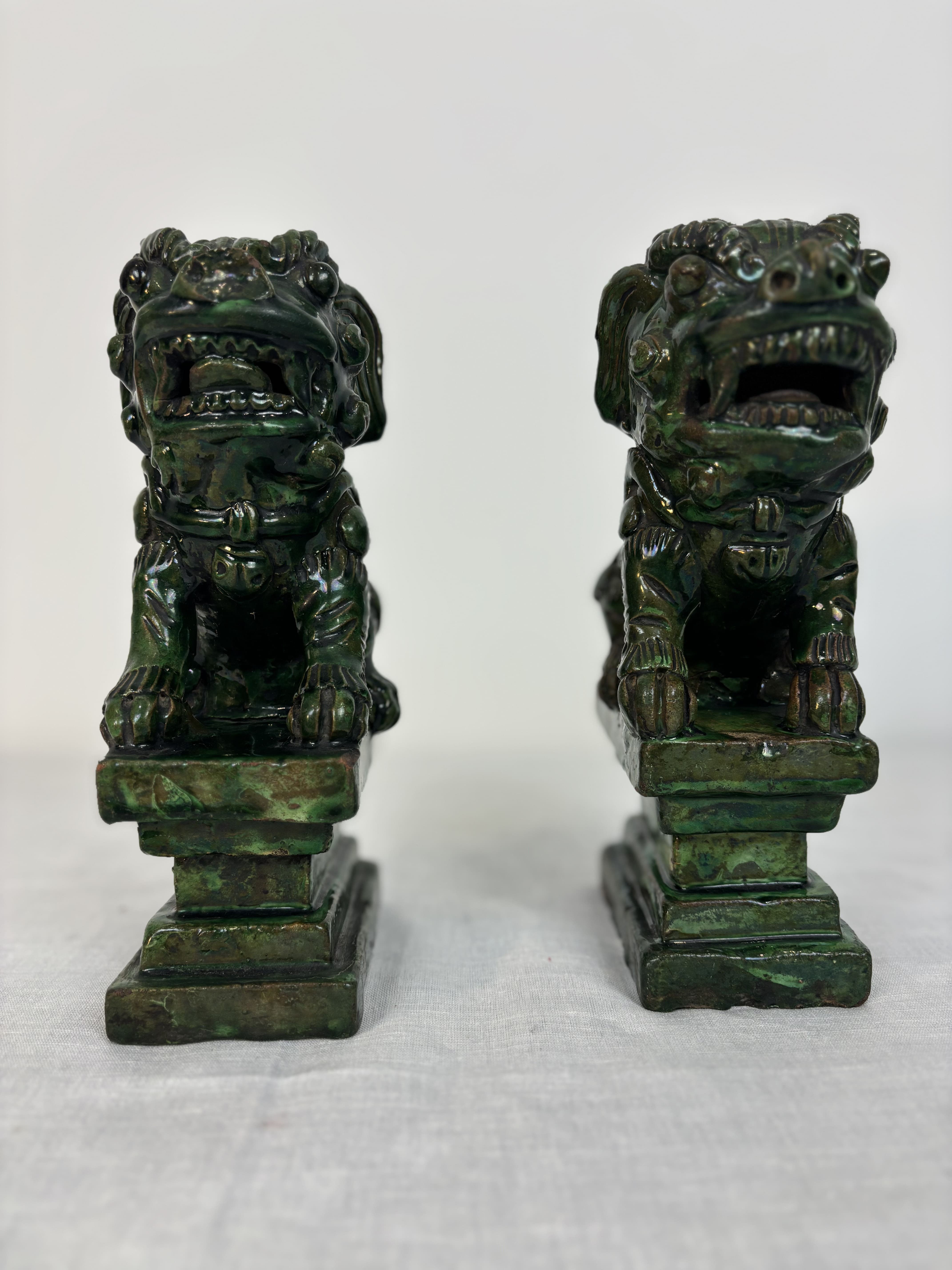
A pair of Chinese guardian Foo dogs in deep-green-glazed ceramic. These traditional figures symbolising protection were once placed at the entrance of dwellings and temples to ward off malevolent influences. Their expressive bearing, the stylised treatment of the manes and decorative volutes lend them great character. The architectural bases, formed of stepped tiers, underline their stability and their role as sentinels. The green glaze displays subtle nuances and a slight shimmer, accentuating the lively effect of the surface. The bases still bear an old red wax seal, witness to an early export. Fine patina.
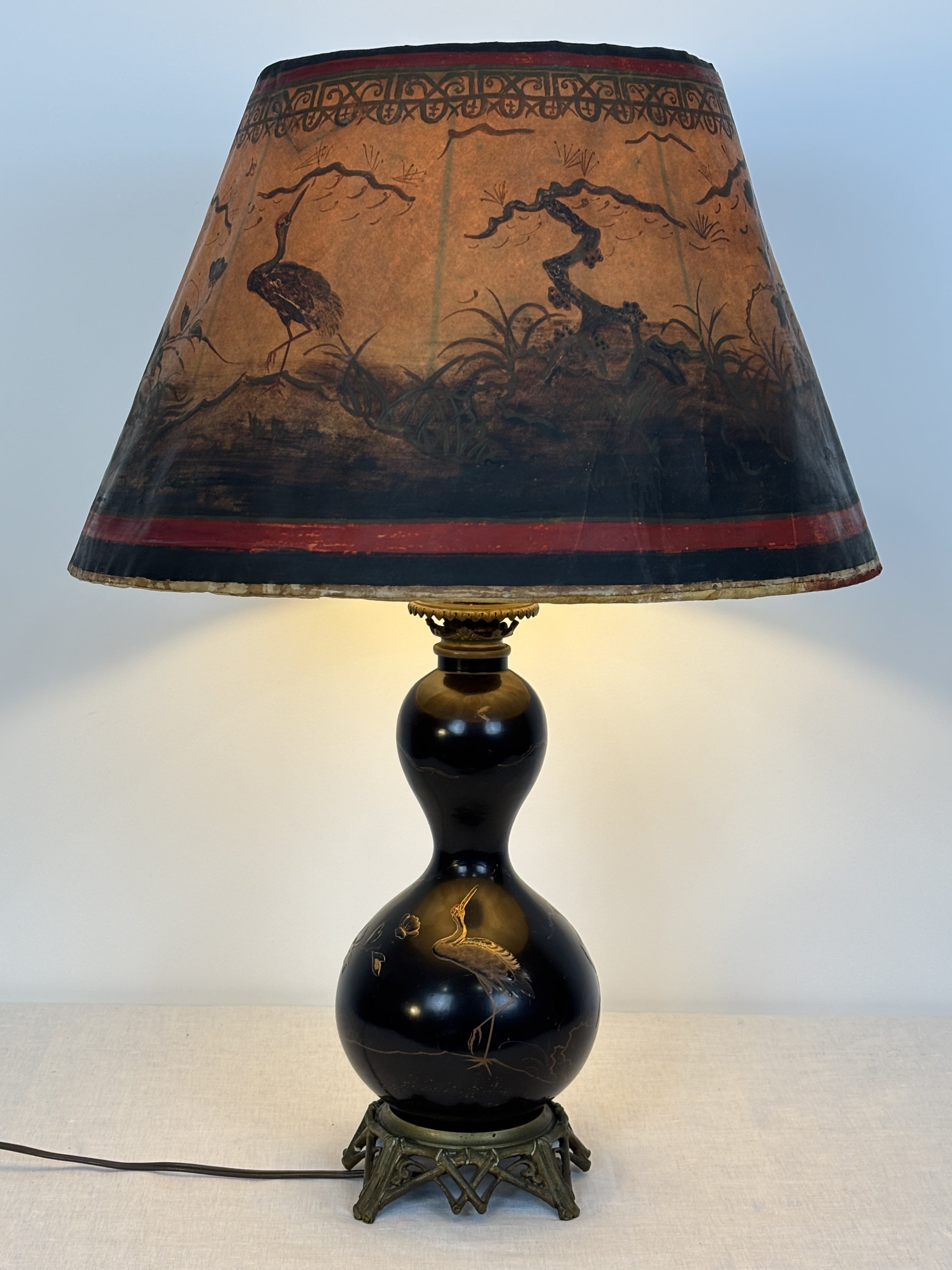
A refined lamp in black-lacquered metal with gilt decoration of cranes — symbols of longevity and happiness — and stylised foliage. Originally an oil lamp mounted on a bronze base in the Japoniste style. The body, in the double-gourd form typical of Japanese aesthetics, is finely adorned with hand-painted scenes: elegant cranes, flowers and symbolic rocks. The original lampshade, in hand-painted paper marouflé onto canvas, reprises this naturalist motif with stylised cranes and trees. A decorative and collector's piece. Period: late 19th to early 20th century.
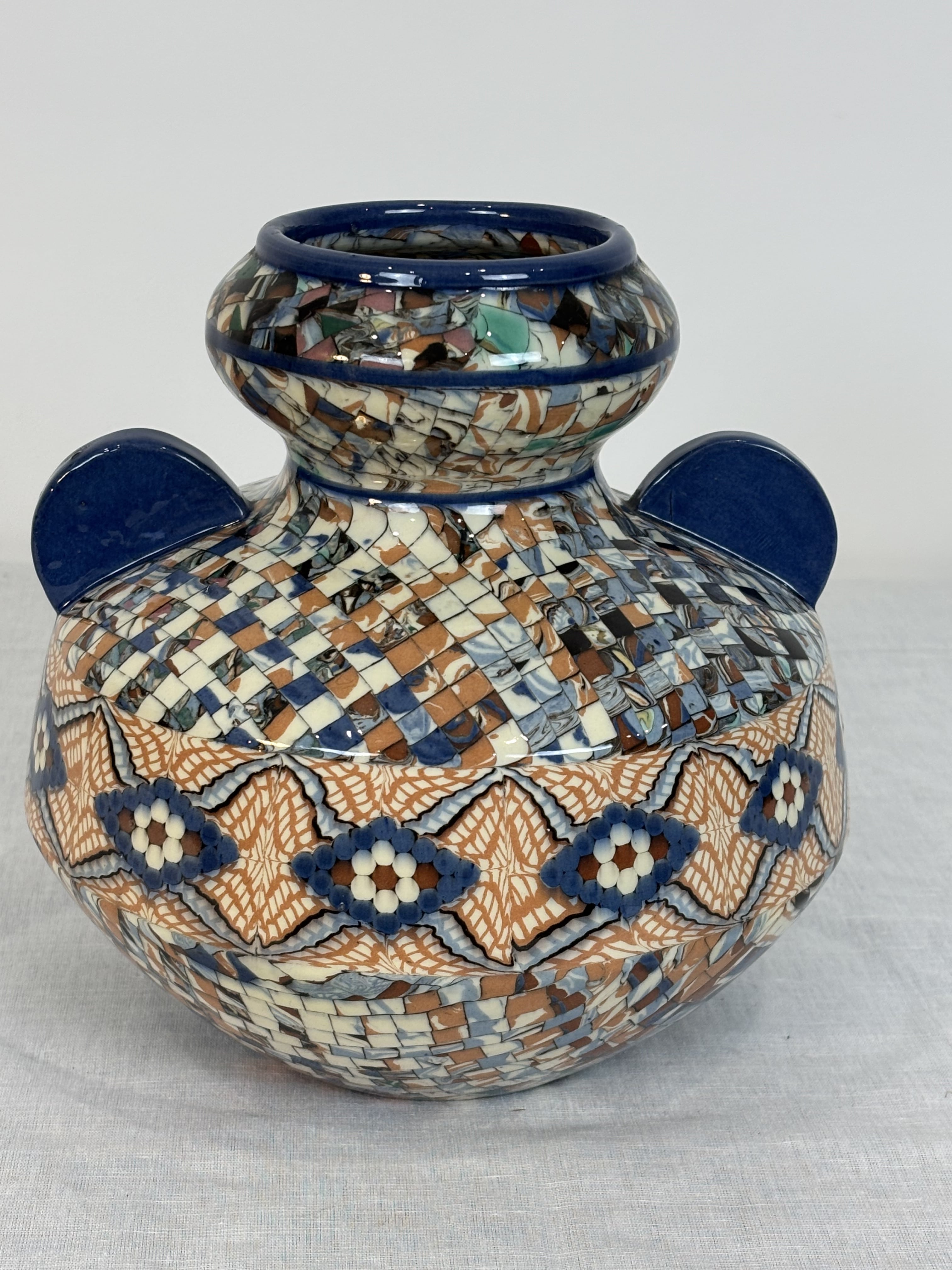
Mosaic by Gerbino, Jean Gerbino (1876-1966). A large bulbous vase with lugs in fine tones of blue, beige and light brown, with mosaic frieze motifs. Mosaic mixed-clay technique. Very good condition. Signed in the hollow on the base: Gerbino, Vallauris / c. 1930.
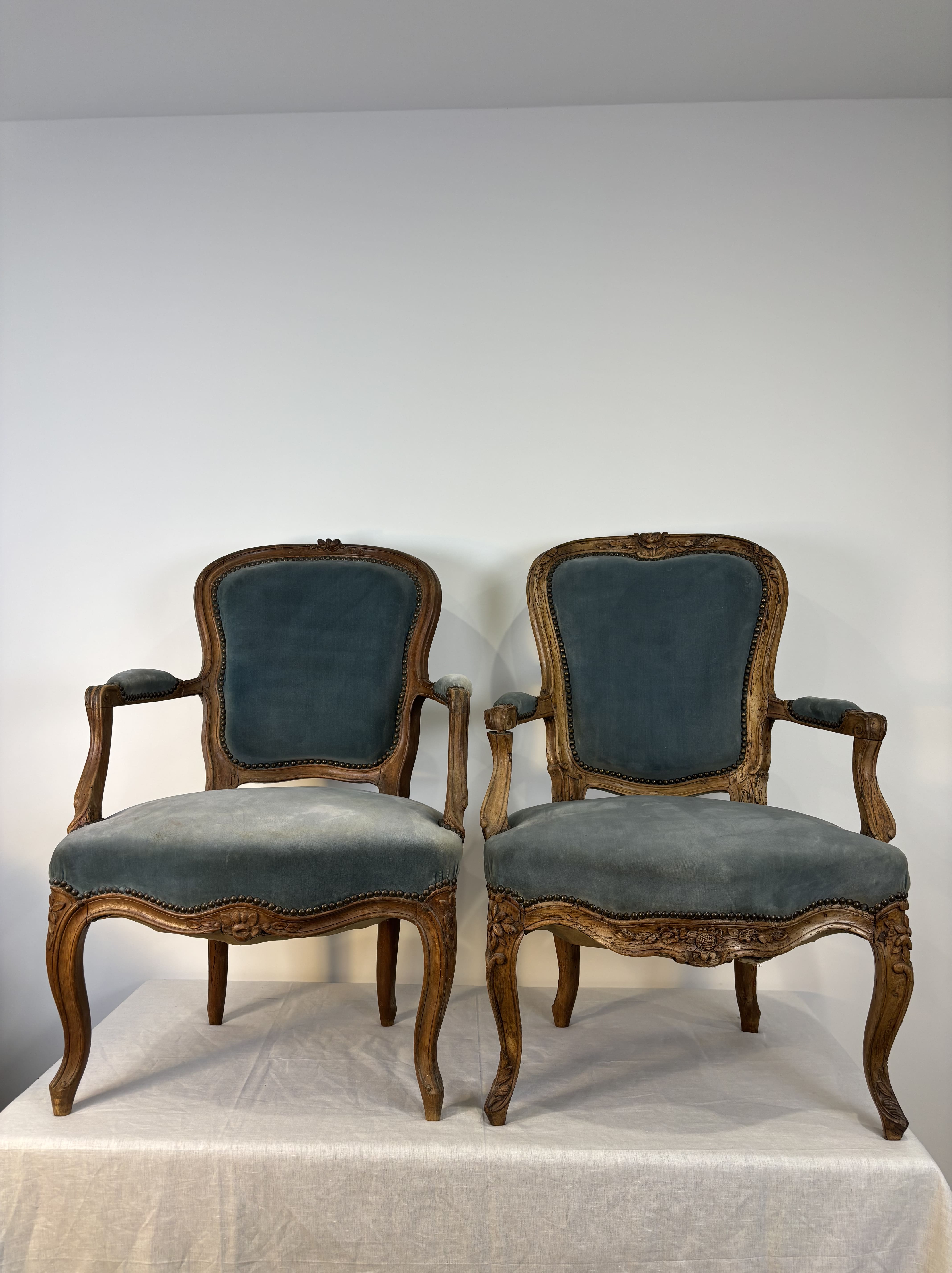
An elegant 'matched' pair of cabriolet armchairs from the Louis XV period with finely carved floral decoration, violin-shaped backs, padded-cuff armrests and cabriole legs.
Seat and back upholstered in blue velvet. Slight wear consistent with use visible on one of the seats (see photo).
French work.
18th century.
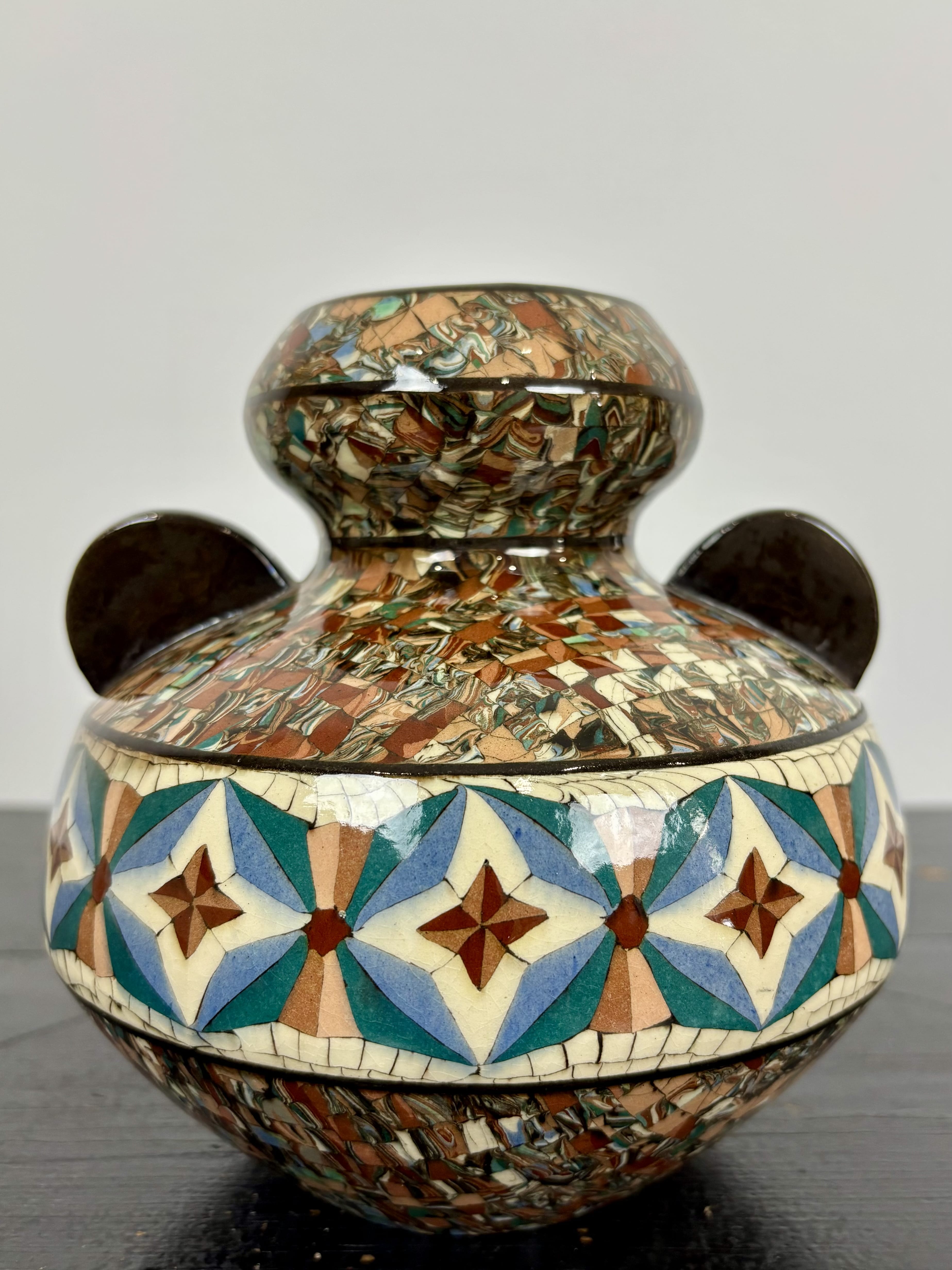
Mosaic by Gerbino, Jean Gerbino (1876-1966). A fine bulbous vase with lugs in fine tones of brown, beige and blue/green, with mosaic frieze motifs. Mosaic mixed-clay technique. Very good condition. Signed in the hollow on the base: Gerbino, Vallauris. Circa 1940-1950.

An original intaglio print by Leonor Fini, hand-signed in pencil by the artist, lower right. Impression on fine-quality Japon paper, with a delicate moiré aspect. Well-marked platemark, clean impression, revealing a careful printing. Presented in a black and silvered wood frame, between two glass plates. Very fine condition.
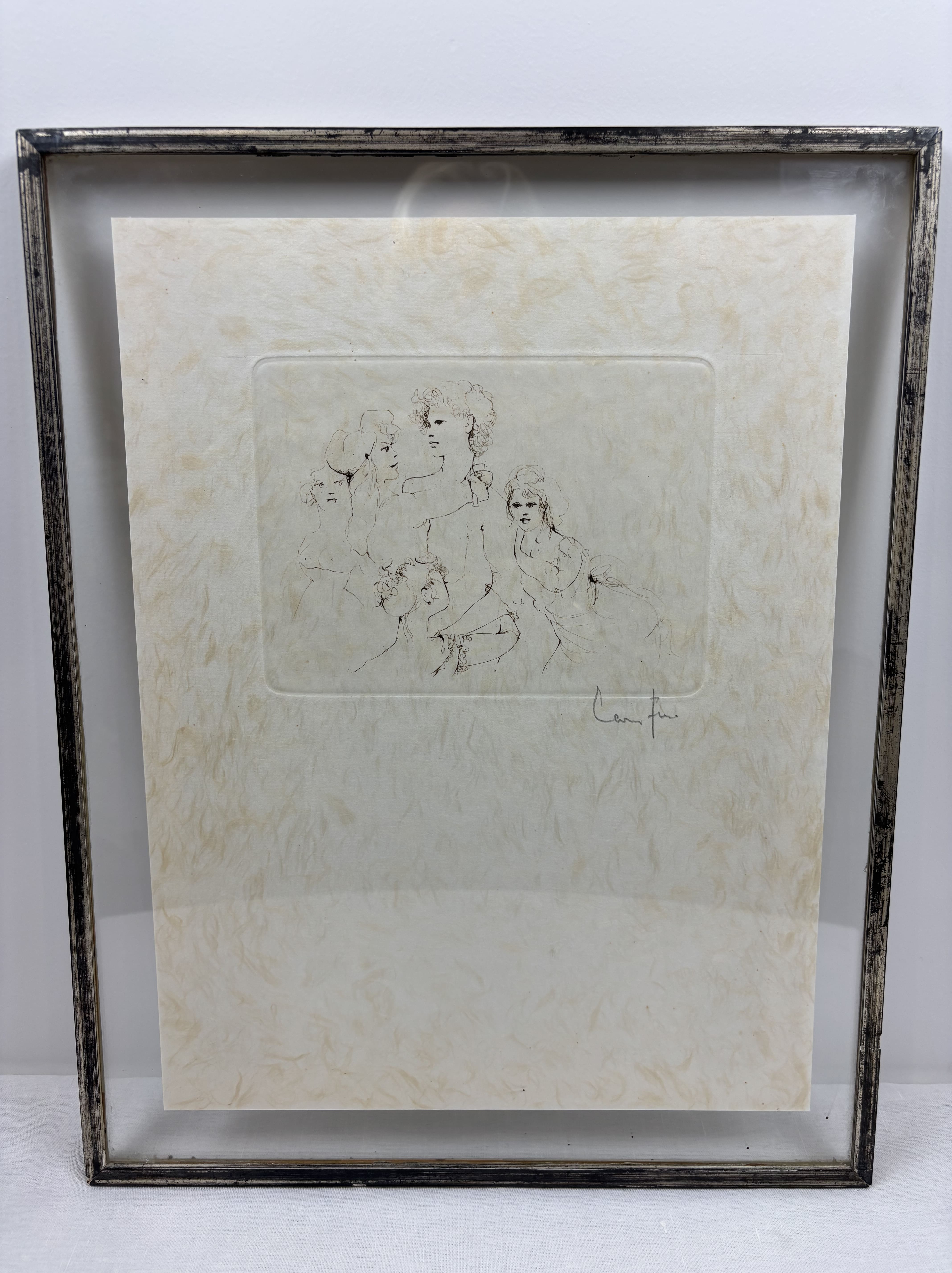
An original intaglio print by Leonor Fini, hand-signed in pencil by the artist, lower right. This composition depicts a group of young people. Impression on fine-quality Japon paper, with a delicate moiré aspect. Well-marked platemark, clean impression, revealing a careful printing. Presented in a black and silvered wood frame, between two glass plates. Very fine condition.
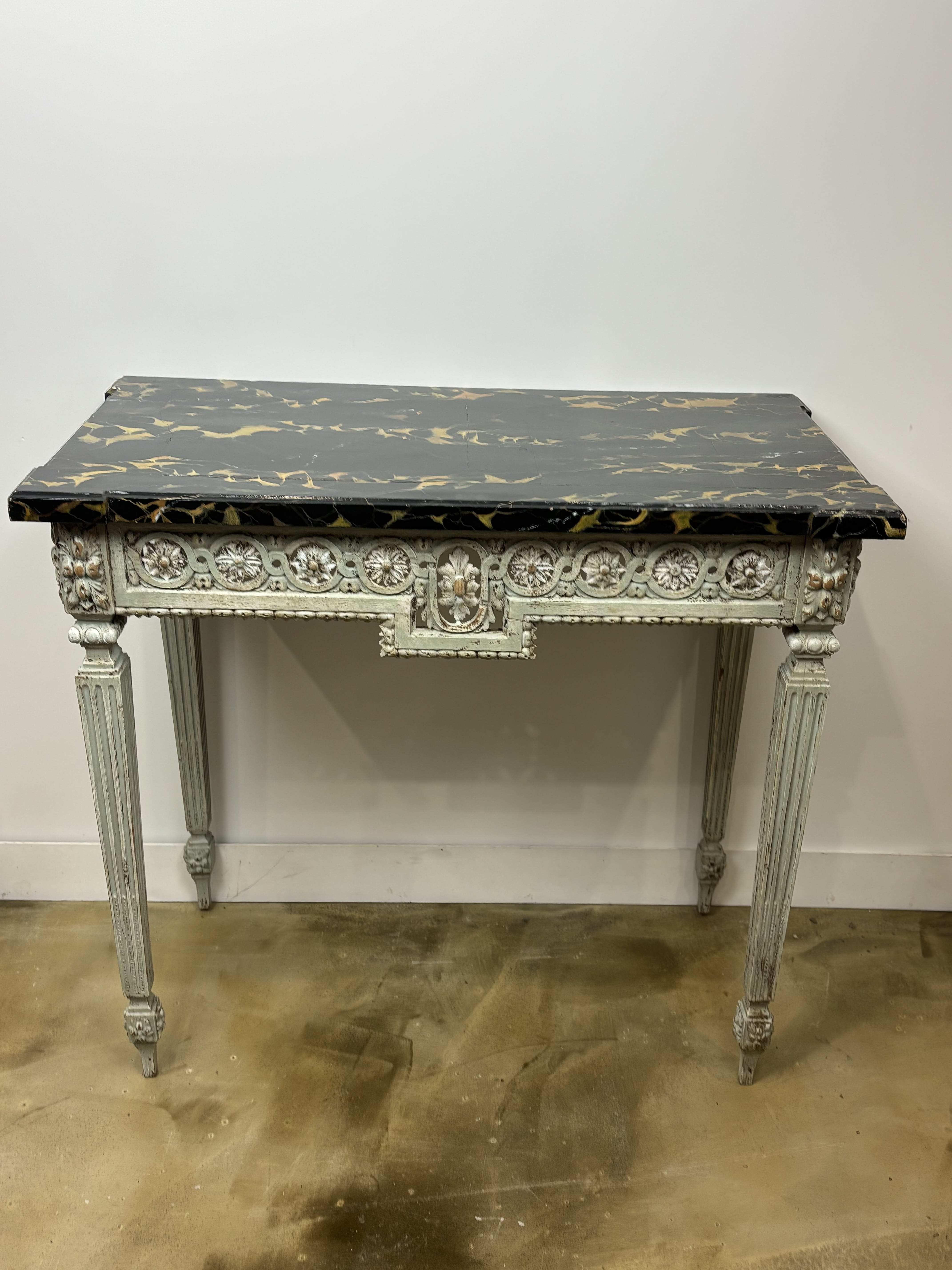
An elegant console in carved wood retaining its early patina, typical of Louis XVI style, early 19th century (circa 1800-1820). It rests on four tapered and fluted legs terminating in transition blocks adorned with carved florettes. The apron displays a refined decoration of rosettes and openwork garlands, together with a central applied motif. The top, probably an early addition, in wood painted to imitate black marble veined with golden brown, executed in the 19th century. This marbling lends the whole a very elegant decorative presence. Good condition. Early patina.

An astonishing and striking large model of the Eiffel Tower, entirely executed in fretwork and polychrome wood. This work of patience and artisanal virtuosity is distinguished by the fineness of its openwork decorations, its architectural elegance and its numerous hand-painted details. The openwork façades are enriched with geometric motifs enhanced with vivid colours — red, blue, green — lending the whole a naïve and authentic charm. Small "RF" (République Française) escutcheons painted on either side are notable, underlining the patriotic character of the work. This tower is composed of two distinct parts:
. The base with its four pillars
. The tower proper which fits into the base
This piece is probably a showcase piece or a commemorative work, executed for the Paris World's Fair (1889) or in the following decades, when the Eiffel Tower had become a national symbol. A rare and striking piece by its scale and decorative quality. Ideal for a folk art collection, a shop display or an evocative Belle Époque setting.
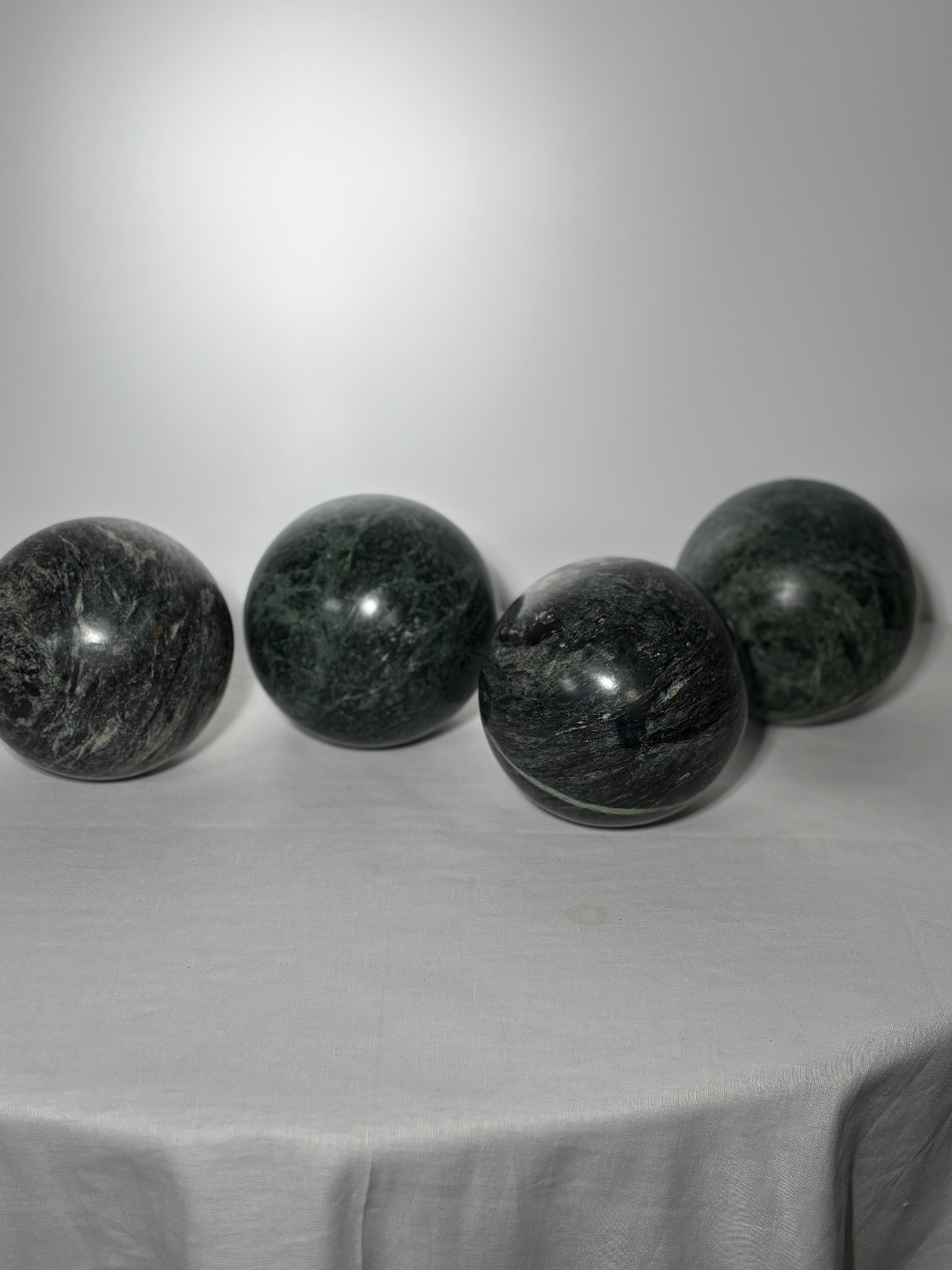
An elegant set of four large polished green marble spheres, with subtle variations in shades of deep green, punctuated by natural white or emerald veins. Each measures 15 cm in diameter and weighs between 4.500 and 4.800 kg, highlighting the density and quality of these pieces. Ideal as a centrepiece on a console, in a contemporary bookcase or as a mineral sculpture. Period: 20th century.
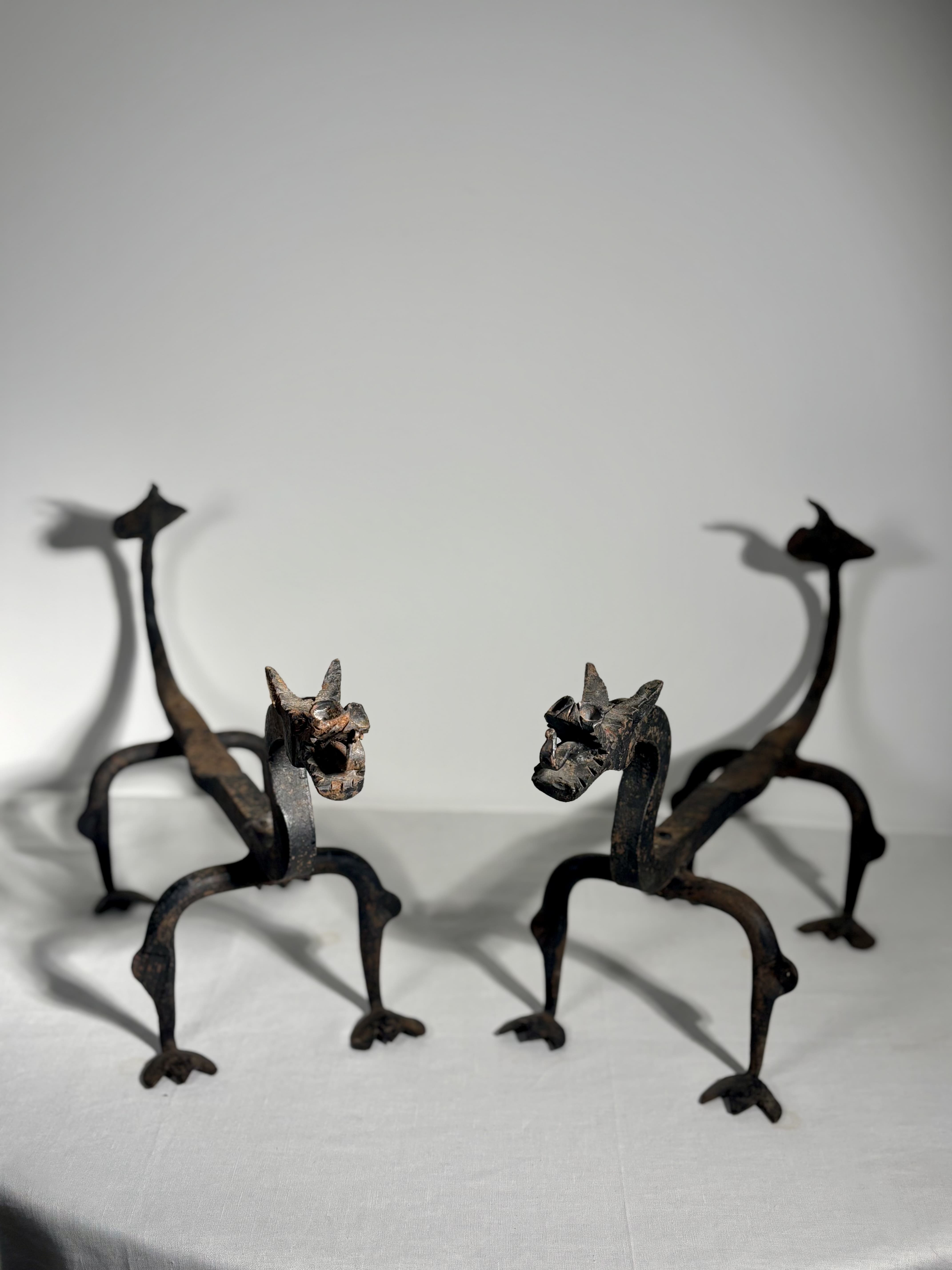
A pair of wrought-iron andirons figuring fantastical dragons with slender silhouettes and ferocious expressions. Work of great forging quality. From Bruges in Belgium. Each dragon presents a finely worked head, scrolled tongue and pronounced teeth, a sinuous body resting on four clawed paws and a long tail raised to the rear. These andirons combine function and aesthetic, serving to hold logs in the hearth while imposing a strong decorative presence. Even early patina. Weight: 7.300 kg the pair.
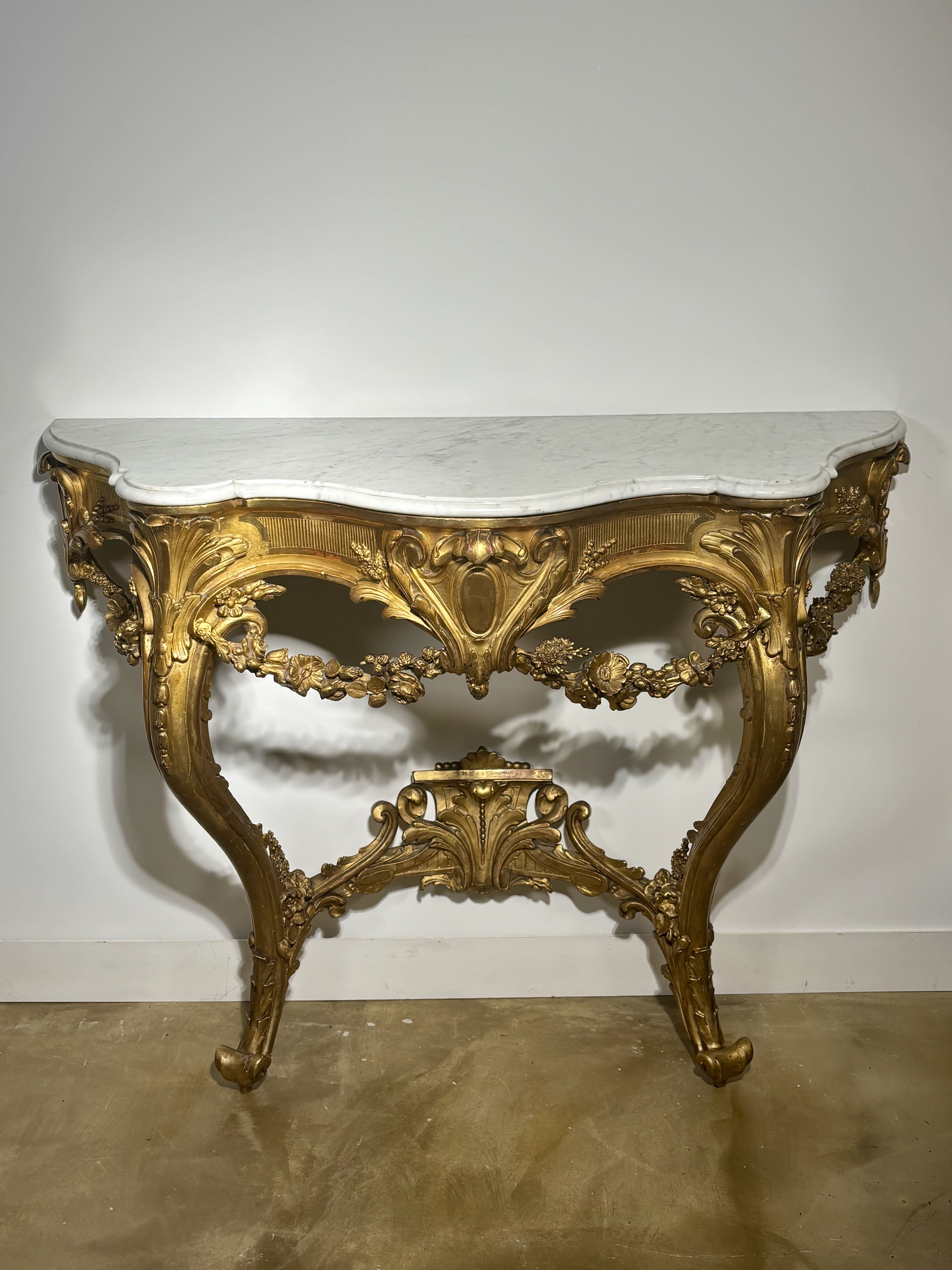
A console in finely carved and giltwood, with Rocaille decoration of scrollwork, acanthus leaves, central cartouche, shells and flower garlands. Cabriole base joined by an openwork foliate stretcher. Shaped white marble top with scrolled moulding. The gilding showing the red bole in places. French work, 19th century.
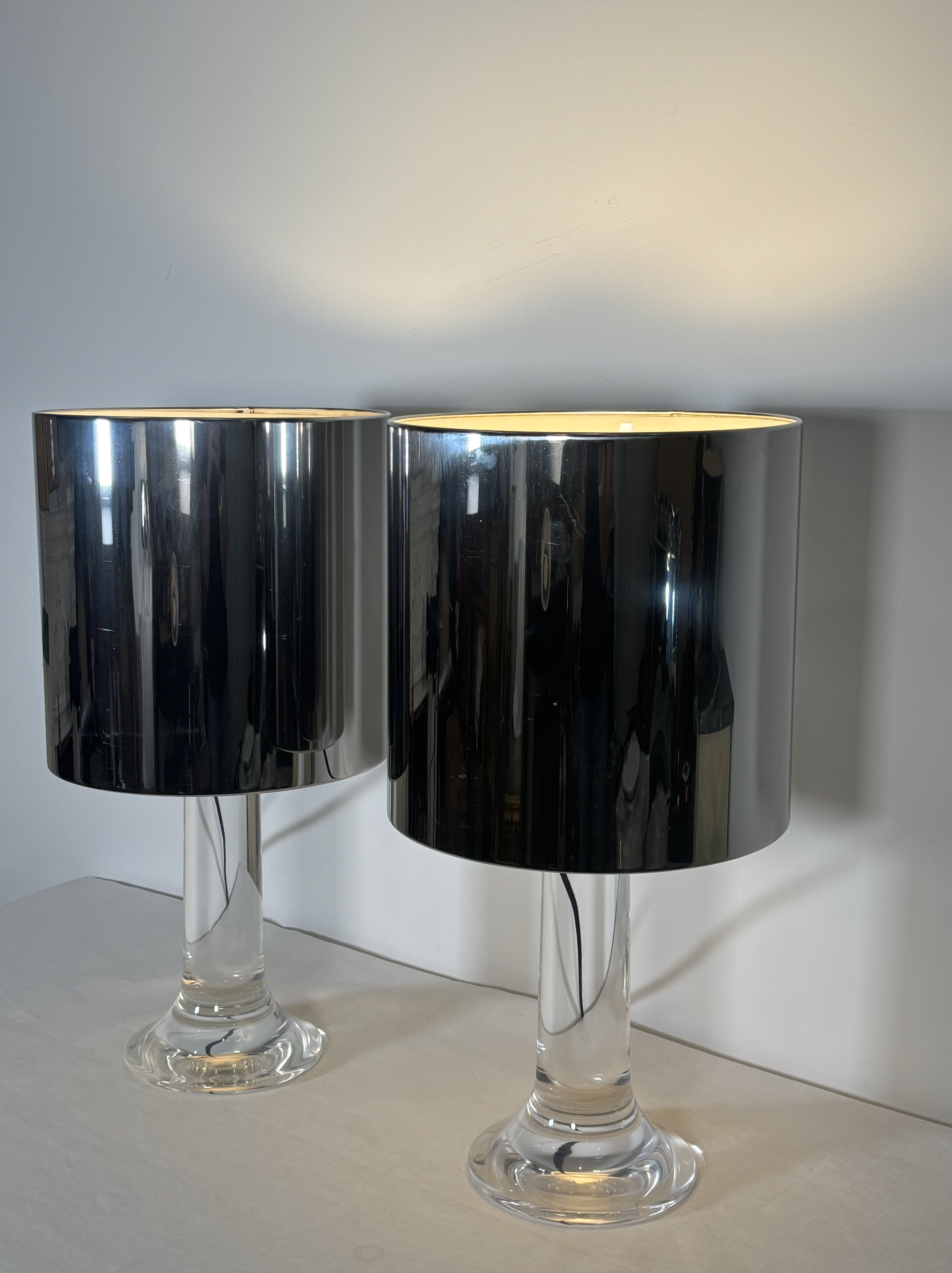
An elegant pair of table lamps produced by Harvey Guzzini, the celebrated Italian design firm of the 1960s-1970s. Their emblematic silhouette combines a tulip base in transparent plexiglass with a cylindrical chrome-metallic shade with a clear interior, offering both a diffuse and warm light. A true manifesto of Italian Space Age design, this model — rare as a pair — perfectly embodies the refined and futuristic aesthetic of Harvey Guzzini. It integrates equally well into a contemporary décor or a high-end vintage interior. Very good condition, minor signs of use consistent with age. Recently rewired to EU standards.
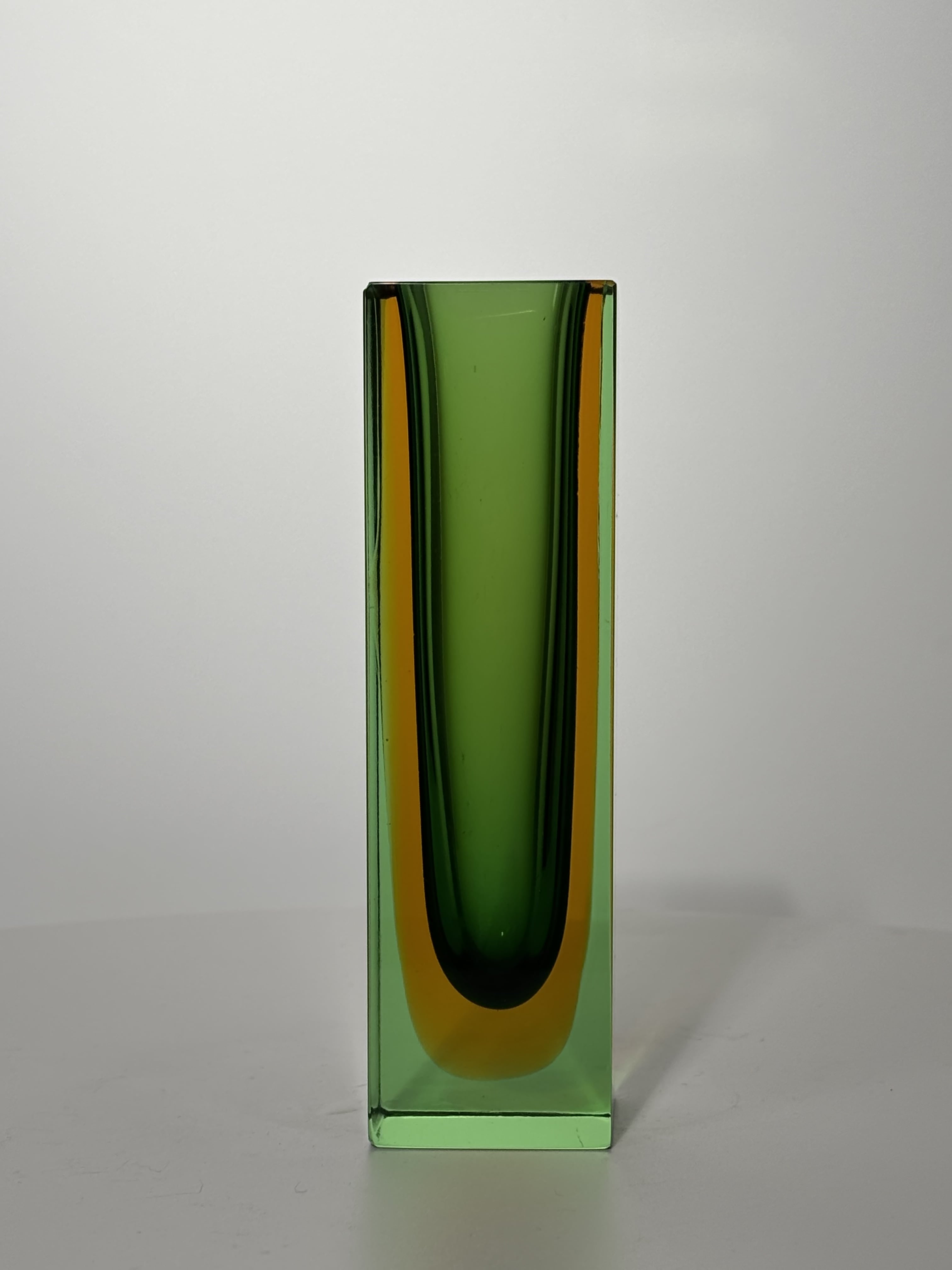
An elegant vase in Murano glass, executed using the sommerso technique. Its decoration is composed of superposed layers of glass, an emerald-green core, accentuated by a warm amber tone. The prismatic form, with geometric lines and a slightly softened square aperture, reflects the Modernist aesthetic of Murano in the 1960s-1970s.
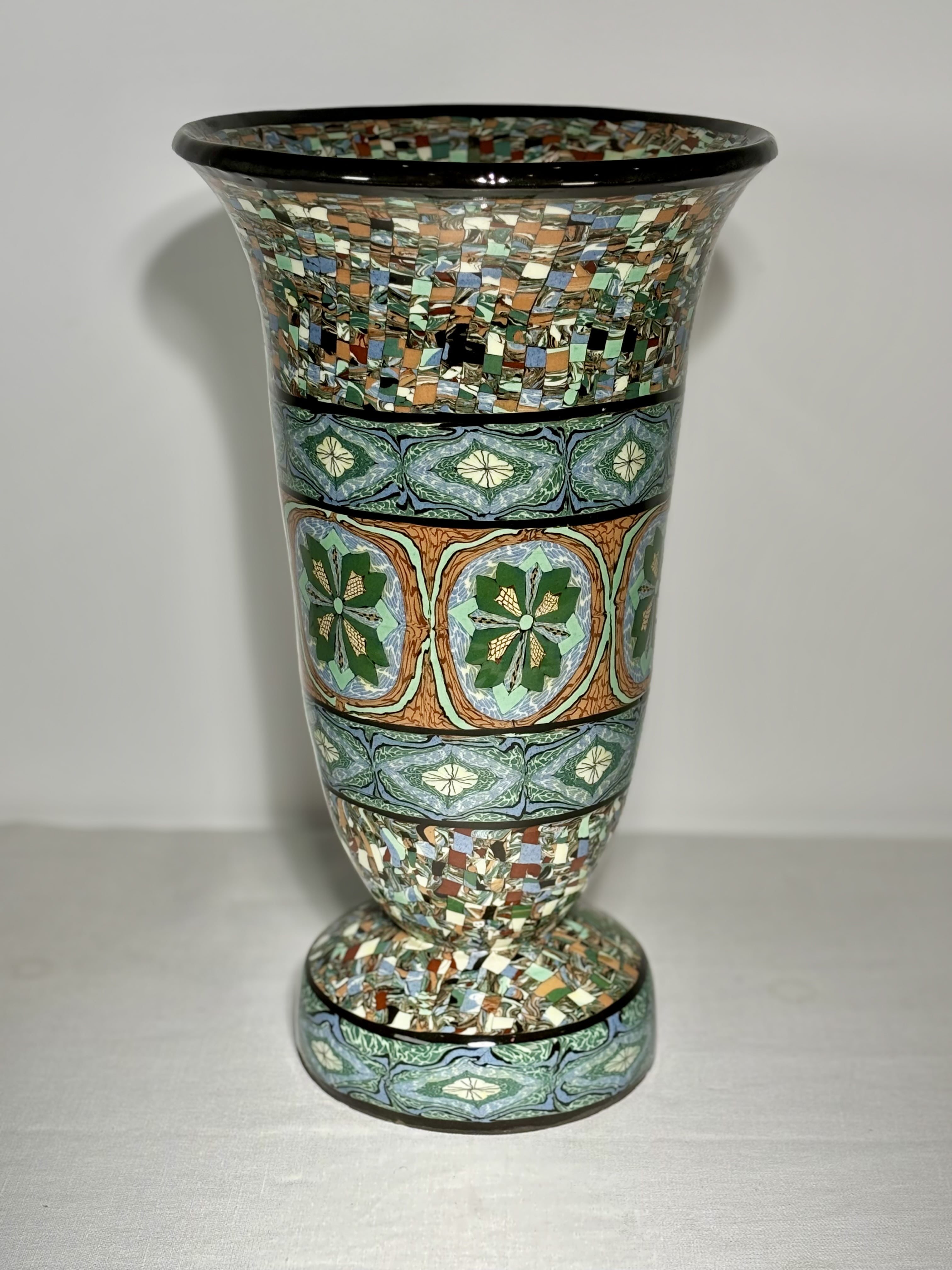
A large tulip vase in mixed-clay with polychrome decoration of stylised geometric floral motif friezes. Characteristic work of Jean Gerbino, the master ceramicist established in Vallauris, inventor of this striking technique consisting of composing decorations by assembling coloured clays within the mass. Each unique piece reveals the virtuosity of Gerbino's craftsmanship in Vallauris in the 1940s-1960s. Signed "Gerbino Vallauris" beneath the base.

An elegant pair of vases of architectural form, executed in stoneware and enhanced with an ash glaze. Each piece is adorned with a decorative frieze incised with a stylus that emphasises the verticality of the lines. 20th century.
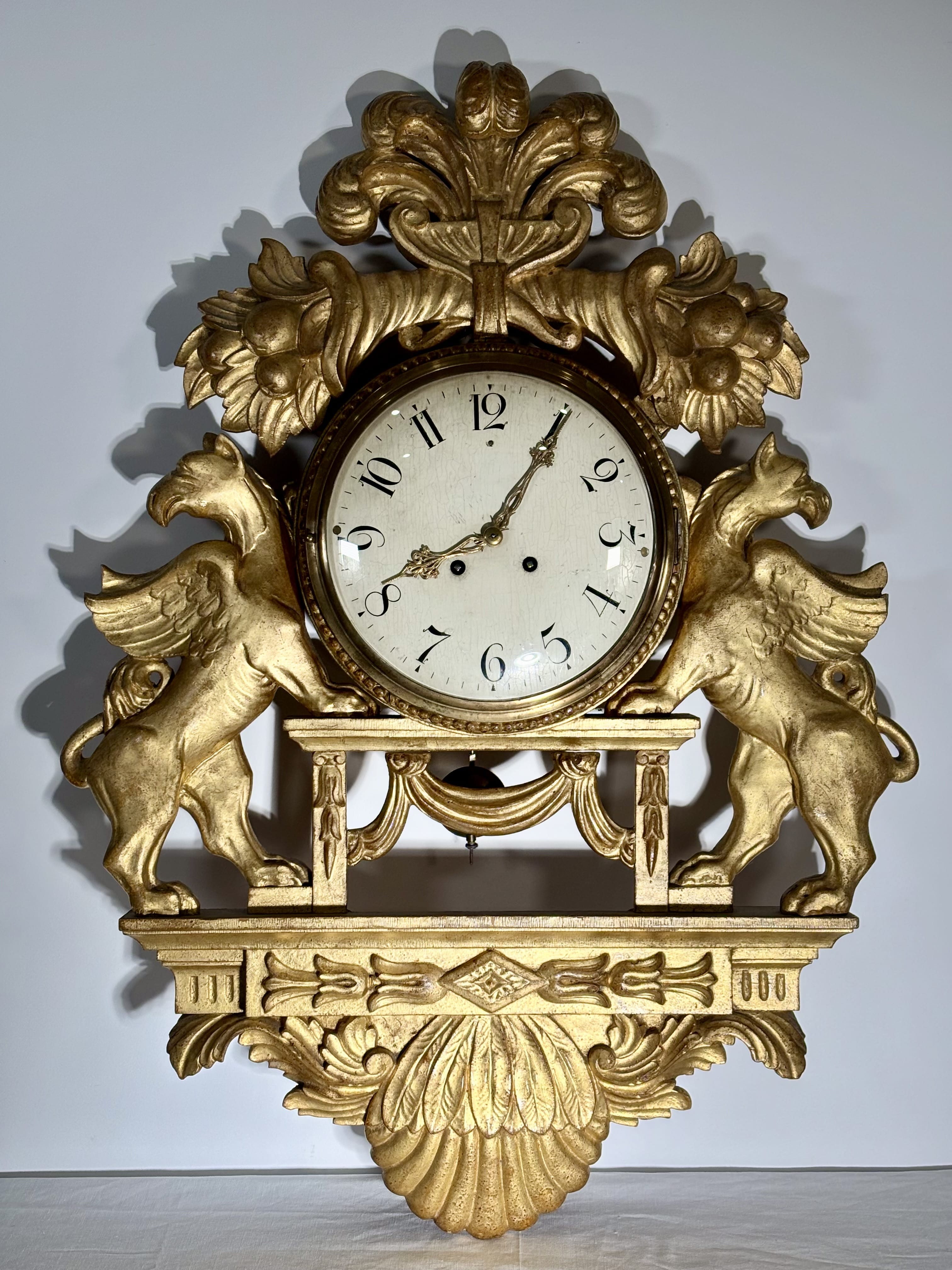
A striking 19th-century wall clock combining ornamental richness and horological precision. The finely carved and gold-leaf gilded case displays an exceptional decoration: two winged griffins flanking an enamelled dial, a stylised palmette at the top, columnettes, floral garlands and a Rocaille shell in the lower section. The whole evokes the Neoclassical aesthetic. Functional mechanical pendulum movement, signed Lenzkirch AG (Germany), numbered 92833. Wall mount signed AUG Stenman — Eskilstuna (Sweden), renowned late 19th-century ironwork. Late 19th century.
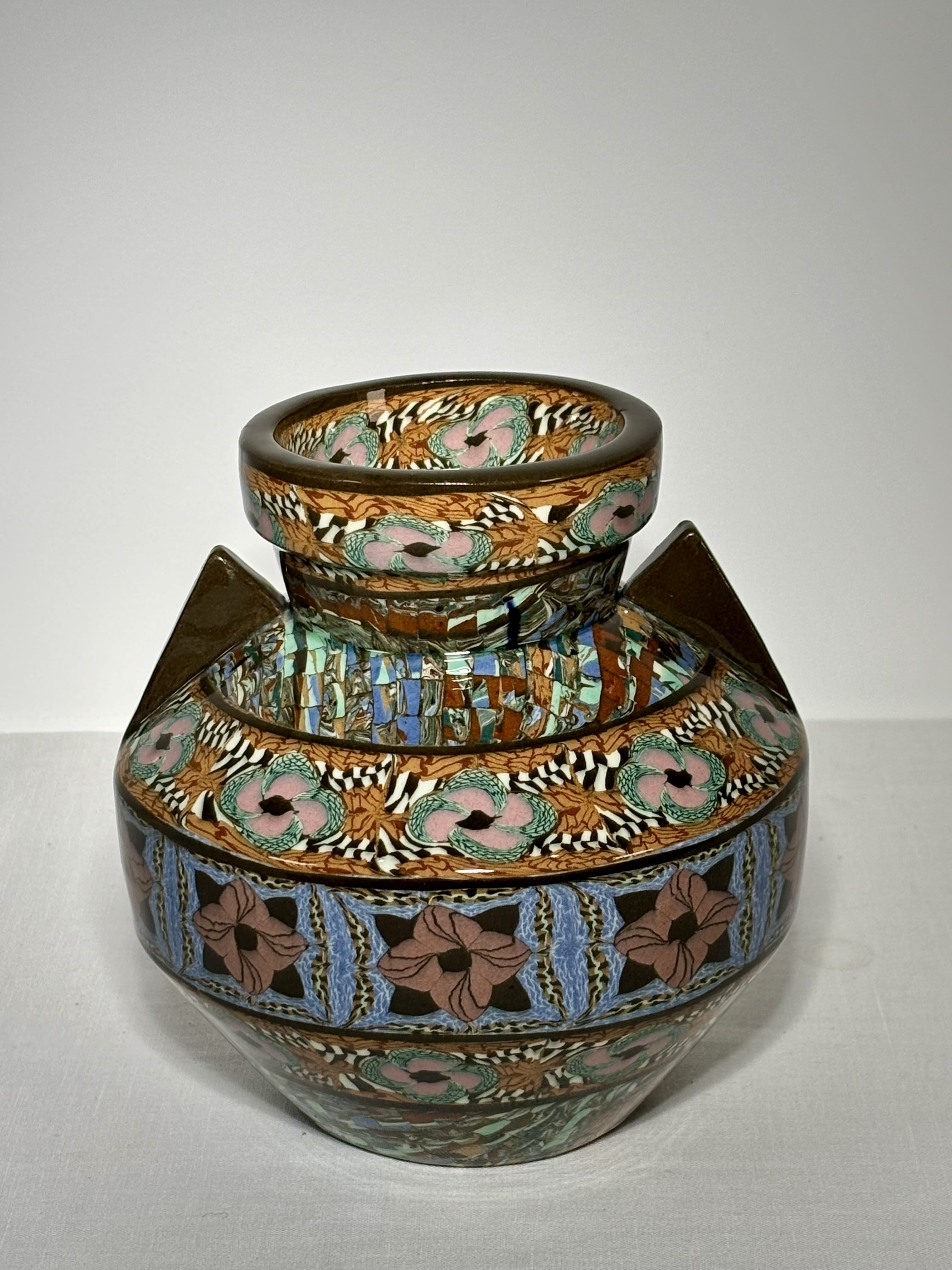
A baluster-form vase in polychrome mixed-clay with two triangular handles, signed Gerbino Vallauris beneath the base. It displays the mosaic decoration distinctive of Jean Gerbino's workshop, the master ceramicist established in Vallauris (France), known for his original "mosaic of coloured clays" technique, developed in the 1930s. The piece offers a fine harmony of warm and cool tones, alternating stylised floral motifs, geometric scrolls and interlacings of coloured clays. The contrasts between blue, green, powder pink and browns bring a decorative richness characteristic of the Gerbino savoir-faire. The vase adopts a bellied form with constricted everted neck, flanked by two rectangular handles giving it a both traditional and Modernist appearance.
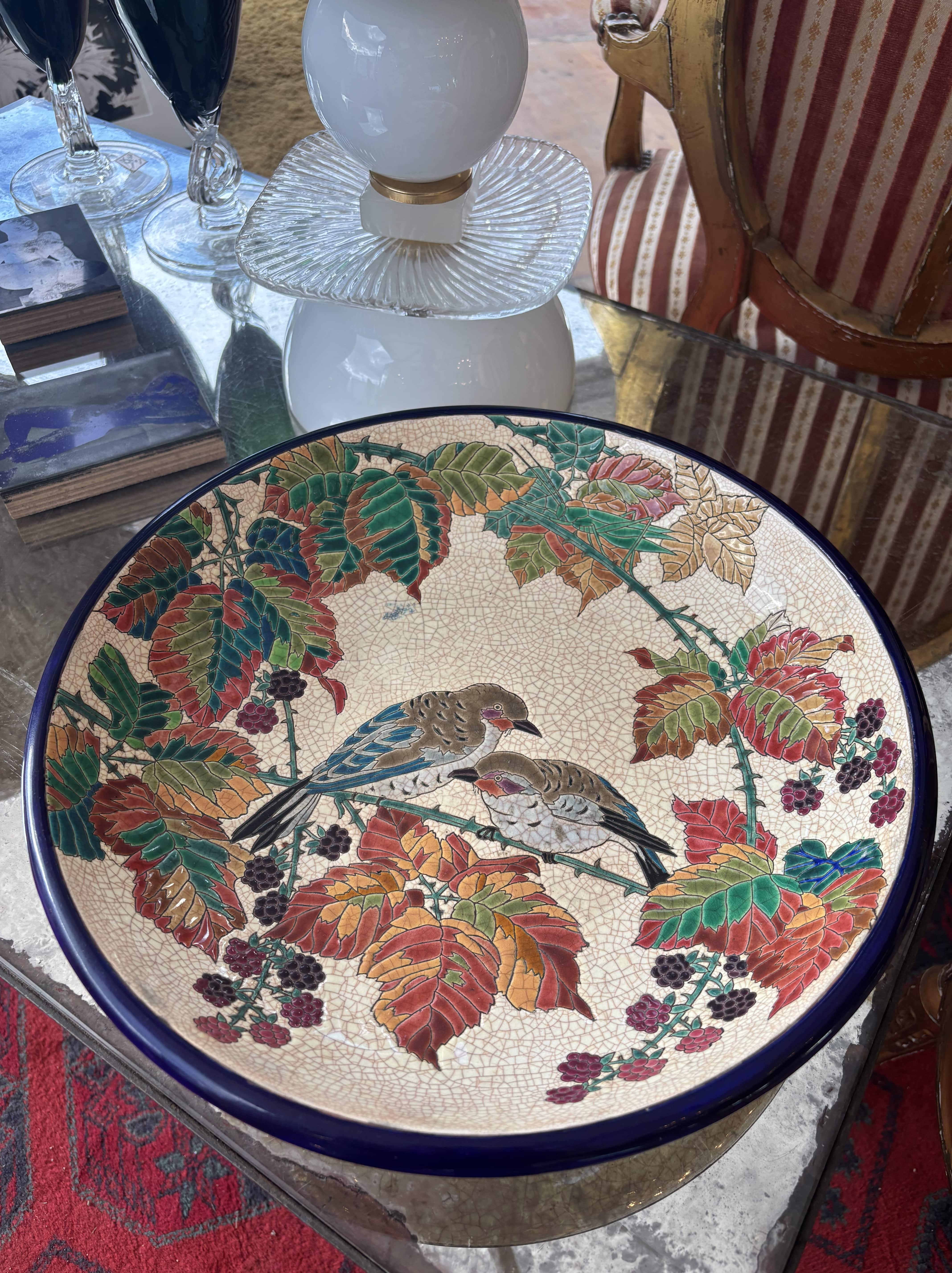
A large circular plate in cloisonné Longwy enamels, decorated by hand. The polychrome composition depicts two birds perched on a bramble branch laden with blackberries, surrounded by broad foliage in autumnal colours. The ivory ground with a characteristic network of crackles enhances the vivacity of the enamels, underlined by a deep blue line on the rim. On the reverse, stamp "Emaux de Longwy - Décoré à la main - France", used between 1950 and 1955. Numbered.
Galerie Bleu Magenta brings together a singular selection of antiques, vintage design and decorative arts, ranging from 18th-century furniture to 1970s Murano lighting, with signed 20th-century ceramics in between. Each piece is chosen with exacting care for its aesthetic value, its authenticity and its ability to converse with contemporary interiors. The gallery champions a vision of sustainable, responsible luxury, where beauty circulates, is passed on and grows richer over time. Exploring our catalogue, you will discover antique furniture, baroque mirrors, Italian glass, period seating, decorative objects and rare creations, all selected for their refinement and singularity.

I recently bought a handcrafted lamp from Bleu Magenta and I am completely won over! The unique design and exceptional quality really impressed me. The customer service was also flawless, with personalised advice and quick delivery.
I found the perfect gift for my best friend's birthday: a set of handmade ceramic vases. Not only were they beautiful, but the story behind each creation added a personal touch that made my gift even more special!