Our Collection
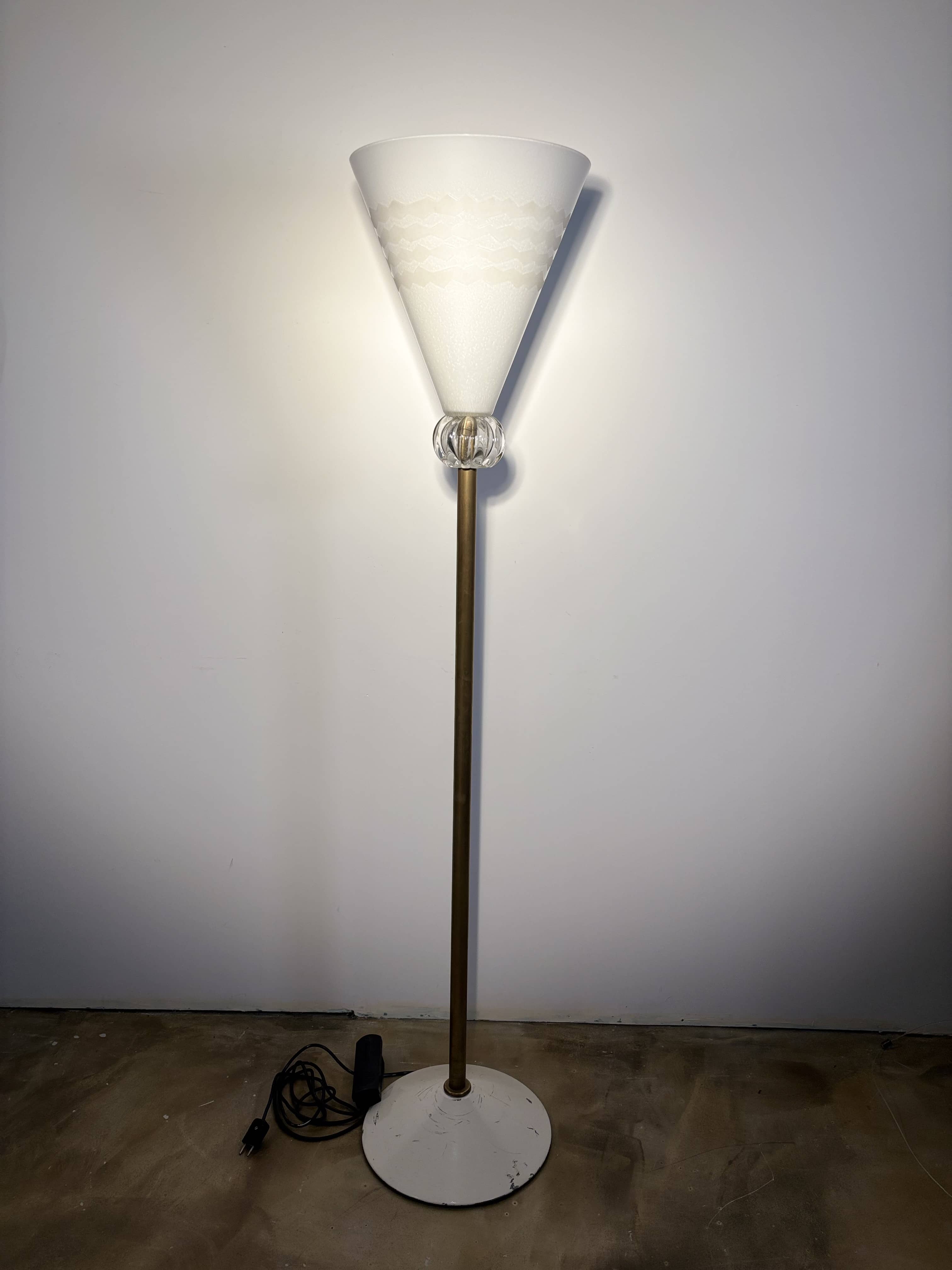
Italian floor lamp signed Barovier & Toso, Murano, with original label preserved (Barovier & Toso lozenge logo + “Vetri Murano VM 007” certification label, mark of the Consorzio Venezia Vetro used between 1981 and the early 2000s).
The conical shade in blown opaline glass, with the granular texture characteristic of Venetian work, is adorned with a frieze of acid-etched waves along its lower third, echoing techniques and a decorative vocabulary inherited from the great years of Venetian glassmaking. It rests upon a sphere of colourless Murano glass, blown and cut with twisted ribbing, which closes it onto the brass stem — a torchère-type floor lamp, the light being diffused upwards through the glass.
The brass shaft descends to a circular base in white lacquered metal. Original foot dimmer.
Good overall condition consistent with use. The lacquered base shows visible marks of use and micro-scratches (see photographs), with no impact on the structure or operation.
Glass shade and crystal sphere intact, without chip or crack.
Original electrical fittings in working order.
Origin: Italy, Murano — Barovier & Toso, circa 1980.
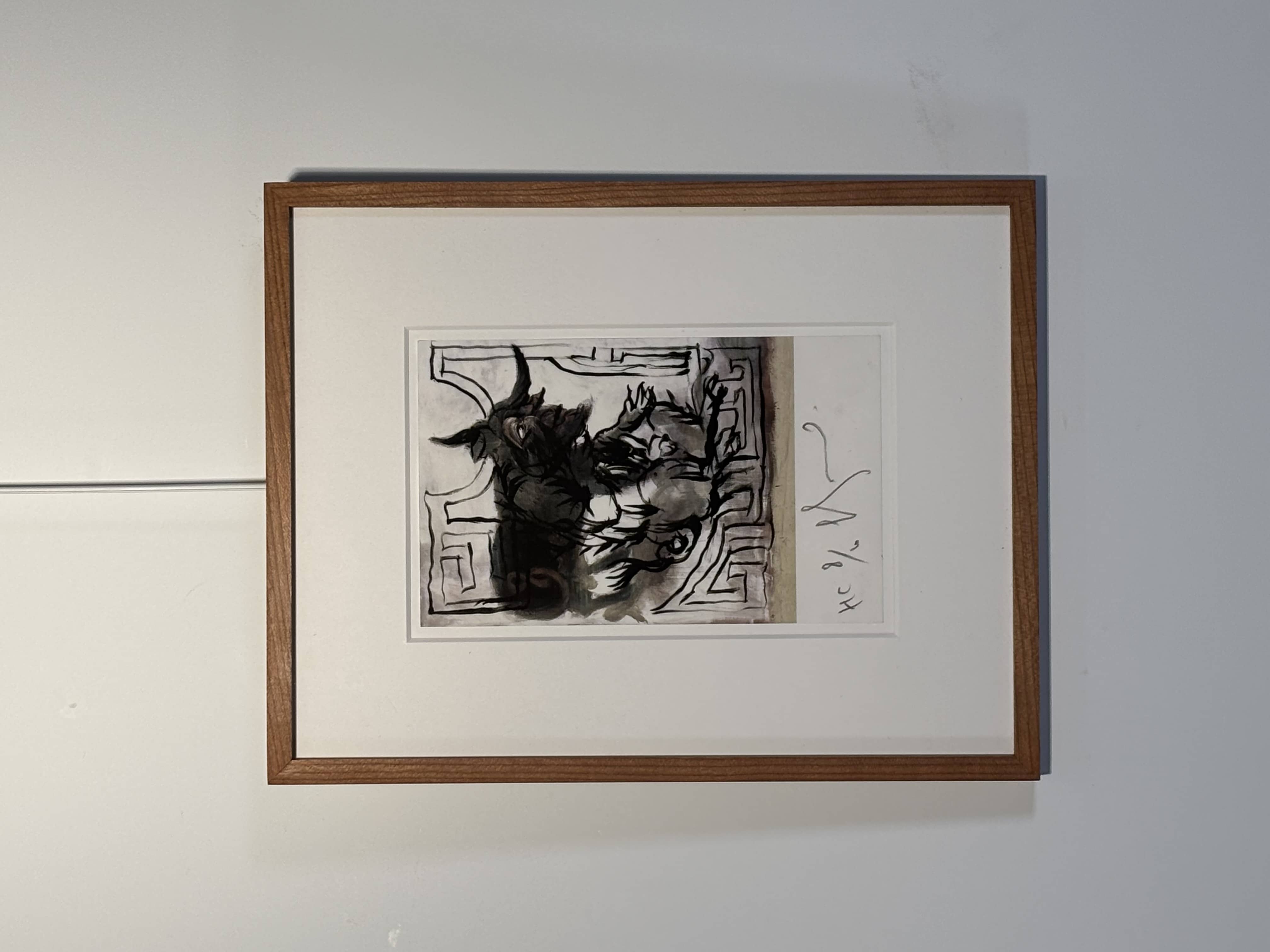
“L’Apiculteur et les Indiens” — a print by Gérard Garouste, Hors Commerce, signed and numbered 8/10.
The Minotaur emerges from a Greek-inspired setting, its meander and foliate scrolls drawn in black line, almost architectural in feel.
The face escapes this rigour: hand-painted, in browns and pinks that soften the figure.
In Garouste’s work, “the Indian” is never an incidental detail. Since his play “Le Classique et l’Indien” (1977), the figure has embodied the painter’s double: opposite the Classical — reason, order — the Indian carries the savage, the mad, the uncontrollable. A theme he would explore for more than thirty years, culminating in his “Indiennes” series.
The full title of this print echoes that of a book Michel Onfray devoted to his painting in 2009.
Presented in museum-quality framing, with anti-reflective and anti-UV glass.
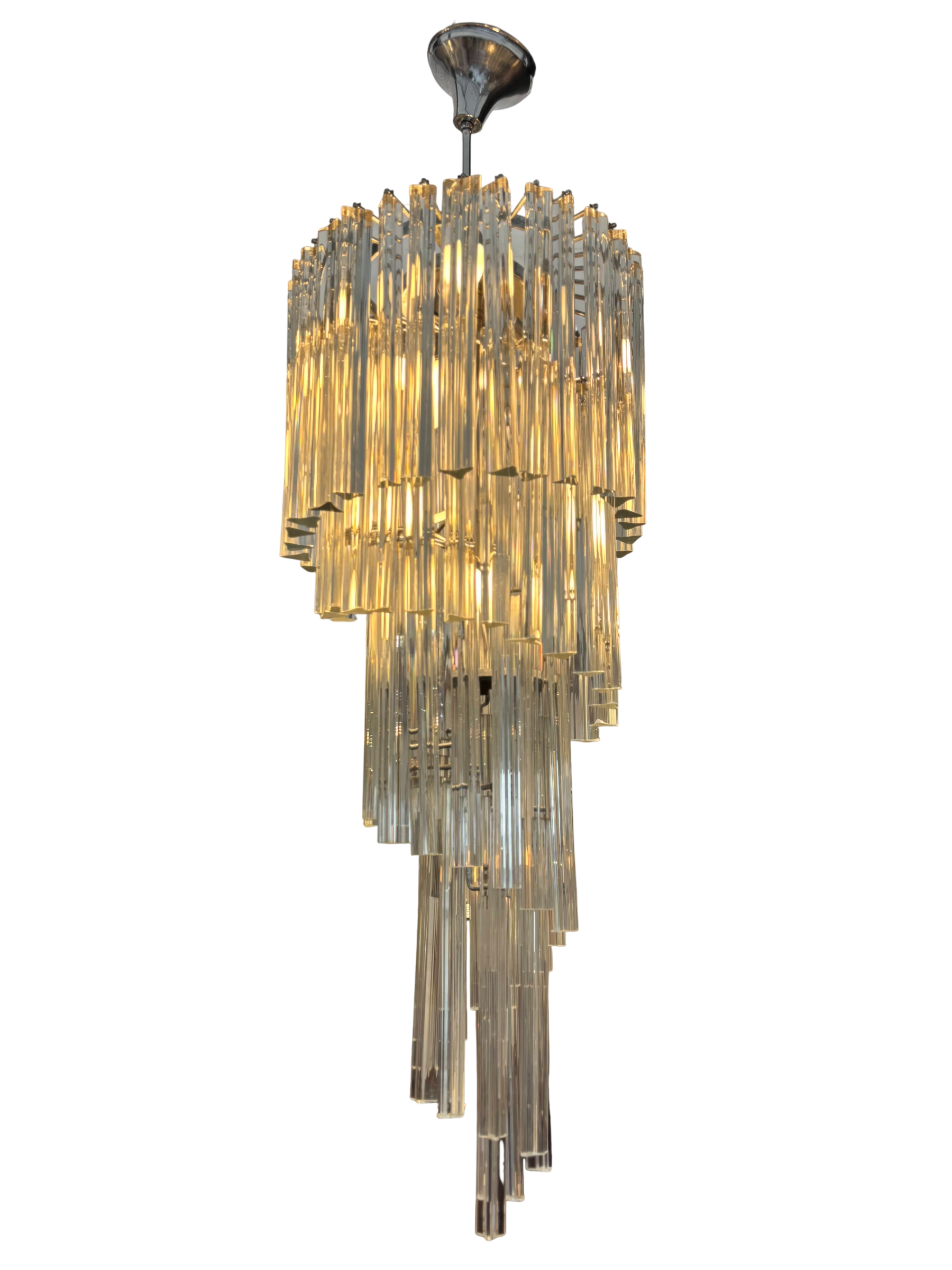
Spectacular Italian chandelier in Murano glass, composed of a multitude of long crystalline glass rods with a prismatic section, arranged in a cascade and of varying heights.
The composition, particularly elegant and sculptural, forms a dynamic and airy silhouette, characteristic of the great Italian glass design of the second half of the 20th century Venini, and notably of its compositions using prismatic elements of the Triedri type, developed from the late 1950s onwards. The glass elements, of remarkable transparency, offer magnificent plays of light and reflections when illuminated.
The chandelier features a silvered/chromed structure. The warm reflections visible in the photographs come solely from the lighting.
A very fine piece of character, monumental and rare, particularly well suited to a contemporary interior, an entrance hall, a dining room or a space benefiting from generous ceiling height.
Italy, circa 1960-1970.
Rewired by a professional.
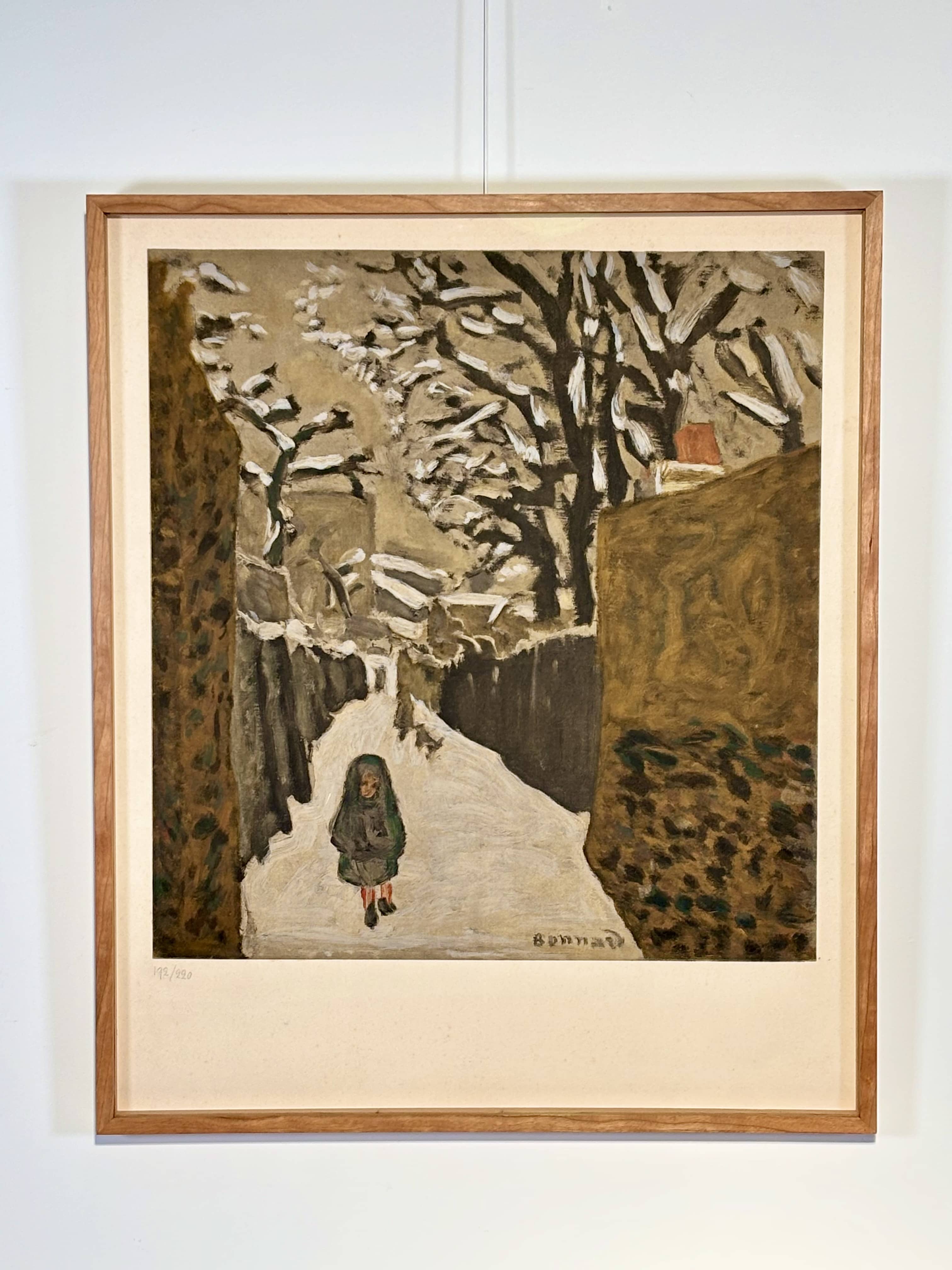
Colour print/lithograph on wove paper after the iconic work by Pierre Bonnard depicting an intimate winter landscape.
The composition opens onto a snow-covered path bordered by walls and trees with branches heavy with snow, at the centre of which a child advances, wrapped in a coat.
All the modernity of the Post-Impressionist movement is to be found here: tight framing, stylisation of forms, outlined touches of colour and a muted palette awakened by the vivid note of a chimney in the background and the child’s legs. A composition characteristic of Bonnard’s view of wintry Parisian street scenes.
The artist’s signature is printed in the plate at the lower right.
Numbered in pencil 192/220 at the lower left.
Posthumous reproduction, art edition type, from the 1950s-1970s.
The work benefits from a bespoke museum framing under glass: anti-reflective and UV-filtering glass.
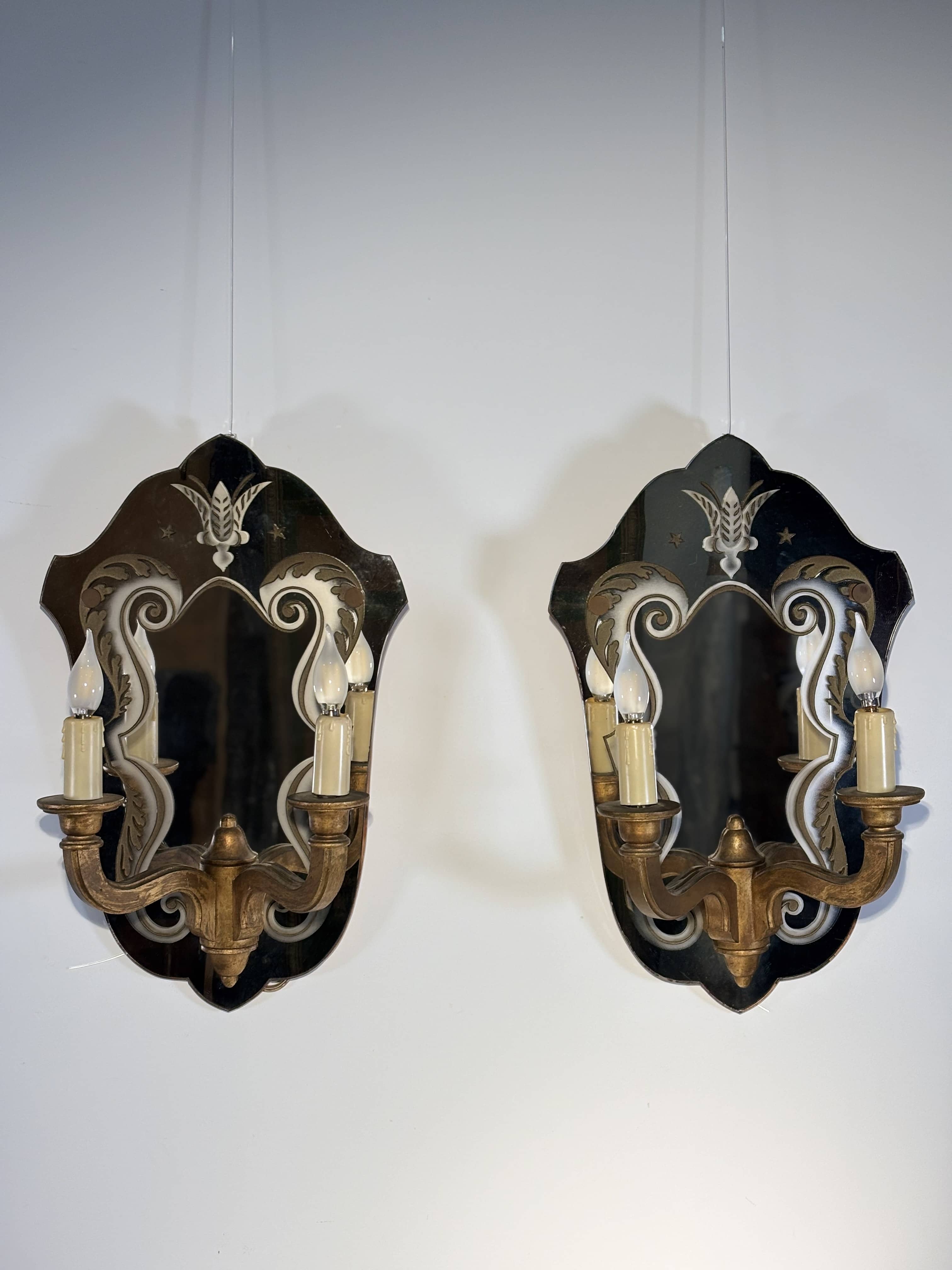
An elegant pair of two-branch wall lights, Italian work or in the Venetian style dating from the mid-twentieth century (circa 1950).
Each sconce comprises a shaped and curved mirror plate with a bevelled edge, forming a reflective backplate. The glass is richly intaglio-engraved and embellished with gilded and sanded motifs, depicting at the summit a stylised foliate motif flanked by stars, together with broad leafy scrolls bordering the contours.
The lower structure supporting the two light arms is executed in carved and gilded wood with an antique patina.
The curved arms with double moulding support moulded bobèches. The backs are in original plywood.
Very good overall condition.
Original electrification.
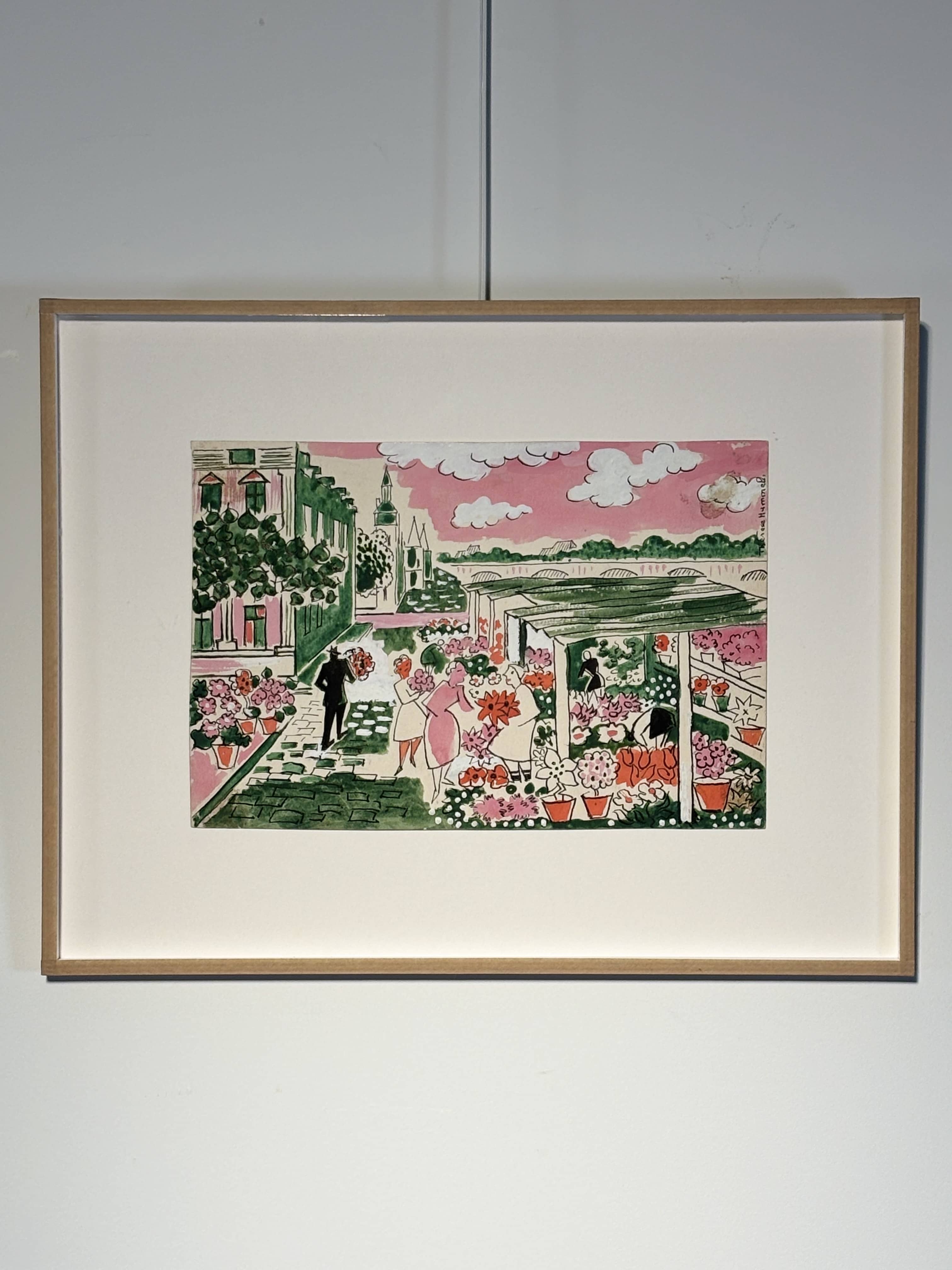
A sparkling and luminous watercolour heightened with ink and touches of gouache, entitled Le Marché aux fleurs, executed by the artist Thérèse Hummel (1896-1967).
The scene transports us to the heart of a bustling Parisian flower market (evoking the banks of the Seine, with the bridge and the towers of the Conciergerie silhouetted against the background). Beneath covered arbours, a profusion of pots, bouquets and floral arrangements bursts forth in vivid touches of colour: poppy orange, tender pink, pure white and deep greens.
Amidst this floral setting, several figures busy themselves: a florist in an apron advises an elegant lady in a pink dress, other strollers select their bouquets, while an elegant gentleman in a dark suit and hat walks away in the centre, a generous bouquet under his arm. The composition is crowned by a poetic sky tinged with pink, traversed by small cottony clouds. Thérèse Hummel deploys here all the freshness of her palette and the graphic freedom so characteristic of her œuvre.
Biography / About the artist
Thérèse HUMMEL (1896-1967)
An intimate figure within the Parisian artistic circles of the first half of the 20th century, Thérèse Hummel belongs to that generation of independent female artists who evolved at the very heart of modernity.
Close to the great names of the avant-garde of Montparnasse and Montmartre, she shared privileged bonds of friendship with Jeanne Hébuterne, Amedeo Modigliani and Pablo Picasso. Immersed in this exceptional creative effervescence, her œuvre is characterised by a remarkable plastic freedom, combining the poetry of the everyday, simplification of forms and expressiveness of colour.
Her works, sought after and rare on the market, constitute a precious testimony to the creative spirit of the École de Paris.
The work benefits from a bespoke museum-quality framing: anti-reflective glass with UV filtering.

An important and rare ritual perfume burner of rectangular form in hardwood carved in relief, retaining superb remnants of polychromy and Cinnabar-style red lacquer.
This cult vessel of exceptional dimensions, intended for incense offerings upon a principal altar or within a temple, is distinguished by the strength of its lines and the quality of its carved elements.
The two impressive lateral handles, of animated inverted-S form, lend the object its full stature. They are carved in low relief with a scrolling frieze of blossoming lotus flowers, the Buddhist symbol of purity.
The perfume burner rests upon four vigorous feet, carved in the round with the heads of protective mythical creatures, heightened with red lacquer.
The body presents ogee-moulded panels of great structural sobriety, which contrast elegantly with the exuberance of the handles and feet.
One of the lateral sides of the body bears a rare ritual inscription incised with six sinograms, perfectly integrated into the patina of the wood. Translation: “Respectfully offered by (or in memory of) Yu Lin Shizhang”.
This nominative dedication attests that this perfume burner is an object of worship and devotion, commissioned by a family or a learned devotee.
Weight: 7,600 g
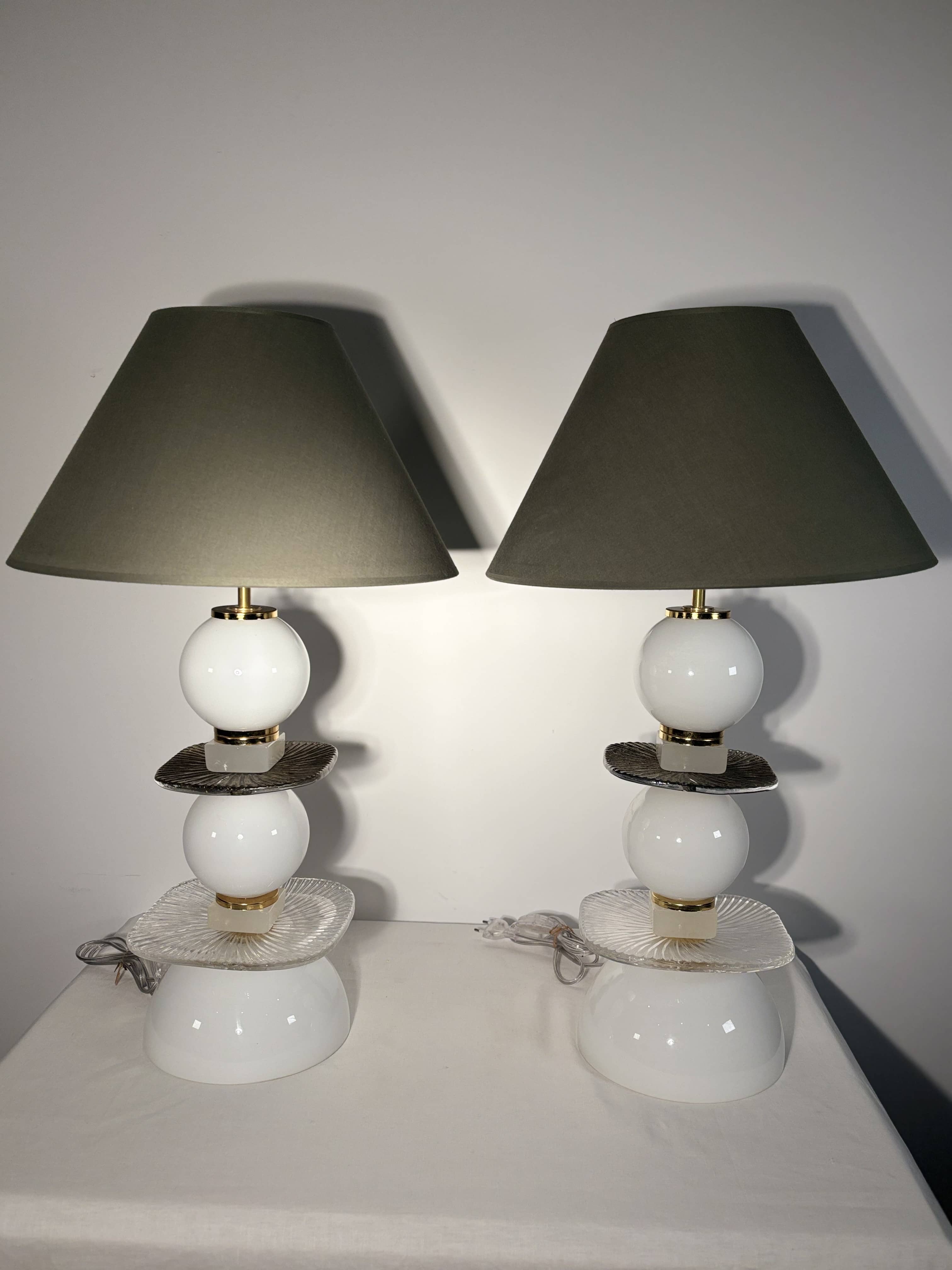
An elegant pair of postmodern/Hollywood Regency style table lamps, crafted in 1980s Murano glass and brass.
These light fittings are distinguished by a “totem” structure composed of a stack of various hand-blown glass elements, offering an interplay of textures and contrasts:
* White opaline glass: globes and a domed base in satin opaline glass
* Gold-leaf textured glass: intermediate discs in solid moulded blown glass, one translucent with radiating ribs, the other enriched with gold dust inclusions according to the traditional Murano technique.
* Geometric elements: Murano glass cubes that structure the architectural silhouette of the whole. The mount and separating rings are in gilt brass, accentuating the elegance of the materials.
The design is characteristic of the high-end Murano production of this period, in the spirit of houses such as Barovier & Toso or Mazzega.
Excellent state of preservation.
Electrics fully overhauled and refurbished.
Presented here with conical grey/green shades.
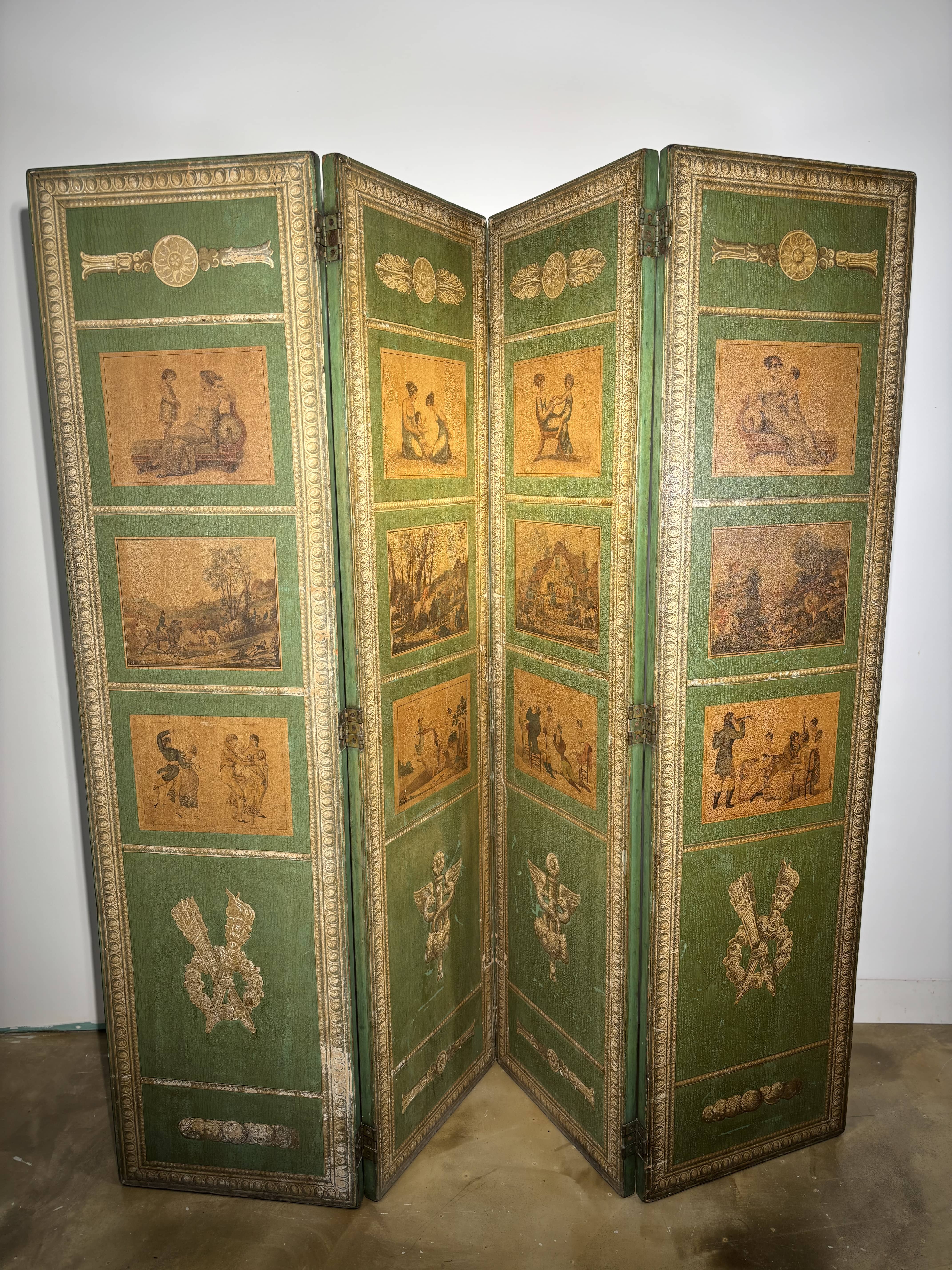
An exceptional and rare four-leaf screen presenting an Arte Povera (or Lacca Povera) decoration on a ground of antique green lacquer. This piece constitutes a refined testimony of the taste of the Directoire period, marking the transition between the delicacy of the 18th century and the rigour of the First Empire.
The decoration is composed of applied engravings, after the works of Carle Vernet (1758-1836). One finds here the artist's favourite themes: hunting scenes, genre scenes, Neoclassical repertoire such as winged caducei, quivers, torches and laurel wreaths. The Arte Povera technique consists of the meticulous application of engravings on a painted support, the whole protected by numerous layers of resin varnish.
The reverse of the screen is treated with equal care, presenting moulded panels painted in a green tonality. Late 18th / early 19th century.
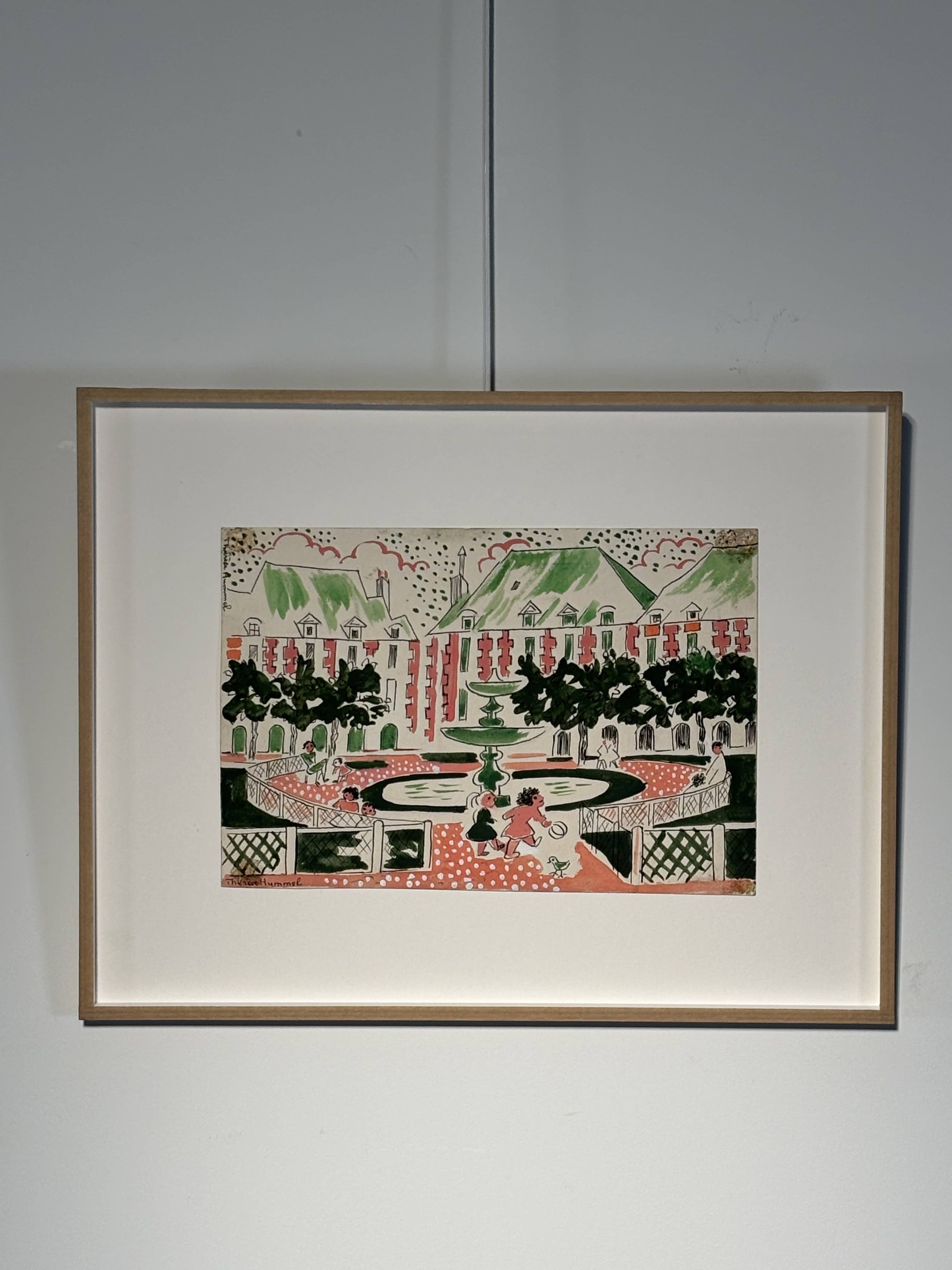
A lively and poetic watercolour entitled La Place des Vosges, executed by the artist Thérèse Hummel (1896-1967).
In this balanced composition, the artist captures the joyful atmosphere of the famous Parisian square. One finds there the emblematic 17th-century architecture with its pink brickwork and verdant slate roofs, bordering the central garden structured around its monumental fountain and lime tree walks.
In the foreground, children play with a ball, stroll and amuse themselves near the basin, watched over by elegant figures seated on the square’s benches. Thérèse Hummel employs a fresh and rhythmic palette, dominated by the deep green of the vegetation and the ochre pink of the façades and paths, enhanced by small white dots suggesting gravel or light. The spontaneity of the ink line combines perfectly with the delicacy of the watercolour washes.
An intimate figure of the Parisian artistic circles of the first half of the 20th century, Thérèse Hummel belongs to that generation of independent female artists who evolved at the heart of modernity.
Close to the great names of the Montparnasse and Montmartre avant-garde, she shared privileged bonds of friendship with Jeanne Hébuterne, Amedeo Modigliani and Pablo Picasso. Immersed in this exceptional creative effervescence, her work is characterised by a remarkable plastic freedom, combining the poetry of everyday life, simplification of forms and expressiveness of colour.
Her works, sought-after and rare on the market, constitute a precious testimony to the creative spirit of the École de Paris.
The work benefits from a high-end presentation with a bespoke museum-quality conservation framing:
Museum-quality glass: anti-reflective and UV-filtering.
Art framing: executed by a leading Parisian atelier.
Signed lower left.
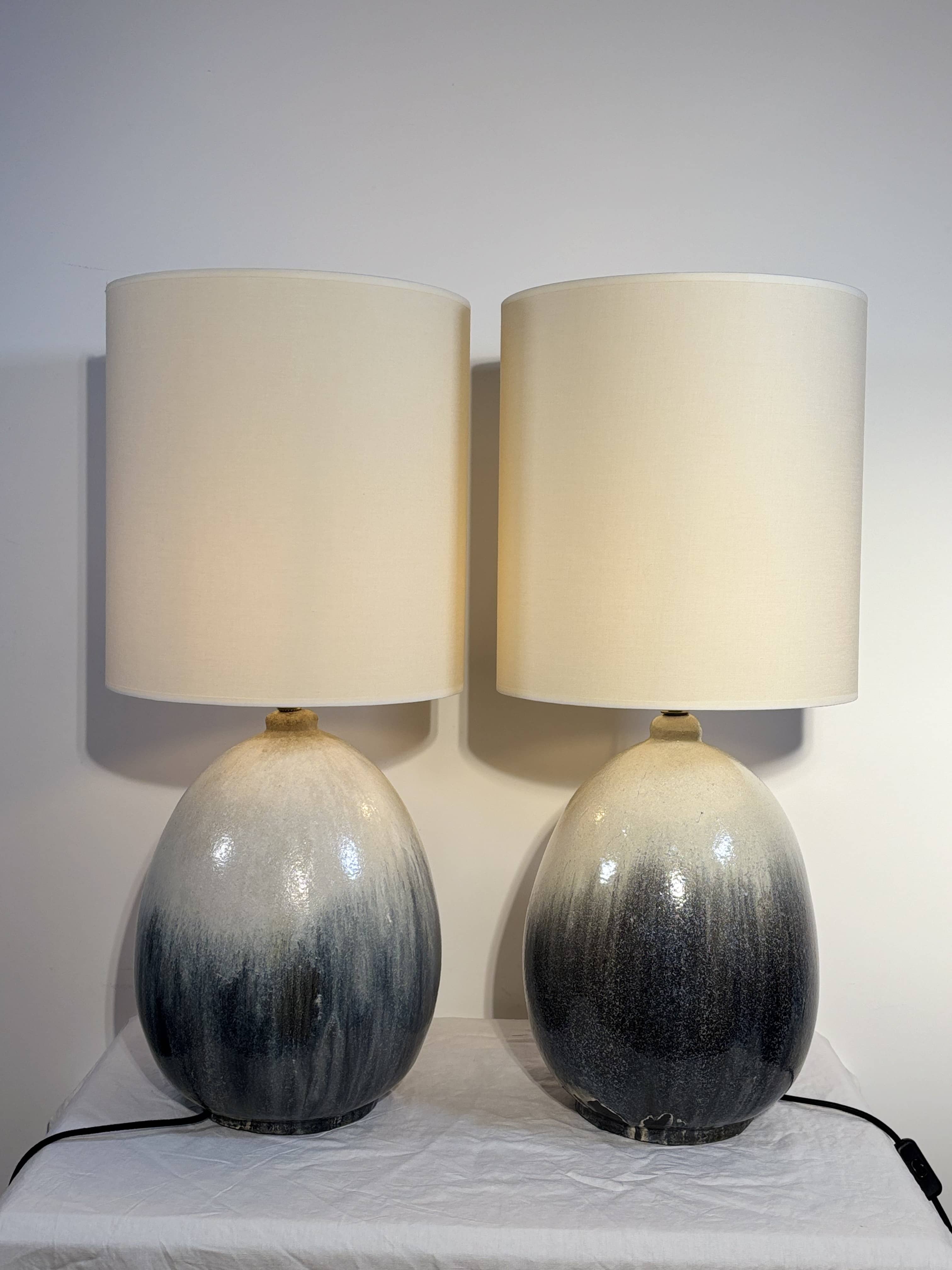
A rare pair of monumental lamps in glazed stoneware, the work of the Florentine ceramicist Marcello Fantoni (1915–2011), one of the leading figures of twentieth-century Italian art ceramics, whose pieces are held in the permanent collections of the Metropolitan Museum of Art, the Victoria & Albert Museum and the Museo Internazionale delle Ceramiche in Faenza.
The hand-shaped ovoid bodies display a poured glaze of remarkable chromatic subtlety: the creamy, frosted white of the summit dissolves in a gradient into bluish grey, then deep midnight blue, punctuated with ashen streaks. Flecks of pyrite and textured crystalline effects (characteristic of Fantoni’s explorations of materials) enrich the surface, at once grainy and luminous, revealing Fantoni’s mastery of the kiln.
Each piece is signed by hand on the reverse.
The electrification has been entirely renewed by a professional (new socket and wiring). The cylindrical shades in natural ecru fabric were made to measure by a shade-maker from the Decorative Arts sector, in perfect harmony with the tonality of the ceramics.
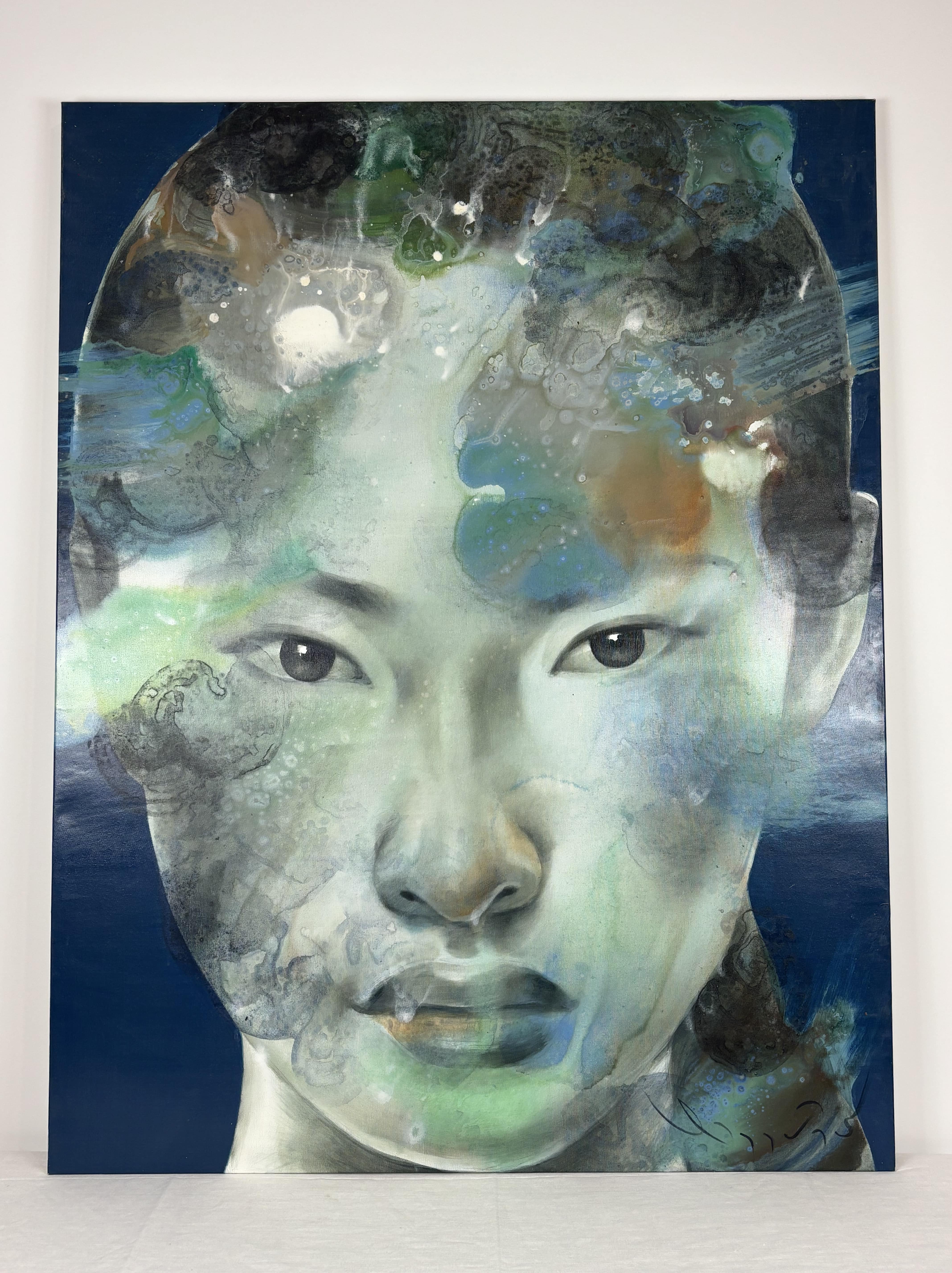
Large contemporary portrait by the Thai artist Silawit Poolsawat, renowned for his powerful and sensitive works. Asian Beauty captures the delicacy and depth of an Asian female face, in a composition that blends realism, subtle transparencies and dreamlike atmospheres. Silawit Poolsawat’s paintings are inspired by women and children he has encountered during his travels, whose expressions have left a profound impression on him. Signed lower right. Framing: mounted on an aluminium stretcher, ready to hang.

Charming and luminous watercolour entitled Les amoureux, place de la Comédie, executed by the artist Thérèse Hummel (1896-1967).
The artist deploys a synthetic graphic style of great modernity, playing elegantly with a contrasted and masterfully controlled chromatic palette: the verdant green of the foliage and architectural elements answers the vibrant red-orange of the silhouettes and stylised street lamps.
In the foreground, a group of pigeons pecks at the square, lending a beautifully lively and poetic dynamic to the scene. In the background, the pair of lovers strolls near the fountain and the street lamps, before the imposing Parisian façades. The precision of the line combined with the lightness of the washes bears witness to the artist's remarkable plastic mastery.
An intimate figure of the Parisian artistic circles of the first half of the 20th century, Thérèse Hummel belongs to that generation of independent women artists who evolved at the heart of modernity.
Close to the leading names of the Montparnasse and Montmartre avant-garde, she shared privileged bonds of friendship with Jeanne Hébuterne, Amedeo Modigliani and Pablo Picasso. Immersed in this exceptional creative effervescence, her œuvre is characterised by a remarkable plastic freedom, combining the poetry of the everyday, simplification of forms and expressiveness of colour.
Museum-quality framing custom-made by a leading Parisian atelier: anti-reflective, UV-filtering glass.
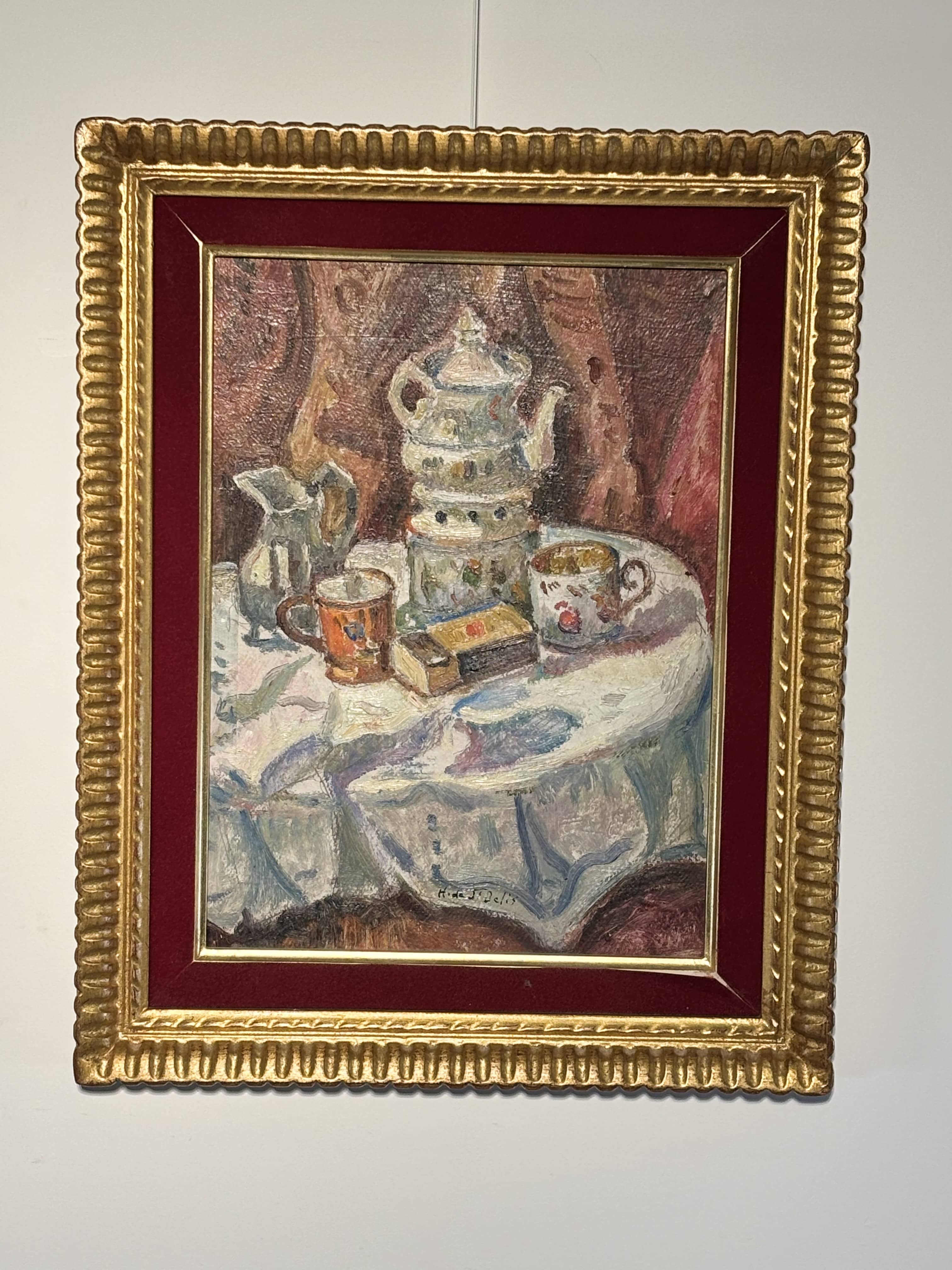
A luminous oil on heavy card (historic Canson & Montgolfier support) depicting an intimate studio scene: a table laid for tea with its samovar, ceramic cups and a box of matches.
The work bears witness to the superb technical mastery of Henri de Saint-Delis, an emblematic figure of the École de Rouen and of Honfleur. The artist deploys a modern touch, generous in impasto, inherited both from Norman Impressionism and from the chromatic freedom of Fauvism. The white cloth, sculpted by light, shimmers with bluish and mauve reflections characteristic of his finest manner. The impasted, vibrant brushwork and the chromatic range of ochres, blues and powdery pinks are typical of the artist’s style, having trained in Le Havre alongside Othon Friesz, Raoul Dufy and Georges Braque, before settling permanently in Honfleur where he would paint the greater part of his œuvre.
Signed lower.
Work authenticated by the Cabinet Marc Ottavi, Paris (approved C.V.V. expert, specialising in nineteenth- and twentieth-century paintings).
Support: The reverse bears its original label from the manufacturer Canson & Montgolfier (No. 347, moiré grain), a precious mark of the period.
Framing: Presented in a period-style moulded and gilded wooden frame, enhanced by an elegant burgundy velvet Marie-Louise which perfectly underscores the warm tones of the background.

Wall light by the French designer Louis Sognot, emblematic of the organic modernism of the 1950s.
Bent rattan structure forming an elegant curvilinear handle supporting a lantern / cage.
Cylindrical inner shade in original ecru fabric filtering a soft, subdued light.
Original socket.
Very fine original condition.
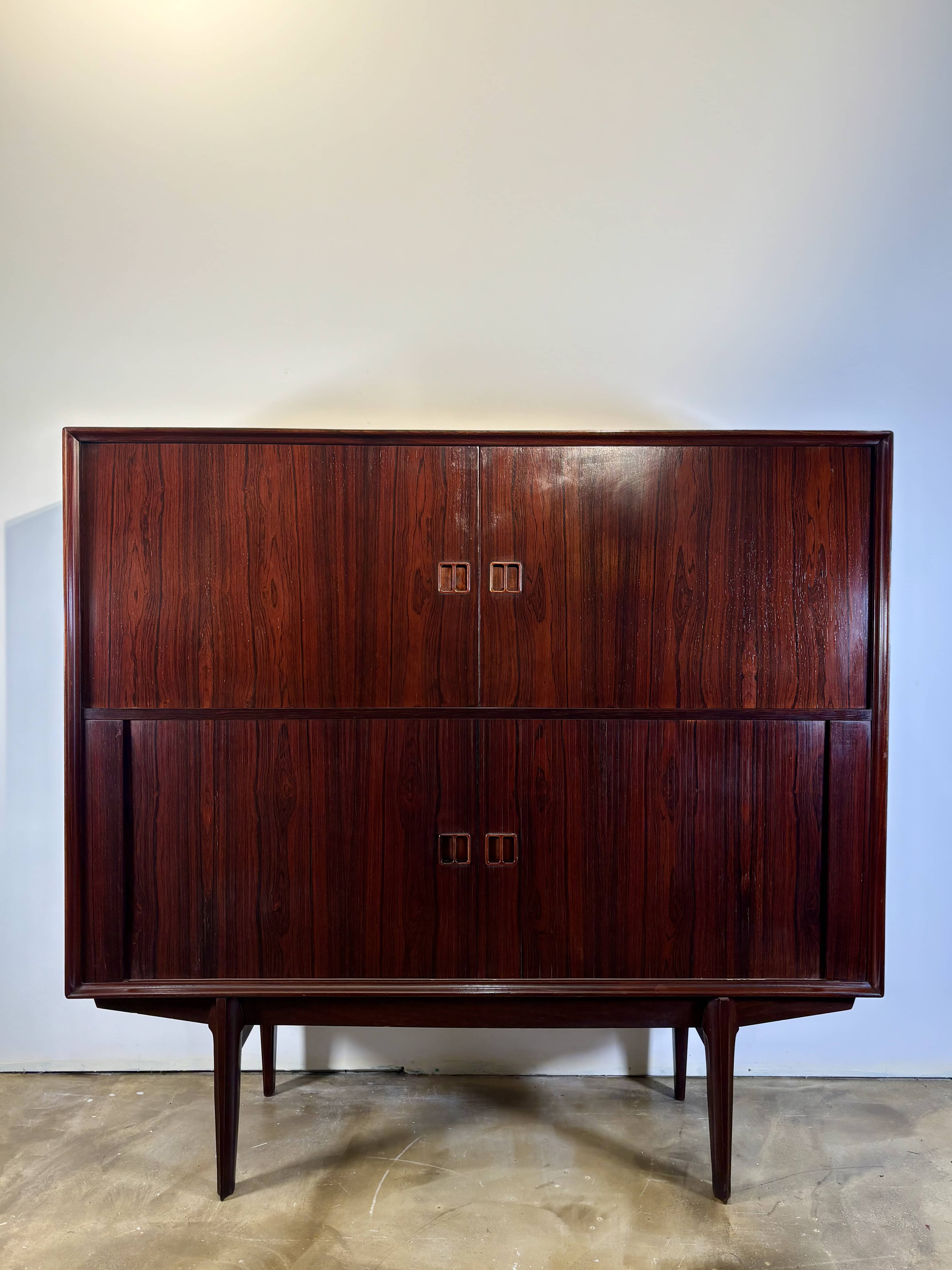
Exceptional Highboard-style storage cabinet (tall sideboard) designed in the 1960s by the celebrated Belgian designer Oswald Vermaercke. This centrepiece perfectly embodies the golden age of Belgian modernist design and the Scandinavian refinement that so strongly influenced Belgian creation during the mid-twentieth century.
Quality of Materials and Woodwork:
This piece is distinguished by the use of Rio rosewood (Brazilian Rosewood) veneer of remarkable quality. The wood grain — dark, contrasted and deeply expressive — has been meticulously selected and applied in “book-matched” fashion across the doors and the upper top. The flame-like figuring of the rosewood lends this cabinet a unique sculptural presence and a highly decorative dimension.
Design and Features:
The cabinet presents a superb geometric façade divided into two distinct sections:
• Upper section: opens via two hinged doors onto a fitted interior comprising shelves and removable vertical dividers, ideal for use as a bar or writing cabinet.
• Lower section: fitted with two sliding doors optimising space, revealing generous adjustable storage shelves.
The signature detail lies in its handles: magnificent rectangular finger-pulls, sculpted in recess directly from the solid wood, typical of Oswald Vermaercke’s craftsmanship. The whole rests on a slender, tapered sledge base, which lends an impression of airy lightness that contrasts elegantly with the robustness of the cabinet’s body.
This piece is in excellent original condition. The original varnish has retained all its lustre, revealing the superb natural, warm patina of the rosewood. Structure perfectly sound and stable. The doors and sliders operate with fluidity. Only minimal traces of use in keeping with its age. Excellent condition, very fine patina.
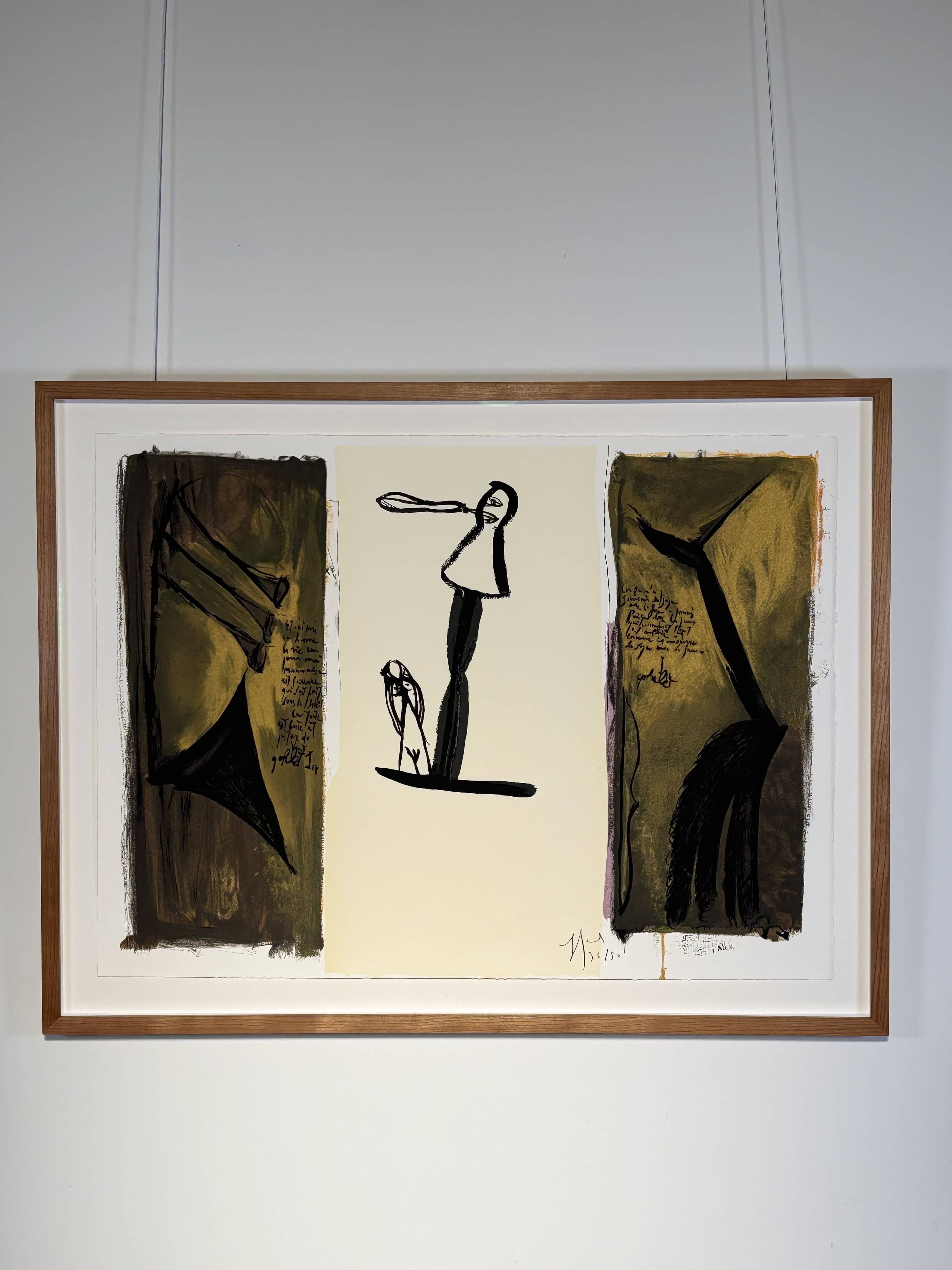
Important original colour lithograph conceived as a narrative triptych, a major theme within the artist’s œuvre.
The composition is arranged around a pared-down central panel in which stands a slender, hieratic figure (evoking the world of Don Quixote or the Preacher), flanked by two expressionist scenes in powerful tones of ochre, dark earths and deep blacks.
The work bears witness to Garouste’s fascination with sacred texts and the Hebrew language, incorporating two handwritten philosophical passages drawn from the biblical book of Ecclesiastes (signed with its Hebrew name, Gohélet / Qohélet):
On the left (Gohélet I, 17): “And I have seen life, a day for me evil, is the work done under the sun, for all is vanity and pasture of the wind.”
On the right: “For who remembers the wise man with the fool for ever, since in the days to come already all is forgotten. And how the wise man shall die with the fool.”
Institutional Reference: A similar impression from this same edition is held in the national collections of the Centre Pompidou / Musée National d’Art Moderne (inventory no.: AM 2022-64).
Original colour lithograph on heavy wove paper.
Numbered 35 / 50 in pencil (highly confidential edition of only 50 impressions).
Signed with the artist’s official monogram “MG” in pencil, lower right.
Excellent state of preservation, with beautifully fresh pigments.
Museum-quality framing: Exceptional bespoke presentation carried out by a leading Parisian atelier.
Float mounting in a box frame: The work is fixed in a reversible manner, revealing the entirety of the paper’s deckled edges. Cherrywood box-profile moulding, neutral conservation backing and museum-quality glass (anti-reflective and UV-protective).
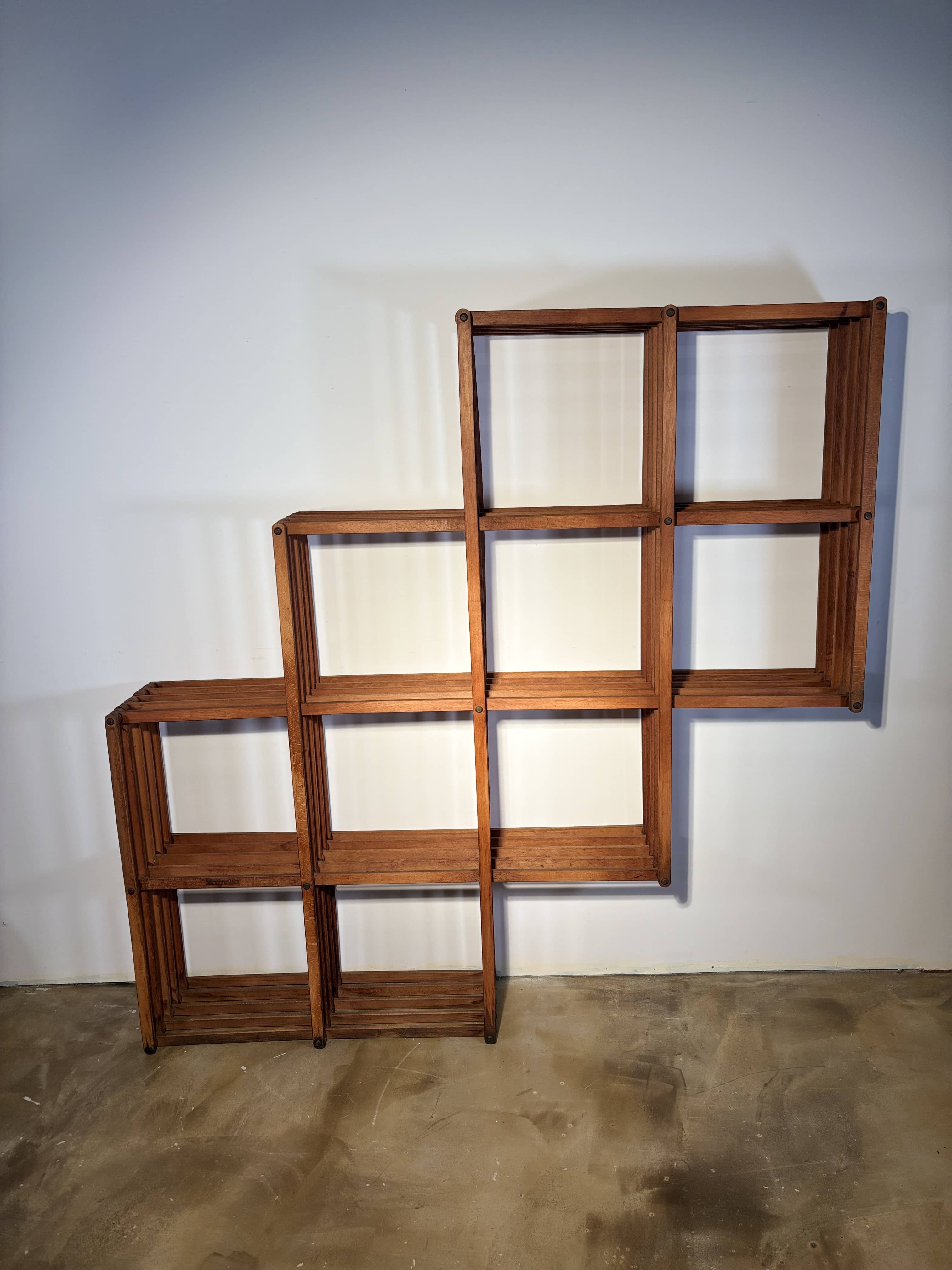
Architectural bookcase composed of articulated wooden modules with parallel slats, assembled by metal pivots.
The accordion folding system allows flat storage and free reconfiguration: stepped, symmetrical or asymmetrical, according to the space and use.
Wooden structure, fine period patina, original hardware.
Nine compartments in standard configuration.
A rare piece of 1970s Italian design.
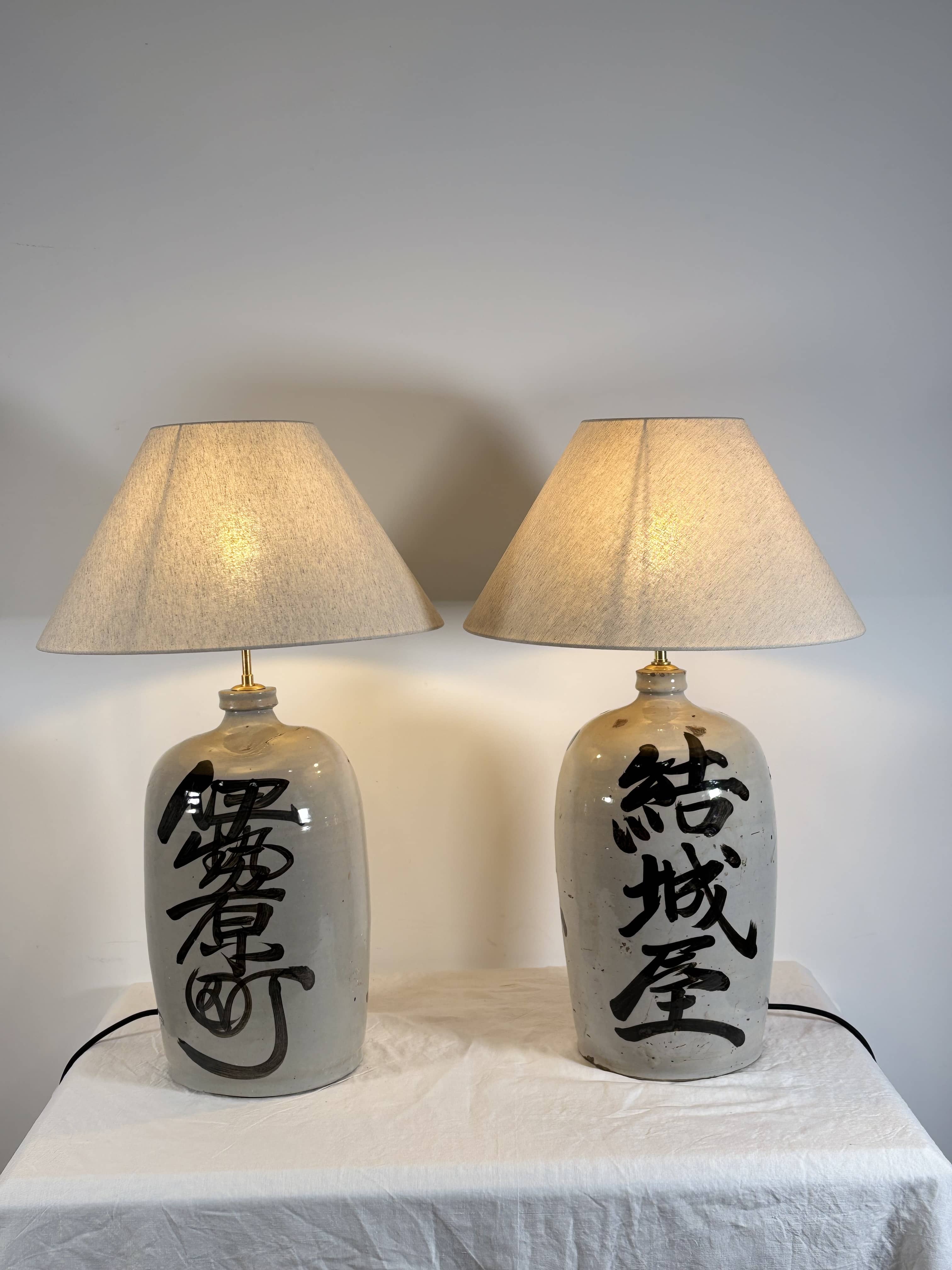
Pair of lamps mounted on sake jars (tobin) in grey-white glazed stoneware, Japan, first half of the 20th century.
Each jar bears, on several faces, calligraphic inscriptions in black ink under the glaze, executed with the brush with remarkable gestural flair — names of trading houses and merchant quarters (Yūkiya, Rokkōmachi) characteristic of the commercial production of the Meiji–Taishō era. Body in stoneware with a slightly sanded ivory glaze, banded neck, squat ovoid form.
Traces of wear and natural patina consistent with age and original use.
Entirely new electrical fitting, carried out by a professional electrician, in accordance with current French standards.
Gilt brass socket. Conical natural linen shade included.
Available individually: €500 each
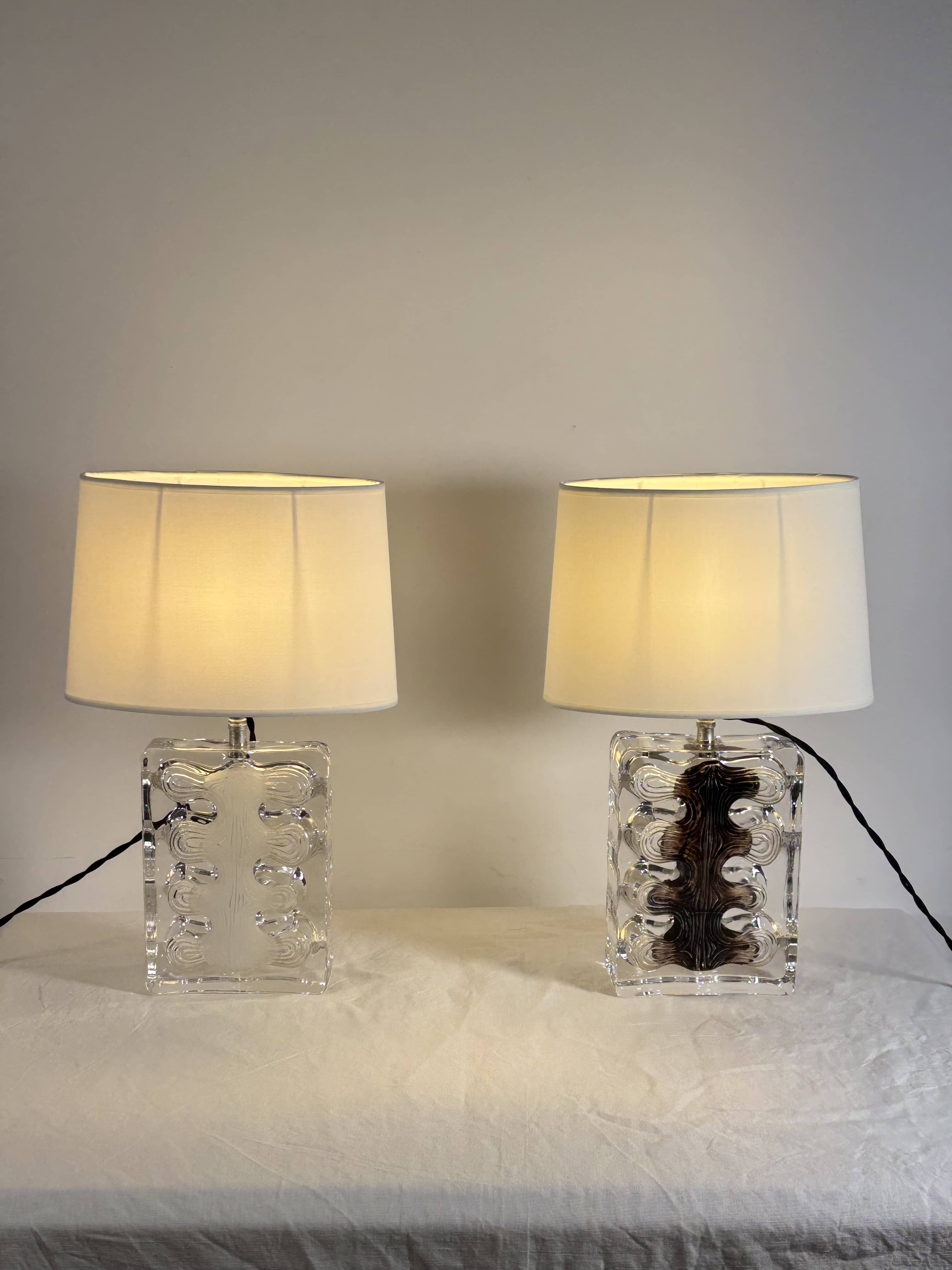
Pair of lamps with a rectangular base in solid crystal, Lynx model, created in 1973 by the sculptor Jean-Pierre Demarchi, then artistic director of the Daum crystalworks.
The crystal, hollowed into a biomorphic form of symmetrical scrolls, is enhanced by a column of white opaline crystal on one of the two bases and brown crystal on the other — a variation in tone that distinguishes each piece without breaking the unity of the pair.
The interplay between the transparency of the crystal and the matte finish of the central applique captures the light with striking sculptural presence, faithful to Demarchi’s approach, which regarded crystal as a material in its own right, on par with bronze or stone.
The strength of this pair lies in its bold chromatic and textural contrast.
Signed Daum France on each base.
Newly rewired to current standards by a professional.
Galerie Bleu Magenta brings together a singular selection of antiques, vintage design and decorative arts, ranging from 18th-century furniture to 1970s Murano lighting, with signed 20th-century ceramics in between. Each piece is chosen with exacting care for its aesthetic value, its authenticity and its ability to converse with contemporary interiors. The gallery champions a vision of sustainable, responsible luxury, where beauty circulates, is passed on and grows richer over time. Exploring our catalogue, you will discover antique furniture, baroque mirrors, Italian glass, period seating, decorative objects and rare creations, all selected for their refinement and singularity.

I recently bought a handcrafted lamp from Bleu Magenta and I am completely won over! The unique design and exceptional quality really impressed me. The customer service was also flawless, with personalised advice and quick delivery.
I found the perfect gift for my best friend's birthday: a set of handmade ceramic vases. Not only were they beautiful, but the story behind each creation added a personal touch that made my gift even more special!